Beekeeping Startup Costs and Honey Yield Projection for Beginners
Beekeeping is one of the most accessible livestock enterprises for beginners — it requires no pasture, minimal daily labor, and can be started on a suburban lot. But many new beekeepers underestimate both startup costs and the time to profitability. A realistic budget and yield projection will help you decide how many hives to start with and when to expect a return on investment. This guide breaks down every cost category and provides realistic honey production estimates based on location and management level.
Related calculators:
Initial Equipment Costs per Hive
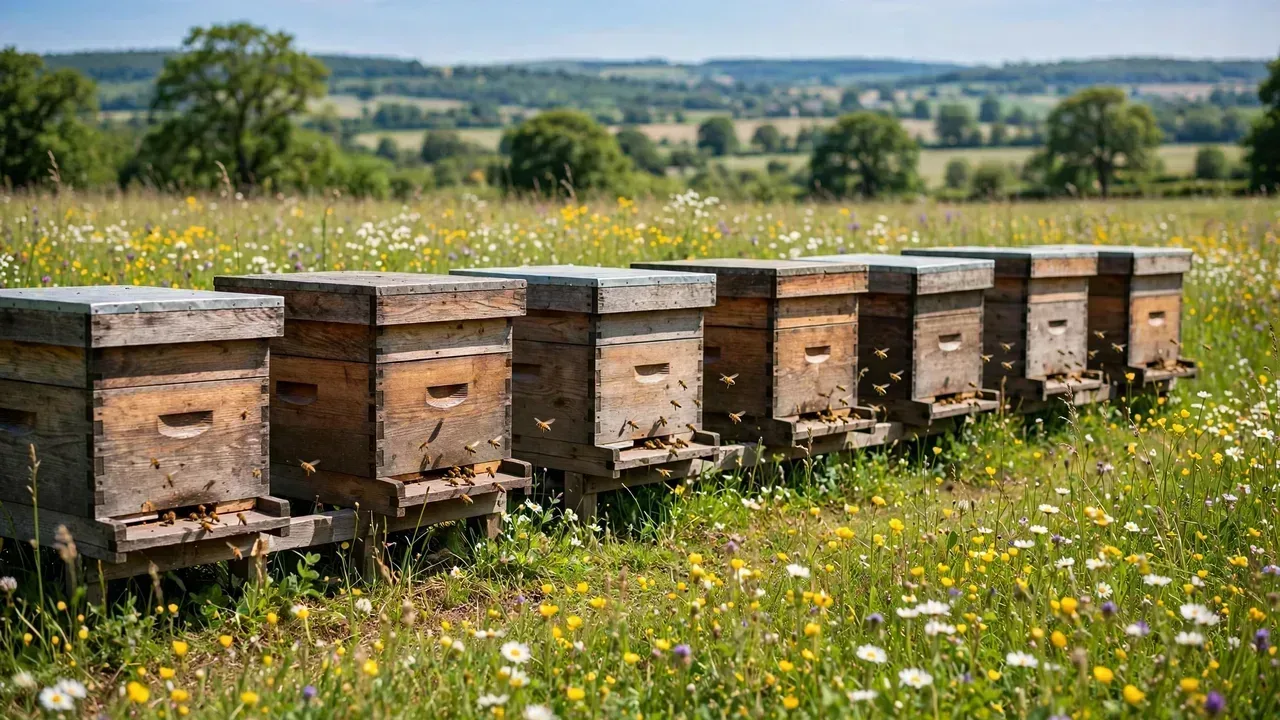
A single Langstroth hive — the most common system in North America — requires the following components. Prices are for new, mid-quality equipment from major beekeeping suppliers:
- Hive stand: $15-30 (elevates hive off damp ground, improves ventilation)
- Bottom board: $15-25 (standard or screened for mite monitoring)
- Deep brood boxes (2): $20-35 each, $40-70 total (where the queen lays and bees raise brood)
- Medium honey supers (2): $18-30 each, $36-60 total (where surplus honey is stored)
- Frames with foundation (10 per box, 40 total): $2-4 each, $80-160 total
- Inner cover: $8-15
- Telescoping outer cover: $15-25
- Queen excluder: $8-15 (keeps queen out of honey supers)
Total per-hivequipment cost: $217-405. Buying in bulk (5+ hives) reduces per-hive cost by 15-25%. Used equipment can be cheaper but carries disease risk (American foulbrood sporesurvive for decades) — only buy used hives from trusted sources and freeze frames at 0°F for 48 hours before use.
Shared Tools and Protective Gear
Certain tools are shared across all hives and represent a one-time investment regardless of how many colonies you keep:
- Bee suit or jacket + veil: $50-150 (a ventilated suit is worthextra cost in summer)
- Gloves (leather or nitrile): $15-30
- Smoker + fuel: $25-40 (calms bees during inspections)
- Hive tool: $10-15 (pry bars for separating frames and boxes)
- Bee brush: $5-10 (for gently removing bees from frames)
- Feeder (entrance or top): $5-15 per hive (for spring feeding)
- Varroa mite treatment: $5-15 per hive per treatment (essential — mites kill more colonies thany other cause)
- Honey extraction equipment: If you plan to extract your own honey, a manual 2-framextractor costs $150-300, an electric 4-framextractor $400-800. Beginners can also rent extractors from local bee clubs or pay a small fee at a community extraction day.
Shared tools for a 2-hive beginner setup: approximately $120-250, plus extraction equipment if purchased. Many beginnerstart with 2 hives and shared tools, for a total first-year investment of $550-1,050 before bees.
Cost of Bees: Packages, Nucs, and Queens
You cannot start a hive with equipment alone — you need bees. Three common options:
- Package bees (3 lb, ~10,000 bees + mated queen): $120-180. Shipped in a screened box, installed in spring. Cheapest option but requires the bees to build comb from scratch, delaying honey production in year 1.
- Nucleus colony (nuc — 5 frames with brood, bees, and laying queen): $180-280. A mini established colony that builds up faster and is more likely to survive the first year. Recommended for beginners despite higher cost.
- Mated queen (forequeening or splits): $30-60. Used to replace an aging or failing queen, noto start a new colony from scratch.
For a beginner starting 2 hives with nucs, bee costs are $360-560. With packages, $240-360. Order bees by January-February for April-May delivery — suppliersell out early.
Realistic Honey Yield Projections
Honey yield per hive varies enormously based on climate, forage availability, colony strength, and beekeeper skill. Realistic ranges:
- Year 1 (new colony): 0-30 lbs per hive. Package beespend most of the season building comb and population, often producing no surplus honey. Nucs may produce 10-30 lbs if installed early in a good forage area. Never harvest honey in year 1 unless the colony has at least 60 lbs of stored honey going into winter — bees need 40-60 lbs to survive.
- Year 2 (established colony): 30-60 lbs per hive in most temperate regions. With good management and strong forage, 60-80 lbs is achievable.
- Year 3+ (mature, well-managed): 50-100 lbs per hive in good forage areas. Top producers in regions with abundant clover, alfalfa, or citrus can exceed 100 lbs, while arid or urban areas may yield only 20-40 lbs.
Colony loss is a reality — average winter loss in the US is 25-30% annually, and first-year beekeepers often lose 40-50% of their colonies due to inexperience. Factor this into your projections: if you start 4 hives and lose 2 over winter, your effective yield is halved. Use our Beekeeping Honey Calculator to project honey production based on your location, number of hives, and experience level, and our Farm Budget Calculator to model revenue, costs, and break-even timing.
Revenue Streams Beyond Honey
Honey is the most obvious revenue source, but diversified beekeepers earn more per hive through multiple products:
- Honey sales: $5-12 per lb retail (directo consumers at farmers markets), $2-4 per lb wholesale to stores orestaurants. A 60-lb hive yields $300-720 retail or $120-240 wholesale.
- Beeswax: 1-2 lbs per hive per year, worth $8-15/lb. Can be made into candles, lip balm, or cosmetics for higher margin.
- Propolis and pollen: Small quantities, $10-30 per hive combined if harvested and sold.
- Nuc and queen sales: Once you have strong colonies, splitting hives to sell nucs ($180-280 each) or queens ($30-60 each) can be more profitable than honey. A single strong colony can be split into 2-3 nucs per year.
- Pollination services: Farmers pay $50-200 per hive for crop pollination (almonds $170-220/hive, apples $50-100/hive). More suitable for operators with 20+ hives.
Break-Even Analysis
For a beginner starting 2 hives with nucs and mid-range equipment, total first-year investment is approximately $900-1,400 (equipment $500-800 + bees $400-560 + tools $150-250 + treatments $100-200). In year 1, expect little or no honey revenue — perhaps $50-150 if nucs produce a small surplus. In year 2, if both coloniesurvive and produce 50 lbs each (100 lbs total), retail revenue is $500-1,200, plus $30-60 in wax. By year 3, with 4-6 hives producing 50-80 lbs each, revenue reaches $1,500-4,000, and the operation reaches cumulative break-even.
Most hobbyist beekeepers do not achieve positive cash flow until year 3, and many never fully recoup costs if they sell at wholesale prices or lose colonies frequently. The key to profitability is: (1) keep colony loss below 20% through diligent mite management, (2) sell directo consumers at retail prices, (3) diversify into nuc sales and value-added products, and (4) scale to 10+ hives to spread fixed costs (extractor, suit, tools) over more colonies.
First-Year Management Calendar
To maximize survival and future yield, follow this basic schedule: April — install packages or nucs, feed 1:1 sugar syrup until they draw 2-3 frames of comb. May-June — inspect every 7-10 days, check for queen laying, add second brood box when first is 70% drawn. July-August — add honey supers when brood boxes are full, monitor varroa mites (treat if above 2 per 100 bees). September — remove honey supers, ensure 40-60 lbs of winter stores, feed 2:1 syrup if short. October-November — apply winter mite treatment (oxalic acid), reducentrance, insulate in cold climates. December-March — check monthly on warm days, ensure food stores remain.
Related Tools
Project your honey yield and beekeeping budget withese free tools.
Beekeeping Honey Calculator →Farm Budget Calculator →Frequently Asked Questions
How much does it costo start beekeeping with 2 hives?
A 2-hive beginner setup costs $900-1,400 total: equipment ($500-800), bees via nucs ($400-560), shared tools and protective gear ($150-250), and first-year supplies/treatments ($100-200). Starting with package bees instead of nucs reduces bee costs by $120-200 but delays honey production. A honey extractor ($150-800) is optional in year 1 — many beginners rent or borrow one.
How much honey does one hive produce in a year?
Year 1 new colonies produce 0-30 lbs (often zero for package bees). Established colonies in year 2+ produce 30-80 lbs per hive in most temperate regions, with top producers reaching 100+ lbs in excellent forage areas. Leave 40-60 lbs of honey in the hive for winter survival — only harvest surplus above that threshold.
When do beekeepers break even?
Most hobbyist beekeepers reach cumulative break-even in year 3, assuming colony survival above 70% and retail honey sales. Selling at wholesale prices or experiencing high winter losses (40%+) can delay break-even indefinitely. Scaling to 10+ hives andiversifying into nuc sales and value-added products accelerates profitability significantly.
Should I start with package bees or a nuc?
Beginnershould start with nucs (nucleus colonies) despite the higher cost ($180-280 vs $120-180 for packages). Nucs include drawn comb, brood in all stages, and a laying queen, so they build up 4-6 weeks faster and have higher first-year survival (70-80% vs 50-60% for packages). The extra $60-100 per hive is easily recovered through earlier honey production and lower colony loss.
What is the biggest cause of colony loss for beginners?
Varroa destructor mites are the leading cause of colony death, responsible for 40-60% of winter losses. Mites weaken bees by feeding on their fat bodies and transmit deadly viruses (deformed wing virus, acute bee paralysis virus). Beginners must monitor mite levels monthly from July through October and treat when levels exceed 2 mites per 100 bees. Neglecting mite management is the #1 reasonew beekeepers lose their first hives.
References & Sources
- FAO (Food and Agriculture Organization) - Irrigation and Drainage Paper 56: Crop Evapotranspiration
- USDA (United States Department of Agriculture) - Natural Resources Conservation Service (NRCS) Guidelines
- IPCC (Intergovernmental Panel on Climate Change) - 2019 Refinement to the 2006 IPCC Guidelines for National Greenhouse Gas Inventories
- NRC (National Research Council) - Nutrient Requirements of Domestic Animals Series
- Extension Services - Land-Grant University Cooperative Extension System
This content is for informational purposes only. Always consult with local agricultural experts and extension services for site-specific recommendations.
Frequently Asked Questions
How much honey does one hive produce per year?
A healthy, well-managed hive produces 25–50 kg (55–110 lbs) of surplus honey per year in temperate climates. Top yields of 60–80 kg are possible with strong forage. First-year hives typically produce less (10–20 kg) as the colony establishes.
What is the profit margin for beekeeping?
With 10 hives producing 35 kg each at $8/kg wholesale, gross revenue is $2,800. After annual costs of $800–$1,200 (treatments, sugar, equipment maintenance, queen replacement), net profit is $1,600–$2,000. Selling direct-to-consumer at $15/kg doubles margins.
How long until beekeeping becomes profitable?
Most beekeepers break even in year 2. Year 1 has high upfront equipment costs ($400–$700/hive) and low honey yields. By year 3, with established colonies and direct sales channels, a 10-hive operation can generate $1,500–$3,000 net profit annually.
What are the biggest costs in beekeeping?
The largest recurring costs are: Varroa mite treatments ($30–$60/hive/year), sugar syrup for winter feeding ($20–$40/hive), queen replacement ($25–$40/queen every 1–2 years), and equipment maintenance/replacement. Colony loss (average 30% annually) is the biggest hidden cost.