Sprinkler Irrigation: Calculating Water Requirements and Run Times
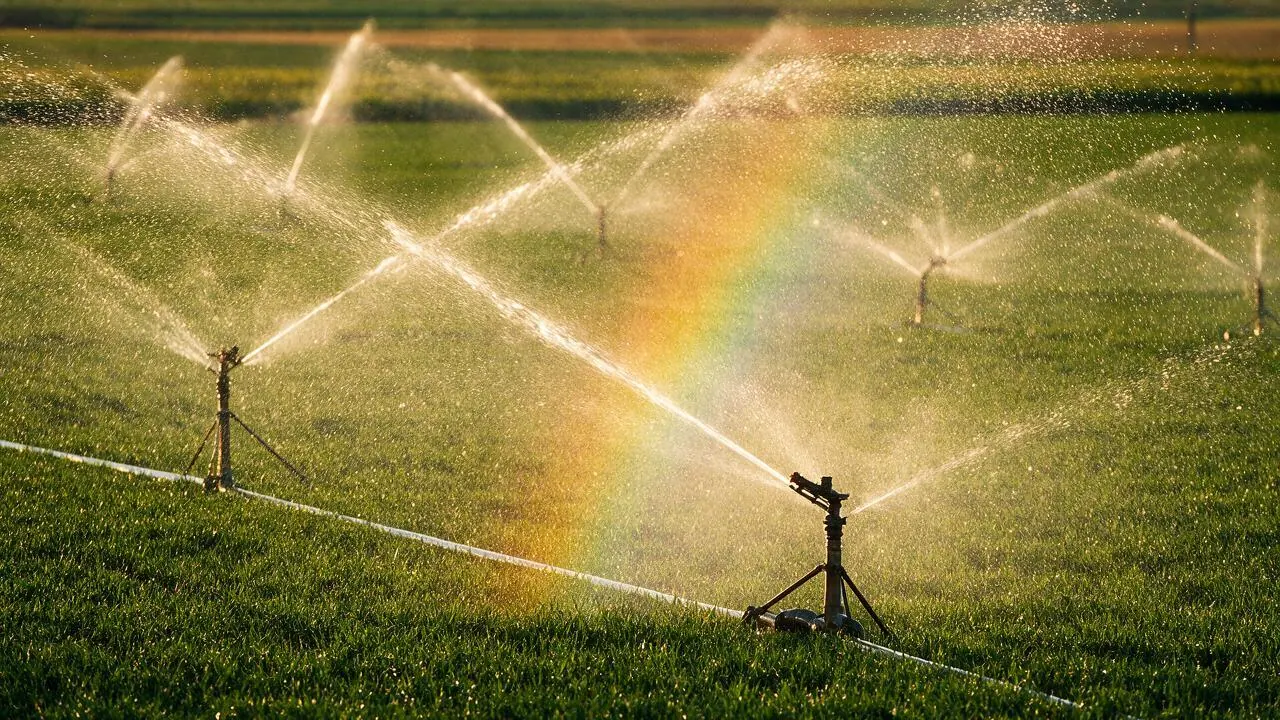
Sprinkler irrigation remains one of the most popular methods for row crops, pastures, and large fields because it covers broad areas efficiently and works on most soil types. However, many farmers run their sprinklers on a fixed schedule rather than calculating actual water needs — leading toverwatering, nutrient leaching, and inflated water bills. This guide shows you how to calculate precise water requirements and run times for any sprinkler setup.
Understanding Crop Water Requirement (ETc)
Every crop loses water through transpiration, and the soil loses water through evaporation — together called evapotranspiration (ET). The reference evapotranspiration (ETo) is the water use of a standard grass surface under specific conditions, measured by local weather stations inches or millimeters per day. Your crop's actual water requirement (ETc) equals ETo multiplied by a crop coefficient (Kc) that changes with growth stage.
For example, corn in mid-July has a Kc of about 1.2. If your local ETo is 0.25 inches/day, your corn needs 0.30 inches/day (0.25 × 1.2). Over a 7-day period, that is 2.1 inches of water. If it rained 0.5 inches that week, you only need to apply 1.6 inches through irrigation. You can find ETo data from your local extension service or USDA weather stations, and Kc values from FAO-56 crop coefficientables.
Calculating Sprinkler Precipitation Rate
The precipitation rate is how fast your sprinklers apply water, measured inches per hour. It depends on sprinkler flow rate (GPM), spacing between sprinklers, and spacing between lateral lines. The formula is:
Precipitation Rate (in/hr) = (GPM × 96.3) ÷ (Sprinkler Spacing × Lateral Spacing)
Where spacing is in feet. For example, if you have impact sprinklers flowing at 4 GPM, spaced 40 feet apart along the lateral, with laterals 50 feet apart: (4 × 96.3) ÷ (40 × 50) = 385.2 ÷ 2,000 = 0.193 inches per hour. This means your system applies roughly 0.2 inches of water per hour of operation.
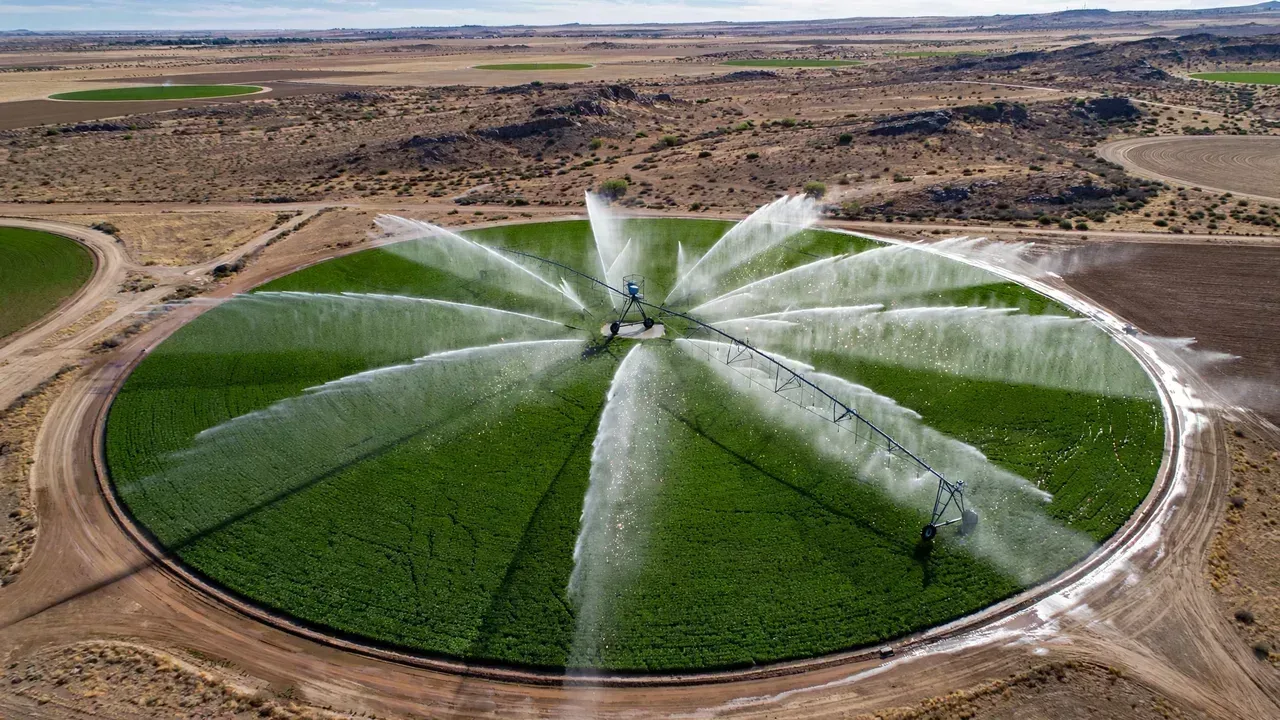
For center pivots, the calculation is different — use the system's total GPM and covered acreage: Precipitation Rate = (GPM × 1.6) ÷ Acres. A 500 GPM pivot covering 130 acres applies about 6.15 inches per full revolution, which at 24 hours per revolution equals 0.26 in/hr.
Accounting for Distribution Uniformity and Efficiency
No sprinkler system applies water perfectly evenly. Distribution Uniformity (DU) measures how evenly water is distributed — a well-designed system has DU of 75-85%, while poorly maintained systems can drop below 60%. To compensate, divide your target water amount by the DU (expressed as a decimal). If you need 1.6 inches and your DU is 0.80, you must apply 1.6 ÷ 0.80 = 2.0 inches to ensure the driest area receives enough water.
Sprinkler application efficiency is typically 70-80% due to wind drift and evaporation losses. On windy days (above 10 mph), efficiency can drop to 60% or lower. Schedule irrigation during early morning or evening hours when wind is calm and evaporation is low to maximizefficiency.
Computing Run Times
Now combineverything to find your run time:
Run Time (hours) = (Target Water Depth × DU factor) ÷ Precipitation Rate
Using our example: Target = 1.6 inches, DU = 0.80 (so factor = 1.25), Precipitation Rate = 0.193 in/hr. Run time = (1.6 × 1.25) ÷ 0.193 = 2.0 ÷ 0.193 = 10.4 hours. So you would run that sprinkler zone for about 10.5 hours to deliver the needed water.
If your soil has a low infiltration rate (clay soil absorbs only 0.15 in/hr), you cannot apply water faster than the soil can take it without causing runoff. In that case, split the irrigation into multiple cycles: run for 3 hours, wait 1-2 hours for infiltration, then run again. This "cycle and soak" method is essential for heavy clay soils or sloped ground.
Building an Irrigation Schedule
Once you know run times, build a weekly schedule based on crop growth stage, soil water-holding capacity, and weather forecasts. Sandy soils hold less water (1-1.5 inches per foot) and need more frequent, shorter irrigations; clay soils hold more (1.5-2.5 inches per foot) and can go longer between irrigations. A typical schedule for loam soil might be 10-12 hours of irrigation every 4-5 days during peak summer demand.
Use our Irrigation Calculator to computexact run times for your sprinkler configuration, and our Crop Water Requirement Calculator to determine ETc for your specific crop and growth stage. Adjust your schedule weekly based on rainfall and ETo data — a flexible schedule saves 15-25% more water than a fixed calendar schedule.
Monitoring and Fine-Tuning
Place rain gauges or catch cups across your field to verify actual precipitation rates and distribution uniformity. Test at leastwice per season and after any maintenance. Replace worn sprinkler nozzles — a nozzle worn 20% oversized wastes 20% more water and reduces pressure at downstream sprinklers. A $5 nozzle replacement can save hundreds of gallons per irrigation cycle.
Related Tools
Calculate your sprinkler irrigation needs withese free tools.
Irrigation Calculator →Crop Water Requirement Calculator →Frequently Asked Questions
How do I calculate sprinkler irrigation water requirement?
Water requirement = crop evapotranspiration (ETc) - effective rainfall, divided by irrigation efficiency. ETc = reference ET (ETo) × crop coefficient (Kc). For example, corn at peak ET (ETo 6 mm/day, Kc 1.2) needs 7.2 mm/day; with 75% sprinkler efficiency, pump 9.6 mm/day. A crop water requirement calculator using FAO Kc values automates this.
What is the typical efficiency of sprinkler irrigation?
Center pivot sprinklers achieve 75-85% efficiency. Solid-set and portable sprinklers achieve 65-75%. Low-pressure spray heads on pivots reach 80-90%. Windy conditions (>15 km/h) reduce efficiency by 10-20% due to drift and evaporation. Compare with drip irrigation (85-95%) using an irrigation efficiency comparison.
How long should I run my sprinkler system?
Run time = required water depth (mm) ÷ application rate (mm/hour) × 60. A typical center pivot applies 8-15 mm per full revolution (24-48 hours). For a 5 mm irrigation need at 10 mm/day application rate, run for 12 hours. Use an irrigation run time calculator for precise scheduling.
What size pump do I need for sprinkler irrigation?
Pump flow rate (L/s) = area (ha) × application rate (mm/hour) × 2.78. For 50 ha at 10 mm/hour: 50 × 10 × 2.78 = 1,390 L/s (22,000 GPM). Add 10-15% for losses. Total head includes elevation lift, friction loss, and sprinkler pressure requirement (20-50 m). Use an irrigation pump size calculator for exact sizing.
Related Calculators
Calculate and optimize with these free tools.
crop water requirement calculator →sprinkler irrigation calculator →References & Sources
- FAO (Food and Agriculture Organization) - Irrigation and Drainage Paper 56: Crop Evapotranspiration
- USDA (United States Department of Agriculture) - Natural Resources Conservation Service (NRCS) Guidelines
- IPCC (Intergovernmental Panel on Climate Change) - 2019 Refinement to the 2006 IPCC Guidelines for National Greenhouse Gas Inventories
- NRC (National Research Council) - Nutrient Requirements of Domestic Animals Series
- Extension Services - Land-Grant University Cooperative Extension System
This content is for informational purposes only. Always consult with local agricultural experts and extension services for site-specific recommendations.