Drip Irrigation Design: A Complete Guide
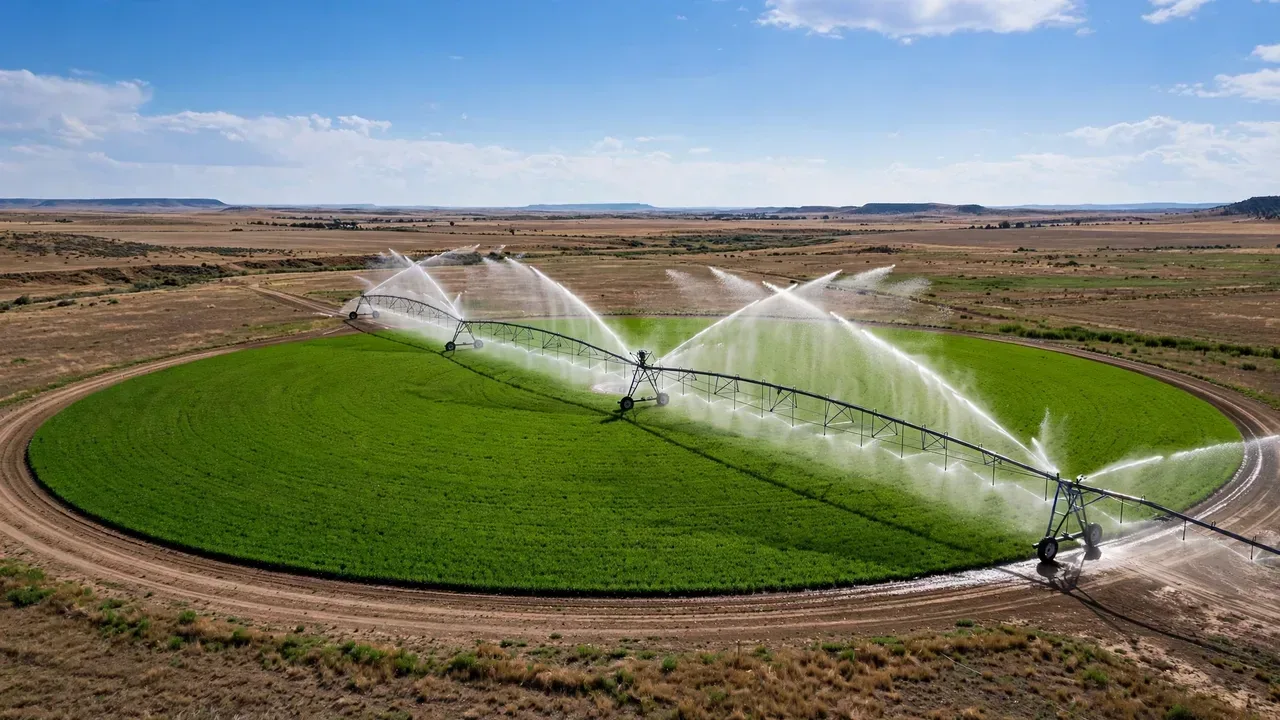
Drip irrigation delivers water directly to plant roots through emitters at 90-95% efficiency, compared to 70-80% for sprinklers and 50-70% for flood irrigation. A properly designedrip system reduces water use by 30-60%, lowers fertilizer costs through fertigation, and increases yields by 10-30%. This guide coversystem design, component selection, installation, and maintenance.
How Drip Irrigation Works
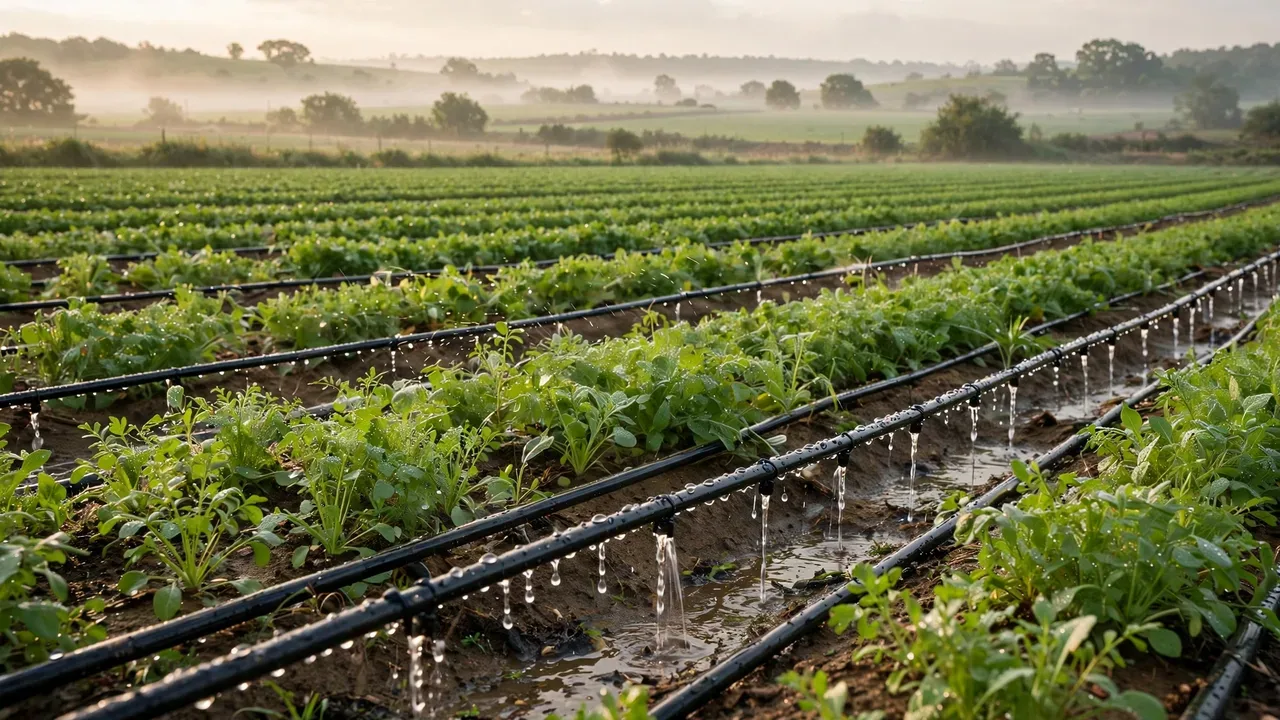
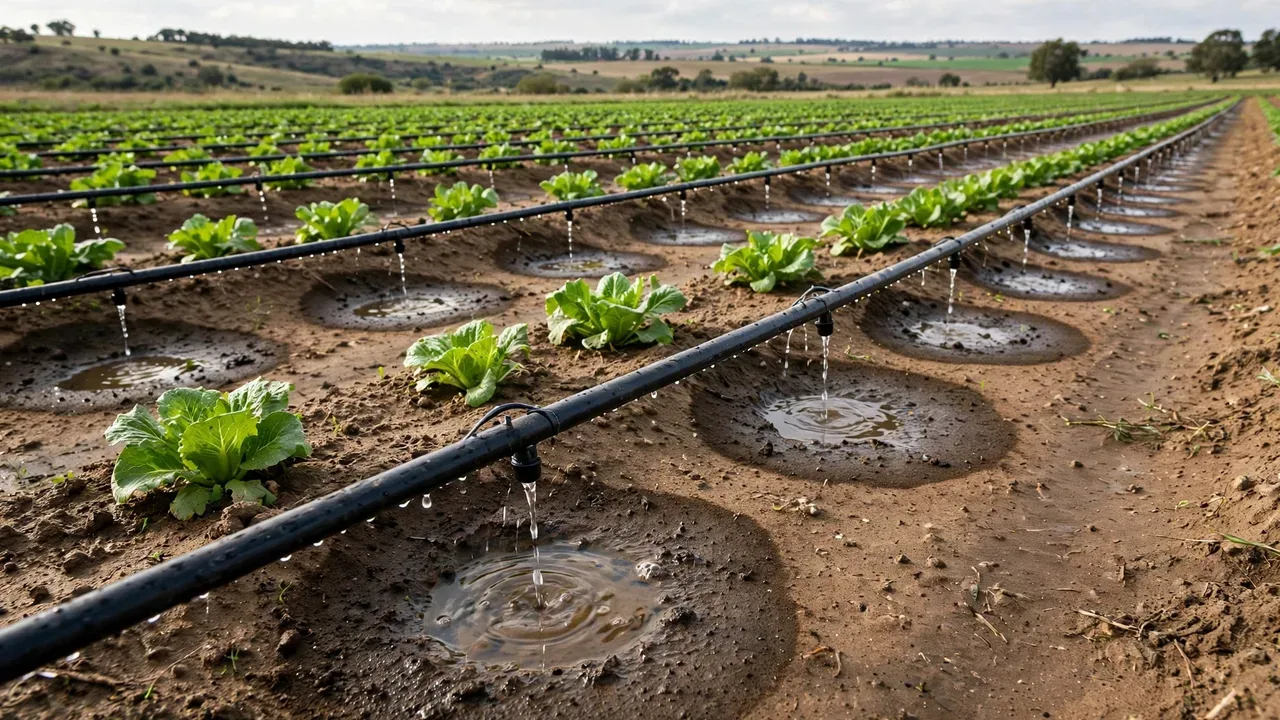
Drip irrigation (also called trickle or micro-irrigation) delivers water slowly and directly to the root zone through small emitterspaced along polyethylene tubing. Water is applied at a rate matched to crop water needs, minimizing evaporation, runoff, andeepercolation. The system can also deliver fertilizer (fertigation) and pest control products withe water, improving efficiency and reducing labor. Esta guía cubre diseño de riego por goteo y cálculos agrícolas relacionados para ayudarle a optimizar las operaciones de su finca.
System Components
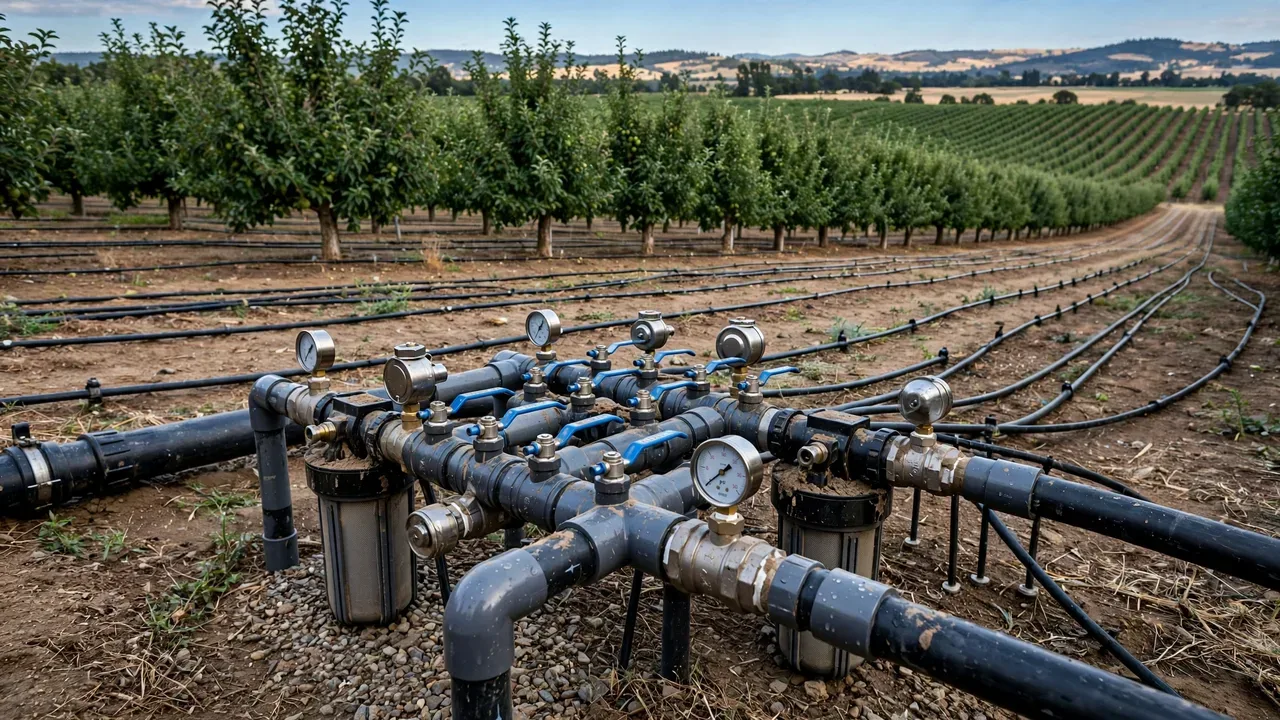
Headworks (Control Unit)
- Pump or water source: Provides pressure (10-20 psi for drip). Can be municipal water, well pump, or gravity tank (minimum 3m head for low-pressure systems).
- Filter: Essential to prevent emitter clogging. Screen filter (100-150 mesh) for clean water, media/sand filter for surface water, disc filter for general use. Filter every system — even "clean" water has particles.
- Pressuregulator: Maintains constant pressure (10-15 psi typical) despite fluctuations. Protects emitters and tubing from damage.
- Flow meter: Measures water applied. Essential for irrigation scheduling and leak detection.
- Controller/timer: Automates irrigation scheduling. Battery-operated ($50-150) or AC-powered with multiple zones ($150-500).
- Fertilizer injector: Venturinjector ($30-100) or proportional pump ($200-800) for fertigation.
- Backflow preventer: Required by code when connected to potable water. Prevents contaminated water from flowing back into the water supply.
Distribution Network
- Mainline: Larger diameter PVC or HDPE pipe (1-4 inches) from water source to zones. Buried 30-60cm deep.
- Submain: Medium diameter pipe feeding multiple drip lines. Often flexible LDPE.
- Drip line/lateral: Thin-walled polyethylene tubing (12-20mm diameter) with built-in emitters. Laid along crop rows. Thin-wall (0.15-0.2mm) for seasonal crops, thick-wall (0.3-0.6mm) for permanent crops.
- Emitters: Built into drip line (integral) or punched in separately (point-source). Flow rates: 0.5-4 L/hour per emitter. Pressure-compensating (PC) emitters maintain uniform flow on slopes and long runs.
- Valves: Solenoid valves ($30-80 each) for automatic zone control, or manual ball valves. One valve per irrigation zone.
Design Steps
Step 1: Determine Water Supply
- Measure flow rate (GPM or LPM) of your water source — this determines how many zones you need
- Check water pressure (PSI/bar) — drip needs 10-20 PSI (0.7-1.4 bar)
- Test water quality — pH, EC, hardness, iron, sediment. Poor water may need filtration or treatment
- Calculate available water per day (flow rate × hours available)
Step 2: Calculate Crop Water Need
Use our Crop Water Requirement Calculator to determine daily water needs. For design, use peak ET (mid-season, hottest month). Example: corn at peak uses 6 mm/day on 1 hectare = 60,000 liters/day. If your water source delivers 20 L/min (1,200 L/hour), you need 50 hours of irrigation per day — impossible with one zone. You need multiple zones or a larger water source.
Step 3: Design Zones
- Divide field into zones based on water availability, crop type, and topography
- Each zone should operate within available flow rate and pressure
- Maximum lateralength: 50-100m for 16mm tubing, 100-200m for 20mm tubing (depends on flow and slope)
- Maximum number of emitters per zone: total flow ≤ available flow × 0.9 (safety margin)
- Grouplants with similar water needs in the same zone
Step 4: Select Emitter Spacing and Flow
| Crop | Emitter Spacing | Flow Rate | Line Spacing |
|---|---|---|---|
| Vegetables (row) | 20-40 cm | 1-2 L/h | 1-1.5 m (per row) |
| Corn | 30-50 cm | 1-2 L/h | 0.75-1 m |
| Orchard trees | 1-2 m | 2-4 L/h | per tree row |
| Vineyard | 0.5-1 m | 1-2 L/h | per vine row |
| Strawberry | 20-30 cm | 0.5-1 L/h | 0.3-0.5 m (2 lines/bed) |
| Greenhouse beds | 20-30 cm | 1-2 L/h | 0.4-0.6 m |
Step 5: Calculate Irrigation Duration
Irrigation duration (hours) = Daily water need (L) ÷ (Emitter flow (L/h) × Number of emitters × System efficiency). Example: 1 ha corn, 6 mm/day = 60,000 L/day. Drip line with 2 L/h emitters every 40cm, 1m line spacing = 25,000 emitters/ha. Total flow = 50,000 L/h. Duration = 60,000 ÷ 50,000 = 1.2 hours/day. Use our Irrigation Calculator for precise scheduling.
Installation Tips
- Flush all lines before connecting emitters: Dirt and pipe shavings clog emitters. Run water through mains and submains for 5-10 minutes before connecting drip lines.
- Install flush valves athend of each lateral: Open monthly to flush sediment. This the #1 maintenance task for drip systems.
- Use pressure-compensating emitters on slopes: Non-PC emitters have uneven flow on slopes (top gets less, bottom gets more). PC emitters cost 20-30% more but save water and ensure uniform crop growth.
- Protectubing from UV: Black tubing resists UV better than clear. Bury or mulch over tubing for permanent installations. Thin-wall seasonal tubing lasts 1-3 seasons; thick-wallasts 5-10 years.
- Install a filter bypass: Allows cleaning the filter without shutting down the system. Check and clean filter weekly (or after heavy water use).
- Use rat guards on buried lines: Gophers and rats chew through tubing. Install metal mesh or use tubing with rat-resistant additives.
Maintenance Schedule
| Frequency | Task |
|---|---|
| Daily | Check controller, flow meter, pressure gauge. Look for wet spots (leaks). |
| Weekly | Clean filter. Check emitters for uniform wetting. Flush laterals if needed. |
| Monthly | Flush all laterals (opend caps for 2-3 minutes). Check for clogged emitters. Test water pH and EC. |
| Seasonal (start) | Replace battery in controller. Check all valves. Flush entire system. Test each zone. |
| Seasonal (end) | Drain lines (freeze protection). Remove and store thin-wall tubing. Clean and store filters. Record system performance. |
| Annually | Check pumperformance. Calibrate flow meter. Inspect mainline for leaks. Replace worn tubing/emitters. |
Common Problems and Solutions
- Clogged emitters: Cause: poor filtration, mineral precipitation, algae. Solution: improve filtration, flush regularly, inject acid (for mineral) or chlorine (for algae). Replace clogged emitters.
- Uneven watering: Cause: pressure variation, slope, clogged emitters, too-long laterals. Solution: pressuregulator, PC emitters, shorter laterals, flush system.
- Leaks: Cause: rodent damage, UV degradation, poor connections, high pressure. Solution: repair with couplers, replace damaged tubing, install pressuregulator, use rodent-resistantubing.
- Salt buildup: Cause: high-salinity water, insufficient leaching. Solution: apply extra water (10-20% leaching fraction), periodically flush with excess water, test soil salinity.
- Root intrusion: Cause: roots grow into emitters seeking water. Solution: use root-barrier emitters, apply copper-based root inhibitor, maintain proper watering schedule.
Design your drip system: Use our Crop Water Requirement Calculator for water needs, Irrigation Calculator for scheduling, Area Converter for field measurements, and Farm Budget Calculator to estimate system costs and ROI.
Cost Estimates
| System Type | Cost per Hectare | Lifespan | Best For |
|---|---|---|---|
| Low-cost thin-wall (seasonal) | $500-1,500 | 1-3 seasons | Row crops, vegetables, small farms |
| Medium-costhick-wall | $2,000-5,000 | 5-10 years | Vegetables, strawberries, orchards |
| High-cost permanent (PC emitters) | $5,000-15,000 | 10-20 years | Orchards, vineyards, high-value crops |
| Greenhouse drip | $3,000-8,000/ha | 5-10 years | Greenhouse vegetables, herbs |
Most drip systems pay for themselves in 1-3 years through water savings, reduced labor, and increased yields. Government cost-sharing programs (EQIP, state programs) often cover 50-75% of installation costs for qualifying farms.
Preguntas Frecuentes
¿Cómo calculo los requerimientos de agua para un sistema de riego por goteo?
Calcule el requerimiento hídrico del cultivo usando: ETc = ETo × Kc, donde ETo es evapotranspiración de referencia (de estación meteorológica local) y Kc es coeficiente del cultivo (varía por etapa: 0.3-0.5 inicial, 0.8-1.2 mediados, 0.6-0.8 final). Para tomate en etapa media con ETo = 6 mm/día y Kc = 1.1: ETc = 6.6 mm/día. Ajuste por eficiencia (goteo = 90-95%): Agua neta = ETc / eficiencia. Considere lluvia efectiva: reste la lluvia del requerimiento. Use una calculadora de requerimiento hídrico para determinar necesidades diarias, semanales y estacionales para su cultivo y ubicación.
¿Qué caudal y espaciamiento de goteros debo usar para riego por goteo?
La selección depende del tipo de cultivo, textura del suelo y disponibilidad de agua. Para cultivos en hilera (hortalizas, fresas): goteros de 0.5-1.0 GPH (2-4 L/h) espaciados 30-60 cm, con una línea por cada 2-4 hileras. Para huertos/viñedos: goteros de 1-4 GPH (4-16 L/h), 2-4 goteros por árbol/planta, colocados en patrón que cubra 30-50% de la zona radicular. Para suelos arenosos: espaciamiento menor (30 cm) y caudales mayores; para suelos arcillosos: espaciamiento mayor (60-90 cm) y caudales menores para evitar escorrentía. Use una calculadora diseñadora de sistema de goteo para especificaciones exactas.
¿Cómo dimensiono tuberías y bomba para riego por goteo?
Dimensionado de tuberías: Calcule caudal total (GPM) = número de goteros × caudal por gotero (GPH) / 60. Para 1,000 goteros a 1 GPH: 1,000 × 1 / 60 = 16.7 GPM. Dimensioné líneas principales y secundarias para mantener velocidad <1.5 m/s y pérdida por fricción <5-10% de presión de operación. Use la ecuación de Hazen-Williams o calculadora diseñadora. Dimensionado de bomba: Presión requerida = presión de operación de goteros (típicamente 10-25 PSI para goteo) + pérdida por fricción + diferencia de elevación + pérdida de filtro (5-10 PSI) + margen de seguridad. Caudal = GPM total del sistema. Use calculadora de bomba de riego.
¿Cómo calculo el tiempo de riego para sistemas de goteo?
Fórmula: Tiempo (min) = (Profundidad deseada (mm) × Área por gotero (m²) × 1000) / (Caudal del gotero (L/h) × 60). Ejemplo: 2 goteros/m² a 2 L/h, aplicando 10 mm: (10 × 0.5 × 1000) / (2 × 60) = 41.7 minutos. Ajuste por tasa de infiltración del suelo (no la exceda para evitar escorrentía), aplique en fracciones en suelos pesados, y use una calculadora de tiempo de riego para programación precisa. Monitoree humedad del suelo para validar y ajustar tiempos.
¿Qué filtración requiere el riego por goteo y cómo la mantengo?
La filtración es crítica — la obstrucción de goteros es el problema #1 de mantenimiento. Nivel requerido según fuente: Agua superficial (presa, canal, río): filtro de malla o disco 100-150 micras, más filtro de arena para algas y materia orgánica. Agua de pozo: filtro de malla 150-200 micras (75-100 micras). Agua municipal: filtro de malla 200 micras. Mantenimiento: Lave filtros semanalmente (malla) o retrolave diariamente (arena). Limpie mallas con cepillo suave — nunca cepillos de alambre. Reemplace mallas dañadas. Instale manómetros antes y después del filtro — diferencia >5 PSI indica necesidad de limpieza. Use filtro dimensionado para 2x el caudal pico.
¿Cómo prevengo y reparo la obstrucción de goteros en riego por goteo?
Causas de obstrucción: físicas (arena, limo, residuos orgánicos), químicas (precipitación de calcio, hierro, manganeso por inyección de fertilizantes), biológicas (algas, limo bacteriano, biopelícula). Prevención: Filtración adecuada, lavado regular de laterales (2-4 veces por temporada, o mensual en uso intensivo), inyección de ácido (fosfórico o nítrico a pH 5.5-6.0 para disolver precipitados minerales, 1-2 veces por temporada), inyección de cloro (1-2 ppm cloro libre para crecimiento biológico, mensual), y evite inyectar fertilizantes incompatibles (ej., calcio + fosfato = precipitación). Reparación: Para goteros obstruidos, primero lave laterales, luego tratamiento con ácido/cloro. Goteros severamente obstruidos pueden necesitar reemplazo. Use diseñador de goteo para planificar puntos de mantenimiento.