Fertilizer Cost per Acre: A Complete Budgeting Guide
Fertilizer cost per acre depends on crop nutrient needs and current fertilizer prices. For corn yielding 180 bu/acre: 180 lb N × $0.60/lb = $108, plus 60 lb P2O5 × $0.80 = $48, plus 90 lb K2O × $0.50 = $45. Total: ~$201/acre for nutrients, plus $8-15/acre for application. Use soil testing and our calculators to apply only what your crop needs.
The True Cost of Fertilizer
Fertilizer typically accounts for 15-30% of total crop production costs — the largest variable input after land rent. In 2022, fertilizer pricespiked to record levels (urea >$900/ton, DAP >$1,000/ton), pushing corn fertilizer costs above $300/acre. Prices have since moderated but remain volatile, driven by natural gas prices (nitrogen feedstock), global supply chains, and geopolitical events. Smart nutrient management is more important than ever — applying only what the crop needs, at the rightime, in the right form. Ce guide couvre calculateur coût engrais par hectare et les calculs agricoles associés pour vous aider à optimiser les opérations de votre ferme.
Nutrient Cost Breakdown
Nitrogen (N) — The Biggest Cost
Nitrogen is typically the most expensive nutrient because it is manufactured from natural gas (Haber-Bosch process). Common N sources: Urea (46-0-0): $400-700/ton, $0.43-0.76/lb N. UAN (28-0-0 or 32-0-0): $250-450/ton, $0.45-0.80/lb N. Anhydrous ammonia (82-0-0): $500-800/ton, $0.30-0.49/lb N (cheapest per lb N, but requirespecialized equipment and safety precautions). For corn needing 180 lb N/acre: cost ranges from $54 (anhydrous) to $137 (ureat high price). Nitrogen is also the most loss-prone nutrient — only 30-50% of applied N is typically recovered by the crop, making efficiency critical.
Phosphorus (P) and Potassium (K)
Phosphorusources: DAP (18-46-0): $500-800/ton, $0.54-0.87/lb P2O5. MAP (11-52-0): similar. Triple superphosphate (0-46-0): $400-600/ton. Phosphorus is relatively stable in soil (does not leach like N), so building soil P levels over time is a valid strategy. Potassium sources: Potassium chloride (0-0-60, muriate of potash): $300-500/ton, $0.25-0.42/lb K2O. Potassium sulfate (0-0-50): more expensive, used for chloride-sensitive crops (tobacco, some fruits). K can leach in sandy soils but is generally stable in loams and clays.
Complete Fertilizer Blends
Blended fertilizers (e.g., 10-10-10, 19-19-19, 13-13-13) are convenient but often more expensive per lb of nutrient because you pay for manufacturing, bagging, and transportation. Bulk custom blends (spread by a retailer coop) are usually cheaper acre than bagged fertilizer. For example: 10-10-10 at $400/ton = $2.00/lb N + $0.87/lb P + $0.67/lb K — the N is 3-4x more expensive than bulk urea. Use blends only when the ratio matches your crop needs exactly; otherwise, buy individual sources and blend or apply separately.
Application Costs
Fertilizer application adds $5-20/acre depending on method: Broadcast (spreader): $5-10/acre. Incorporation (tillage after broadcast): additional $8-15/acre. Side-dress (row crop applicator): $10-18/acre. Fertigation (through irrigation): $2-5/acre (if system already installed), but requires soluble fertilizers (more expensive per lb). Foliar application: $5-10/acre per application, used for micronutrients or late-season N, not primary fertility. Custom application by a retailer coop includes both product and application in one bill — ask for an itemized breakdown to compare costs.
Strategies to Reduce Fertilizer Costs
1. Soil Test and Apply Only What Is Needed
This the #1 cost-saving strategy. A $25 soil test can save $50-100/acre by avoiding unnecessary fertilizer. If your soil tests high in P (>30 ppm) or K (>200 ppm), you may not need to apply those nutrients at all — saving $40-80/acre. Many farmers apply "insurance" fertilizer based on tradition, not soil test results. University trials consistently show that soil-test-based recommendations maintain yield while reducing fertilizer use by 20-40%.
2. Use Legume Cover Crops for Nitrogen
Legume cover crops (clover, vetch, peas, beans) fix atmospheric nitrogen through rhizobium bacteria. A good hairy vetch cover crop can fix 100-150 lb N/acre, replacing $60-100 worth of N fertilizer. Crimson clover: 70-120 lb N/acre. Winter peas: 80-120 lb N/acre. The N is released slowly as the cover crop decomposes, matching crop demand better than synthetic N (which is prone to loss). Cover costs: $20-40/acre for seed + planting, but USDA EQIP and many state programs provide cost-sharing. The soil health benefits (organic matter, erosion control, water infiltration) are additional bonuses.
3. Split Nitrogen Applications
Applying all N before planting (fall or early spring) leads to 30-50% loss through denitrification (wet soils), leaching (sandy soils), and volatilization (surface-applied urea). Splitting N: 30-40% at planting (starter), 60-70% side-dressed at V4-V8 (when crop demand peaks). This can reduce N needs by 15-25% while maintaining or increasing yield. For corn: side-dress at V6 (6-leaf stage) with anhydrous ammonia, UAN, or urea. Equipment: side-dress applicator ($15,000-40,000) or hire custom applicator ($10-15/acre). The savings in N cost often pay for the application cost.
4. Use Enhanced Efficiency Fertilizers (EEFs)
EEFs reduce N losses through controlled release or inhibition: Urease inhibitors (Agrotain, NBPT): reduce volatilization from surface-applied urea by 50-70%. Adds $30-50/ton to urea cost. Nitrification inhibitors (N-Serve, Instinct): slow conversion of ammonium to nitrate, reducing leaching and denitrification. Adds $40-60/acre for anhydrous. Controlled-release (polymer-coated urea, ESN): releases N over 60-90 days, matching crop demand. Adds $100-200/ton. EEFs are most cost-effective in high-risk conditions: sandy soils (leaching), poorly drained soils (denitrification), surface application without incorporation (volatilization), or early spring application. In low-risk conditions, the extra cost may not pay for itself.
5. Manure and Organic Nutrient Sources
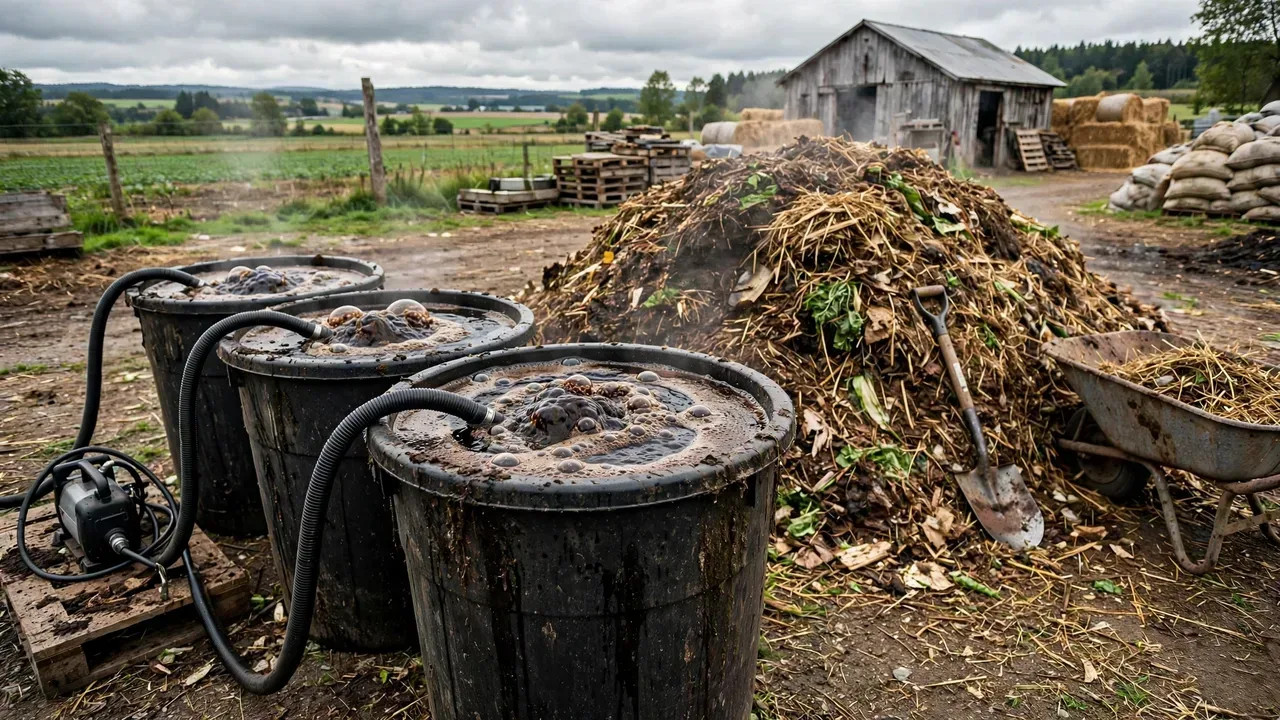
If you have livestock or access to manure, it can replace significant fertilizer. Broiler litter: 3-4% N, 3-4% P, 2-3% K by dry weight. 2 tons/acre of broiler litter = ~120 lb N, 120 lb P, 80 lb K — replacing $100-150 of fertilizer. Cattle manure: lower nutrient content (0.5-1% N), but large volumes. Compost: stable nutrients, improves soil health. Key considerations: test manure for nutrient content (varies 2-3x), account for first-year availability (30-50% of N, 50-80% of P/K), factor in application cost ($10-20/acre), and be aware of pathogen risks (compost first for vegetable crops). Manure is often "free" if you own livestock, but hauling and application costs areal.
Sample Fertilizer Budget: Corn, 180 bu/acre Target
| Item | Rate | Unit Cost | Cost/Acre |
|---|---|---|---|
| Nitrogen (urea, side-dress) | 180 lb N | $0.55/lb N | $99.00 |
| Phosphorus (DAP, broadcast) | 60 lb P2O5 | $0.70/lb P2O5 | $42.00 |
| Potassium (KCl, broadcast) | 90 lb K2O | $0.35/lb K2O | $31.50 |
| Starter fertilizer (10-34-0) | 5 gal/acre | $6/gal | $30.00 |
| Application (broadcast + side-dress) | 2 passes | $10/pass | $20.00 |
| TOTAL | $222.50/acre |
With cover crop N credit (80 lb from hairy vetch): reduce N to 100 lb, saving $44/acre. With soil test showing high P: eliminate P application, saving $42/acre. Optimized total: $136.50/acre — a $86/acre savings without yield loss.
Calculate your fertilizer plan: Use our Fertilizer Calculator for N-P-K product amounts, Organic Fertilizer Calculator for manure nutrients, and Soil pH Calculator toptimize nutrient availability.
Questions Fréquentes
Comment calculer le coût des engrais par hectare et comparer les sources?
Coût des engrais par hectare = (Quantité d'engrais nécessaire par hectare) × (Prix par unité d'engrais). Pour comparer les sources par coût par unité de nutriment: Coût par kg de nutriment = (Prix par tonne d'engrais × 1000 kg/tonne) / (% nutriment × 1000) = Prix par tonne / (% nutriment × 10). Exemple: Urée (46% N) à 500€/tonne: 500 / (0,46 × 10) = 108,70€/kg N. UAN 32% à 350€/tonne: 350 / (0,32 × 10) = 109,38€/kg N. Ammoniac anhydre (82% N) à 700€/tonne: 700 / (0,82 × 10) = 85,37€/kg N — le moins cher par unité N, mais nécessite un équipement d'application spécialisé. Pour les mélanges: calculez le coût par nutriment pour chaque composant. Pour calculer le coût total par hectare: additionnez (nutriment nécessaire × coût par kg nutriment) pour N, P, K, et les micronutriments. Exemple: Maïs nécessitant 200 kg N, 67 kg P2O5, 100 kg K2O à 1,20€/kg N, 1,30€/kg P, 1,10€/kg K: (200×1,20) + (67×1,30) + (100×1,10) = 240 + 87 + 110 = 437€/ha. Utilisez un calculateur de coût d'engrais pour comparer différentes sources, mélanges et stratégies. Acheter en vrac, achats anticipés, et utiliser la source la moins chère par unité de nutriment (pas par tonne) peut réduire significativement les coûts.
Comment calculer les doses d'engrais NPK par hectare?
Pour calculer les doses d'engrais: (1) Déterminez le besoin en nutriments depuis l'analyse de sol ou le taux d'exportation de la culture. (2) Sélectionnez la(les) source(s) d'engrais selon la teneur en nutriments (teneur) et le coût. (3) Calculez la quantité nécessaire: Quantité d'engrais (kg/ha) = Nutriment nécessaire (kg/ha) / (% nutriment dans l'engrais / 100). Exemple: Besoin de 170 kg N/ha, en utilisant de l'urée (46-0-0 = 46% N): 170 / 0,46 = 370 kg urée/ha. Pour les mélanges: calculez chaque nutriment séparément, puis mélangez. Pour les mélanges NPK (ex: 10-10-10): si vous avez besoin de 90 kg N, 90 kg P2O5, 90 kg K2O: 90 / 0,10 = 900 kg de 10-10-10/ha (qui fournit exactement 90-90-90). Utilisez un calculateur d'engrais NPK pour gérer des mélanges complexes, plusieurs sources et conversions d'unités. Tenez toujours compte des crédits de nutriments des cultures précédentes (légumineuses fixent 55-225 kg N/ha), du fumier et de la minéralisation de la matière organique.
Qu'est-ce que la fertigation et comment calculer les doses pour les systèmes goutte-à-goutte?
La fertigation est l'application d'engrais via l'eau d'irrigation, le plus souvent avec des systèmes d'irrigation goutte-à-goutte. Avantages: placement précis des nutriments, réduction du gaspillage (10-30% d'économie), amélioration de l'absorption, et capacité à fractionner les applications tout au long de la saison. Pour calculer les doses de fertigation: (1) Déterminez le besoin nutritionnel total de la saison (depuis l'analyse de sol ou l'absorption de la culture). (2) Fractionnez en applications par stade de croissance (ex: 20% pré-semis, 30% végétatif, 40% floraison/fructification, 10% maturation). (3) Calculez la dose par irrigation: Nutriment par irrigation (kg/ha) = (Besoin du stade × % appliqué par irrigation). (4) Convertissez en quantité de produit fertilisant et injectez dans l'eau d'irrigation à la concentration appropriée (typiquement 100-300 ppm N pour la plupart des cultures). (5) Calculez le débit d'injection. Utilisez un calculateur de dose de fertigation ou un calculateur de CE de solution nutritive pour assurer des concentrations adéquates et éviter les brûlures ou l'accumulation de sels. Injectez toujours l'engrais après la filtration et avant les régulateurs de pression, et rincez les lignes après fertigation pour éviter le colmatage.
Comment calculer les doses de chaux pour les sols acides?
Le besoin en chaux dépend de: (1) pH actuel du sol et pH cible (cible 6,0-6,5 pour la plupart des cultures, 6,5-7,0 pour les légumineuses, 5,5-6,0 pour les cultures acidophiles comme les myrtilles). (2) pH tampon du sol (depuis l'analyse) — mesure la résistance du sol au changement de pH (acidité de réserve). (3) Texture du sol et matière organique — les sols argileux et à haute matière organique ont besoin de plus de chaux que les sols sableux. (4) Qualité de la chaux — Équivalent de Carbonate de Calcium Effectif (ECCE) tient compte de la pureté (CCE) et de la finesse (taille des particules). Formule: Chaux nécessaire (tonnes/ha) = (Changement de pH tampon nécessaire × Facteur de sol) / (ECCE de la chaux / 100). Doses typiques: 2,5-7,5 tonnes/ha pour les sols sableux, 5-12,5 tonnes/ha pour les limons, 7,5-20 tonnes/ha pour les argiles. Utilisez un calculateur de dose de chaux pour des recommandations précises selon votre analyse. Appliquez la chaux 3-6 mois avant les semis (elle met du temps à réagir), incorporez dans les 15-20 premiers cm, et ré-analysez le sol tous les 2-3 ans. La chaux dolomitique apporte aussi du magnésium — utilisez-la si l'analyse montre un Mg faible.
Quels sont le moment et les méthodes optimaux d'application des engrais?
Le moment et les méthodes d'application affectent significativement l'efficacité d'utilisation des nutriments et la réponse de la culture: (1) Azote — les applications fractionnées sont plus efficaces: 20-30% pré-semis ou au semis, 40-50% en couverture pendant la croissance végétative rapide, 20-30% à la floraison/épiaison. Évitez d'appliquer tout l'N en pré-semis (risque de lessivage et de dénitrification). (2) Phosphore — appliquez en pré-semis ou au semis (l'application en bande près de la graine est 2-3x plus efficace que l'épandage sur les sols pauvres en P). Le P ne se déplace pas beaucoup dans le sol, donc le placement importe. (3) Potassium — appliquez en pré-semis ou fractionnez (pré-semis + couverture). Le K est relativement immobile mais peut être lessivé dans les sols sableux. (4) Micronutriments — appliquez selon les besoins de l'analyse de sol ou de l'analyse foliaire; l'application foliaire est efficace pour la correction rapide des carences (zinc, bore, manganèse). (5) Méthodes: épandage et incorporation (pré-semis), en bande/engrais de démarrage (au semis), en couverture (pendant la croissance), fertigation (via irrigation), et pulvérisation foliaire. Utilisez un calculateur d'engrais pour déterminer les doses optimales et les applications fractionnées. Le cadre de gestion 4R (Bonne Source, Bonne Dose, Bon Moment, Bon Endroit) maximise l'efficacité et minimise l'impact environnemental.
Comment optimiser les coûts d'engrais sans réduire les rendements?
Stratégies d'optimisation des coûts d'engrais: (1) Analysez le sol tous les 2-3 ans — appliquer des nutriments selon les besoins réels évite la sur-application gaspillée; sur les sols à hauts niveaux, vous pouvez réduire ou éliminer complètement les applications de P et K, économisant 75-200€/ha. (2) Utilisez la source de nutriment la moins chère par unité — comparez le coût par kg de N/P/K entre les sources (ammoniac anhydre, urée, UAN, MAP, DAP, potasse), pas seulement le coût par tonne. (3) Fractionnez les applications d'azote — appliquer l'N en 2-3 fractions (vs tout en pré-semis) améliore l'efficacité d'utilisation de 10-20%, réduisant l'N total nécessaire et le coût. (4) Utilisez l'agriculture de précision — la fertilisation à taux variable basée sur des cartes de sol et de rendement applique l'engrais seulement où c'est nécessaire, économisant 5-15% sur les champs à sols variables. (5) Maximisez les crédits de nutriments — comptez l'N des cultures légumineuses (55-225 kg N/ha du soja/trèfle), les applications de fumier, et la minéralisation des engrais verts; ces crédits réduisent directement les achats d'engrais. (6) Achetez en vrac et par avance — acheter l'engrais en automne/hiver (avant les pics de demande du printemps) peut économiser 5-15%; les achats en vrac (à la tonne vs en sacs) économisent 10-20%. (7) Utilisez des engrais à efficacité améliorée (EEF) — les engrais N à libération contrôlée et stabilisés réduisent les pertes par volatilisation et lessivage, bien qu'ils coûtent plus cher à la tonne; calculez si l'économie de nutriments justifie la prime. (8) Maintenez un pH adéquat — les sols acides réduisent la disponibilité des nutriments; le chaulage libère les nutriments existants du sol, réduisant les besoins en engrais. Utilisez un calculateur de coût d'engrais pour modéliser différentes stratégies et calculer les économies potentielles. L'objectif est un apport nutritionnel optimal, pas une application maximale — appliquer plus que ce que la culture peut utiliser est pure perte.