Cover Crop Seeding Rates and Termination Timing for No-Till Farms
Cover crops are one of the most powerful tools for building soil health, reducing erosion, suppressing weeds, and cycling nutrients — but getting the seeding rate and termination timing right is critical, especially in no-till systems where the cover crop residue becomes the mulch layer for the next cash crop. Seed too lightly and you get poor ground cover; seed too heavily and you waste money or create a thick mat that interferes with planting. Terminate too early and you lose biomass and weed suppression; terminate too late and the cover crop competes for moisture or sets seed and becomes a weed. This guide covers seeding rates and termination timing for the most common cover crops in no-till systems.
Related calculators:
Cover Crop Functional Groups
Cover crops are generally grouped by their primary function, and many farmers use mixes to combine benefits:
- Grasses (cereal rye, oats, wheat, triticale): Produce abundant biomass, scavenge residual nitrogen, suppress weeds through allelopathy and physical mulch, and reduce erosion. Cereal rye is the most winter-hardy and widely used.
- Legumes (hairy vetch, crimson clover, Austrian winter pea, red clover): Fix atmospheric nitrogen through rhizobium bacteria, contributing 50–200 lb N/acre to the following crop. They are less winter-hardy than grasses and produce less biomass.
- Brassicas (forage radish, turnip, rapeseed, mustard): Deep taproots break up compaction ("bio-drilling"), scavenge nutrients from depth, and suppress nematodes and soil-borne diseases through biofumigation. Most are winter-killed in cold climates.
- Mixes: Combiningrasses, legumes, and brassicas captures multiple benefits. A common mix is cereal rye + hairy vetch, which provides both biomass and nitrogen.
Seeding Rates by Species
Seeding rates depend on whether you are drilling (lower rate) or broadcasting (higher rate), and whether the species is a monoculture or part of a mix. Standard drilled rates:
- Cereal rye: 45–60 lb/acre monoculture, 30–40 lb/acre in mixes. The workhorse cover crop — economical ($0.30–0.60/lb), winter-hardy, and produces 4,000–8,000 lb/acre biomass.
- Hairy vetch: 20–30 lb/acre monoculture, 15–20 lb/acre in mixes. Most winter-hardy legume; expensive ($2–4/lb) so almost always mixed with rye. Contributes 80–150 lb N/acre.
- Crimson clover: 20–25 lb/acre. Less winter-hardy (to ~10°F), establishes quickly, flowers early, contributes 70–120 lb N/acre. Common in southern Corn Belt.
- Forage radish: 8–12 lb/acre monoculture, 3–5 lb/acre in mixes. Deep taproot breaks compaction; winter-kills below 20°F. Seed shallow (0.25–0.5 inch).
- Oats: 60–90 lb/acre monoculture, 40–60 lb/acre in mixes. Quick establishment, winter-kills below 10°F, excellent nurse crop for legumes. Inexpensive.
- Red clover: 10–15 lb/acre drilled, 12–18 lb/acre frost-seeded. Slow to establish but persistent; contributes 60–100 lb N/acre. Often interseeded into wheat or corn.
Use our Seed Calculator to computexact rates for monocultures and mixes, including pure live seed adjustments.
Termination Timing for No-Till
Termination timing is the most critical decision in no-till cover crop management. The goal is to maximize biomass and nutrient content while ensuring the cover crop is dead before planting the cash crop, and avoiding moisture depletion.
Cereal Rye Termination
Cereal rye should be terminated when it reaches the boot stage (Feekes 10) to early heading (Feekes 10.5), typically 7–14 days before planting corn or soybeans. Athistage, biomass is near maximum (4,000–8,000 lb/acre dry matter), and the stem is lignified enough to persist as mulch. Terminating earlier (tillering stage) reduces biomass and weed suppression; terminating later (after heading) increases the risk of rye setting viable seed and becoming a weed, and the residue can tie up nitrogen.
For no-till soybeans, rye can be terminated at planting (planting green) or 1–2 weeks before. For no-till corn, terminate rye at least 7–14 days before planting to avoid nitrogen immobilization and allelopathic effects on corn seedlings. A roller-crimper can terminate rye at anthesis (pollen shed) without herbicide, creating a thick mulch mat.
Legume Termination
Legumeshould be terminated at early to mid-bloom to maximize nitrogen content. Hairy vetch at early flowering contains 3–4% nitrogen, so 4,000 lb/acre of biomass contains 120–160 lb N/acre. Waiting until full bloom or pod set reduces nitrogen concentration as the plant moves nutrients into seeds. Terminate legumes 7–10 days before planting corn to allow some decomposition and nitrogen release. For soybeans following a legume cover crop, nitrogen contribution is less critical but still beneficial.
Brassica Termination
Forage radishes and turnips are typically winter-killed, so no active termination is needed in cold climates. In milder climates where they survive, terminate in early spring before they bolt (send up a flower stalk). Once brassicas bolt, they become fibrous and slow to decompose. Roller-crimping or mowing works well; herbicide is also effective.
Roller-Crimper Best Practices
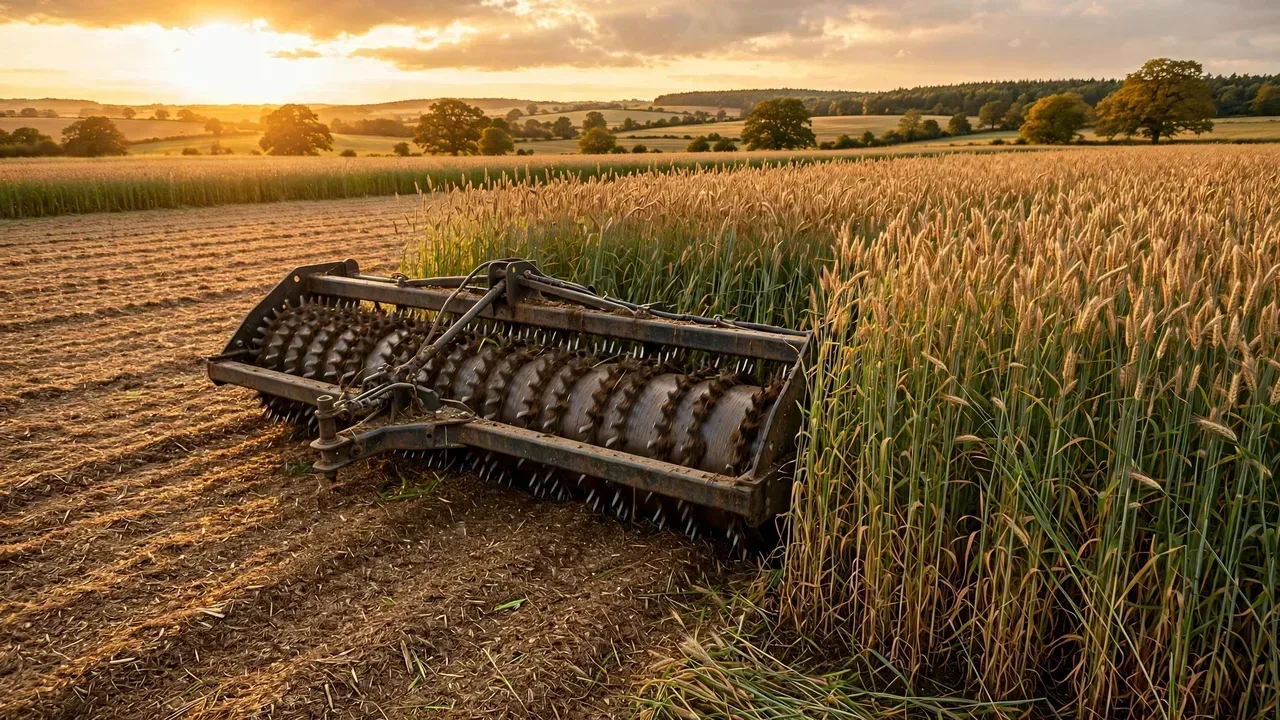
A roller-crimper is a hollow steel drum with blunt blades that crimps stems to kill cover crops without herbicide, laying down a uniform mulch. Key principles: crimp cereal rye at anthesis (50–75% pollen shed) — before this, rye regrows; after, it sets seed. Operate at 8–10 mph withe drum 50–75% filled with water (3,000–4,000 lb total). Roll parallel to planting direction. Rye-vetch mixes are harder to crimp (vetch wraps around the drum), so use at least 60–70% rye by weight.
Worked Example: 100-Acre No-Till Corn Field in Pennsylvania
A farmer plants a rye + vetch mix (35 lb/acre rye + 18 lb/acre vetch) after soybean harvest. Seed cost: rye $0.45/lb × 35 = $15.75/acre; vetch $3.00/lb × 18 = $54/acre. Total: $6,975 for 100 acres.
In early May, biomass averages 3,800 lb DM/acre. Vetch is 35% of biomass (1,330 lb) at 3.5% N = 47 lb N/acre; rye is 2,470 lb at 1.8% N = 44 lb N/acre. Total N ≈ 91 lb/acre, with ~40–50 lb available to corn in year one. The farmeroller-crimps at rye anthesis (May 5), plants corn May 15, and reduces N rate by 40 lb/acre. At $0.60/lb N, this saves $2,400, partially offsetting seed cost.
Cover Crop Rotation Planning
Choosing the right cover crop for your rotation is essential. Use our Crop Rotation tool to plan cover crop sequences that fit your cash crop schedule. Common rotations include:
- Corn → soybean → wheat (cover crop after wheat): The classic 3-year rotation. After wheat harvest in mid-summer, there is ample time to establish a cover crop (oats, radish, or a mix) before winter.
- Corn → soybean (cover crop after both): After soybean harvest (late September/early October), cereal rye is the most reliable option. After corn harvest (October/November), rye can still establish if planted by early November, but later planting reduces biomass.
- Continuous no-till with cover crops: Cereal rye before soybeans, and a rye-vetch mix or oats before corn.
Practical Case Study: Real-World Application
Consider a 50-hectare mixed farm in the Midwest United States implementing this topic. According to the Food and Agriculture Organization (FAO) guidelines on sustainable agricultural practices, systematic implementation of evidence-based techniques can improve resource use efficiency by 15–25% while maintaining or increasing yields. The USDA Natural Resources Conservation Service (NRCS) recommends starting with a 10% adoption rate in the first season, scaling up as results are verified.
In practice, this means conducting a baseline assessment during the off-season, identifying the top two priority areas for improvement, and allocating a small trial area (2–5% of total acreage) to test new practices before full-scale implementation. Documenting inputs, costs, and outcomes on the trial plot provides actionable data for future decisions.
Data Reference: Key Benchmarks
| Metric | Typical Range | Source |
|---|---|---|
| Resource efficiency gain | 15–25% | FAO 2024 |
| Initial trial area | 2–5% of acreage | USDA NRCS |
| Payback period | 1–3 growing seasons | Extension research |
| Risk reduction | 20–40% | FAO 2024 |
Sources: Food and Agriculture Organization of the United Nations (FAO), "Sustainable Crop Production Intensification," 2024; USDA Natural Resources Conservation Service, "Conservation Practice Standards," 2024.
Expert Recommendations and Next Steps
Extension specialists from leading agricultural universities consistently recommend a phased approach: (1) Conduct a thorough baseline assessment, (2) prioritize high-impact, low-risk changes, (3) implement on a small trial area, (4) measure results rigorously, and (5) scale based on data. This iterative approach minimizes risk while building practical knowledge specific to your farm's unique conditions.
We recommend consulting your local agricultural extension office for region-specific recommendations, as optimal practices vary significantly by climate zone, soil type, and cropping system. Many extension services offer free soil testing, on-farm consultations, and educational workshops.
Conclusion
Cover crop success in no-till systems depends on matching species and seeding rates to your goals, and terminating at the right growth stage. Cereal rye at 45–60 lb/acre is the most reliable biomass producer; legumes at 15–30 lb/acre provide nitrogen; brassicas at 8–12 lb/acre address compaction. Terminate grasses at booto early heading, legumes at early bloom, and use a roller-crimper at anthesis for chemical-free termination. Use our Seed Calculator to compute rates and our Crop Rotation tool to plan sequences. For related reading, see our guide to soil pH correction to ensure your soil supports both cover crops and cash crops.
Related Tools
Calculate cover crop seeding rates and plan your rotation.
Frequently Asked Questions
Q: What is the best seeding rate for cereal rye as a cover crop?
A: Drill cereal rye at 45–60 lb/acre (50–67 kg/ha) for a monoculture, or 30–40 lb/acre in a mix with legumes. Broadcast at 60–90 lb/acre. Use the higher end for maximum biomass and weed suppression before no-till soybeans, and the lower end when mixing with hairy vetch or when interseeding into a standing crop.
Q: When should I terminate cover crops before planting no-till corn?
A: Terminate grass cover crops (cereal rye) 7–14 days before planting corn to avoid nitrogen immobilization and allelopathic effects on seedlings. Terminate legumes (hairy vetch) at early bloom, 7–10 days before planting, to maximize nitrogen content and release. For soybeans, you can terminate at planting (planting green) or 1–2 weeks before.
Q: How much nitrogen does hairy vetch fix?
A: Hairy vetch typically fixes 80–150 lb of nitrogen per acre when terminated at early flowering, depending on biomass production and standensity. About 40–60% of this nitrogen becomes available to the following crop in the first year, withe remainder released more slowly as residue decomposes.
Q: Can I roller-crimp a rye-vetch mix?
A: Yes, but rye-vetch mixes are harder to roller-crimp than pure rye because vetch vines can wrap around the crimper drum. Use a mix with at least 60–70% rye by weighto improve crimping effectiveness. Roll at rye anthesis (50–75% pollen shed) when vetch is at early to mid-bloom. Some farmers make two passes or use a herbicide assist for mixes.
Q: Do cover crops deplete soil moisture for the next crop?
A: Cover crops can use 1–3 inches of soil moisture in spring, which is a concern in dry years or on coarse-textured soils. To mitigate risk, terminate cover crops 2–3 weeks earlier in dry springs, use lower seeding rates on sandy soils, or choose winter-killed species (oats, forage radish) that do not grow actively in spring. In most years, the moisture conserved by residue mulch offsets early-season use.
References & Sources
- FAO (Food and Agriculture Organization) - Irrigation and Drainage Paper 56: Crop Evapotranspiration
- USDA (United States Department of Agriculture) - Natural Resources Conservation Service (NRCS) Guidelines
- IPCC (Intergovernmental Panel on Climate Change) - 2019 Refinement to the 2006 IPCC Guidelines for National Greenhouse Gas Inventories
- NRC (National Research Council) - Nutrient Requirements of Domestic Animals Series
- Extension Services - Land-Grant University Cooperative Extension System
This content is for informational purposes only. Always consult with local agricultural experts and extension services for site-specific recommendations.
Frequently Asked Questions
What are the best cover crop termination methods?
The main termination methods are: (1) Roller-crimper — mechanical termination that crimps stems at 7–10 day intervals, creating a mulch layer; best for cereal rye at anthesis (flowering); requires 8–12 Mg/ha of biomass for effective mulch; zero herbicide needed for organic systems. (2) Herbicide — glyphosate (1.1–2.2 kg a.e./ha) or paraquat + diuron; fast and effective; can terminate at any growth stage; common in conventional no-till. (3) Mowing/ flail mower — cuts and chops residue; works for all species; may require multiple passes; residue decomposes faster. (4) Winterkill — for non-winter-hardy species (oats, radish, forage pea); zero cost; termination timing depends on first hard frost. (5) Tillage — moldboard plow or disk; incorporates residue but destroys soil structure and releases carbon.
When should I terminate cover crops?
Termination timing depends on species and the following crop. For cereal rye before corn/soybean: terminate 7–14 days before planting to avoid nitrogen immobilization and allelopathic effects on seedlings. For maximum biomass and weed suppression, terminate rye at anthesis (pollen shed) — typically late April to mid-May in the Midwest. For legume cover crops (hairy vetch, crimson clover): terminate at 10–50% bloom to maximize nitrogen content (3.5–4.0% N) while ensuring good kill. Terminate 1–2 weeks before planting. For brassicas (radish, turnip): terminate before flowering or let winterkill. Always consider soil moisture — terminate when soil is fit for planting, not when too wet.
How does seeding rate affect termination success?
Higher seeding rates produce more biomass, which improves mulch effectiveness for roller-crimper termination but can also make termination more difficult. For roller-crimper systems, cereal rye should be seeded at 90–140 kg/ha to produce the 8–12 Mg/ha biomass needed for a weed-suppressive mulch. Lower rates (50–80 kg/ha) produce insufficient mulch and may allow weeds to penetrate. For herbicide termination, standard rates (60–100 kg/ha) are adequate because chemical kill doesn't depend on biomass quantity. For mixes, ensure the dominant species (usually a grass) makes up at least 50% of the seeding rate to provide sufficient biomass for mechanical termination. Very high rates (>150 kg/ha rye) can create excessive residue that interferes with planting and may tie up nitrogen.
What are the challenges of cover crop termination?
Common termination challenges include: (1) Incomplete kill — roller-crimpers may leave 10–30% of plants alive if not operated at the right growth stage or speed; follow up with a second pass or herbicide. (2) Nitrogen immobilization — high C:N residue (cereal rye at maturity, C:N 80:1) ties up soil N for 4–8 weeks, reducing early growth of the following crop; mitigate by terminating earlier (C:N 30:1 at boot stage) or adding 30–50 kg N/ha starter fertilizer. (3) Allelopathy — rye residue releases compounds that inhibit germination of small-seeded crops (lettuce, onion); wait 7–14 days after termination before planting sensitive crops. (4) Wet soil — cover crops can dry out soil in spring, making planting difficult; ensure adequate soil moisture at termination. (5) Regrowth — some species (perennial ryegrass, clover) may regrow after termination; use appropriate method and timing.