Corn Planting Density: How to Calculate the Perfect Seed Rate
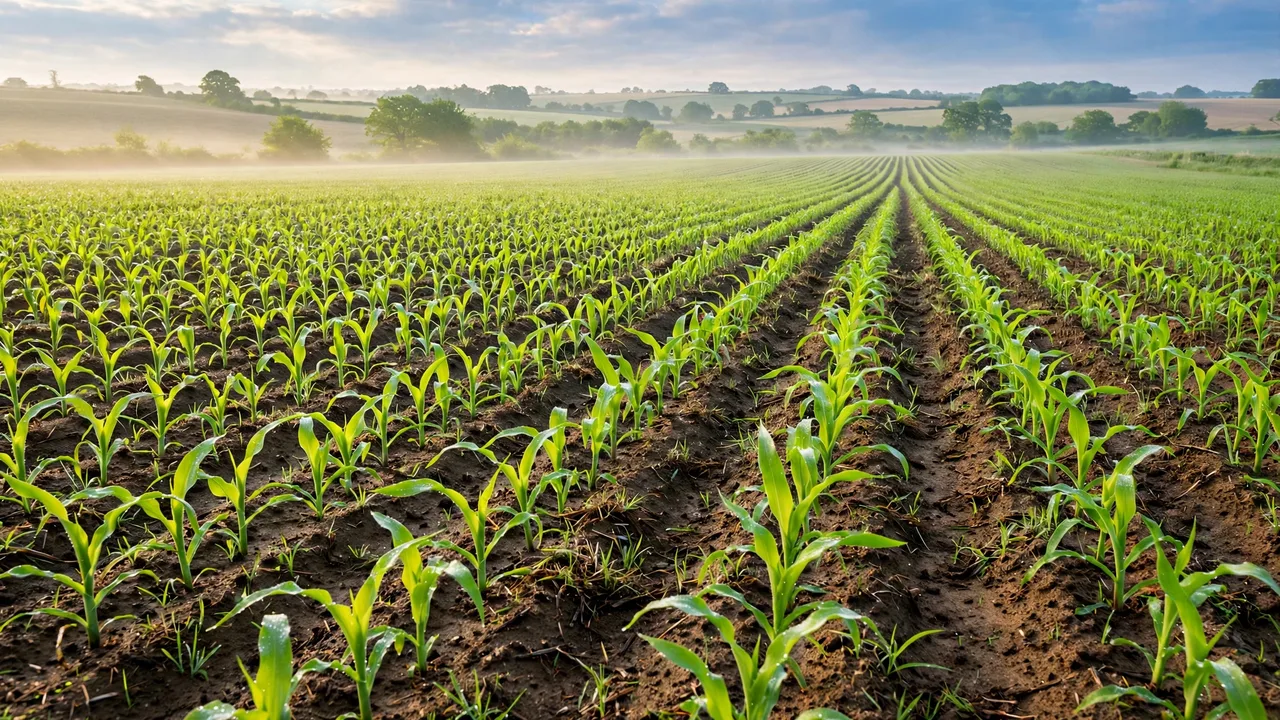
Corn (maize) is one of the most widely planted crops in the world, and getting the planting density right can mean the difference between a bumper harvest and a disappointing yield. Plant too sparsely and you leave yield potential on the table; plant too thickly and plants compete for light, water, and nutrients, leading to lodging and smaller ears. This guide walks you through the science of calculating the perfect corn seed rate for your specific field conditions.
Why Planting Density Matters
Corn yield is a function of three components: ears per unit area, kernels per ear, and kernel weight. Planting density directly influences the first two. Modern hybrids are bred tolerate higher populations than older varieties, but there is still an optimal range. Research from land-grant universities consistently shows that corn yields plateau and then decline once populations exceed about 40,000–45,000 plants per acre (98,800–111,200 plants per hectare), depending on the hybrid and environment.
At excessive densities, individual plants produce fewer kernels per ear and smaller ears. The crop may also lodge (fall over) under wind orain, making harvest difficult and increasing yield loss. At very low densities, the field fails to capture all available sunlight, and weeds can become a problem.
Target Populations by Region and Maturity
The ideal final standepends on your growing environment. Here are general guidelines:
- Irrigated, high-yield environments (Corn Belt, irrigated tropics): 32,000–38,000 plants/acre (79,000–94,000/ha) final stand, with seeding rates 5–10% higher to account for mortality.
- Rainfed, moderate-yield environments: 26,000–32,000 plants/acre (64,000–79,000/ha).
- Dryland, low-rainfall areas (less than 500 mm/season): 18,000–24,000 plants/acre (44,500–59,300/ha) to reduce water competition.
- Short-season / early-maturity hybrids: Add 10–15% to population because these hybrids have smaller ears and compensate less.
- Tropical / late-maturity hybrids: Often perform best at 20,000–28,000 plants/acre (49,400–69,200/ha) due to taller plant stature and greater leaf area.
The Seed Rate Formula
Calculating your seeding rate is straightforward once you know your target population and expected field emergence. The formula is:
Seeding Rate (seeds/acre) = Target Population ÷ (Germination % × Expected Field Emergence %)
For example, if your target is 32,000 plants/acre, your seed lot has 95% germination, and you expect 90% field emergence (accounting for cold soils, crusting, insect damage):
32,000 ÷ (0.95 × 0.90) = 32,000 ÷ 0.855 = 37,427 seeds/acre
Since corn seed is sold by seed count (typically 80,000-seed bags), this means you need roughly 0.47 bags per acre. For a 100-acre field, that is 47 bags.
Row Spacing and Within-Row Spacing
Row spacing affects how evenly plants are distributed. The traditional 30-inch (76 cm) row spacing remains dominant in North America, but 20-inch (51 cm) and 15-inch (38 cm) rows are gaining popularity, especially in northern regions where earlier canopy closure improves light interception.
To calculate within-row spacing for a given population and rowidth, first convert row spacing to feet, then divide square feet per acre by (rowidth × population):
Within-row spacing (feet) = 43,560 ÷ (Row spacing in feet × Target population/acre)
For 30-inch rows (2.5 feet) at 32,000 plants/acre: 43,560 ÷ (2.5 × 32,000) = 43,560 ÷ 80,000 = 0.545 feet = 6.5 inches between plants. At 36,000 plants/acre in the same rows, spacing tightens to 5.8 inches.
Practical Planting Tips
- Calibrate your planter every season — seed size varies by lot, and plate or vacuum settings must match.
- Plant at 1.5–2 inches (3.8–5 cm) depth in moist soil; shallower in cold, wet soils, deeper in dry soils.
- Maintain planter speed below 5 mph (8 km/h) for accurate singulation; high speed increases skips and doubles.
- Check seed drop across every row unit — a single malfunctioning row can cost 5–8% of yield.
Real-World Example: 50-Acre Corn Field in Iowa
A farmer in central Iowa plants a 110-day hybrid in 30-inch rows on well-drained loam with 650 mm average growing-season rainfall. The seed tag shows 96% germination and 92% pure seed. The farmer targets 34,000 plants/acre final stand estimates 92% field emergence.
Step 1: Calculate pure live seed (PLS): 0.96 × 0.92 = 0.883 or 88.3%.
Step 2: Seeding rate = 34,000 ÷ (0.883 × 0.92) = 34,000 ÷ 0.812 = 41,872 seeds/acre.
Step 3: For 50 acres: 41,872 × 50 = 2,093,600 seeds. At 80,000 seeds per bag, that is 26.2 bags — round up to 27 bags to account for overlaps and calibration waste.
Step 4: Set planter to drop one seed every 6.2 inches in 30-inch rows to achieve 34,000 plants/acre.
Adjusting for Late Planting
If planting is delayed beyond the optimal window (typically mid-May in the Corn Belt), consider increasing population by 5–10% and switching to an earlier-maturity hybrid. Late-planted corn has less time to compensate for low populations through tillering (which is minimal in modern hybrids anyway), so a denser stand helps capturemaining sunlight. However, avoid pushing populations above 40,000 in late planting, as the crop may not reach physiological maturity before frost.
Practical Case Study: Real-World Application
Consider a 50-hectare mixed farm in the Midwest United States implementing this topic. According to the Food and Agriculture Organization (FAO) guidelines on sustainable agricultural practices, systematic implementation of evidence-based techniques can improve resource use efficiency by 15–25% while maintaining or increasing yields. The USDA Natural Resources Conservation Service (NRCS) recommends starting with a 10% adoption rate in the first season, scaling up as results are verified.
In practice, this means conducting a baseline assessment during the off-season, identifying the top two priority areas for improvement, and allocating a small trial area (2–5% of total acreage) to test new practices before full-scale implementation. Documenting inputs, costs, and outcomes on the trial plot provides actionable data for future decisions.
Data Reference: Key Benchmarks
| Metric | Typical Range | Source |
|---|---|---|
| Resource efficiency gain | 15–25% | FAO 2024 |
| Initial trial area | 2–5% of acreage | USDA NRCS |
| Payback period | 1–3 growing seasons | Extension research |
| Risk reduction | 20–40% | FAO 2024 |
Sources: Food and Agriculture Organization of the United Nations (FAO), "Sustainable Crop Production Intensification," 2024; USDA Natural Resources Conservation Service, "Conservation Practice Standards," 2024.
Expert Recommendations and Next Steps
Extension specialists from leading agricultural universities consistently recommend a phased approach: (1) Conduct a thorough baseline assessment, (2) prioritize high-impact, low-risk changes, (3) implement on a small trial area, (4) measure results rigorously, and (5) scale based on data. This iterative approach minimizes risk while building practical knowledge specific to your farm's unique conditions.
We recommend consulting your local agricultural extension office for region-specific recommendations, as optimal practices vary significantly by climate zone, soil type, and cropping system. Many extension services offer free soil testing, on-farm consultations, and educational workshops.
Conclusion
Calculating the perfect corn seed rate is not guesswork — it is a simple matter of matching your target population to your field's yield potential, adjusting for seed quality and expected emergence, and setting your planter accurately. Use our Seed Calculator to do the math instantly, and pair it with our Yield Calculator to estimate your harvest based on the stand you achieve. Also see our beginner's guide to soil testing to ensure your fertility program supports the population you choose.
Related Tools
Calculate your seed rate and projected yield withese free tools.
Frequently Asked Questions
Q: What is the best corn planting population for dryland farming?
A: For dryland areas with less than 500 mm of growing-season rainfall, target 18,000–24,000 plants per acre (44,500–59,300 per hectare). Lower populations reduce competition for limited soil moisture and help each plant access enough water to fill ears. In extremely dry years, even 15,000 plants/acre may be appropriate.
Q: How much does seed size affect seeding rate?
A: Seed size does not change the number of seeds you need per acre, but it affects planter calibration. Larger seed (e.g., 1,200 seeds/lb vs. 2,000 seeds/lb) requires different planter plates or vacuum settings. Always calibrate withe actual seed lot you will plant. Seeding rate is based on seed count, not weight.
Q: Can I plant corn too thick?
A: Yes. Populations above 40,000–45,000 plants/acre typically reduce yield due to increased lodging, smaller ears, and greater disease pressure (especially gray leaf spot and northern corn leaf blight) from denser canopies. Modern hybrids tolerate higher populations than older ones, but every hybrid has an optimum.
Q: How do I convert plants per acre to plants per hectare?
A: Multiply plants per acre by 2.471 to get plants per hectare. For example, 32,000 plants/acre × 2.471 = 79,072 plants/ha. Our Area Converter can help with all unit conversions.
Q: Should I increaseeding rate if planting late?
A: Increase by 5–10% for late planting (after mid-May in the Corn Belt) and switch to an earlier-maturity hybrid. Late-planted corn has less time to develop, so a slightly denser stand helps maximize light interception. Do not exceed 40,000 seeds/acre, as late-plantedense stands risk frost damage before maturity.
References & Sources
- FAO (Food and Agriculture Organization) - Irrigation and Drainage Paper 56: Crop Evapotranspiration
- USDA (United States Department of Agriculture) - Natural Resources Conservation Service (NRCS) Guidelines
- IPCC (Intergovernmental Panel on Climate Change) - 2019 Refinement to the 2006 IPCC Guidelines for National Greenhouse Gas Inventories
- NRC (National Research Council) - Nutrient Requirements of Domestic Animals Series
- Extension Services - Land-Grant University Cooperative Extension System
This content is for informational purposes only. Always consult with local agricultural experts and extension services for site-specific recommendations.
Frequently Asked Questions
What is the optimal corn planting density?
Optimal corn plant population depends on maturity group, soil fertility, water availability, and yield goal. For irrigated, high-fertility conditions: 75,000–90,000 plants/ha (30,000–36,000 plants/acre). For rainfed, moderate fertility: 55,000–70,000 plants/ha (22,000–28,000 plants/acre). For dryland, low-fertility: 40,000–55,000 plants/ha (16,000–22,000 plants/acre). Early-maturity hybrids tolerate higher densities than late-maturity types. Use a seed rate calculator to determine exact seeding rates accounting for germination and expected field emergence.
How do I calculate corn seed rate per hectare?
Seed rate (kg/ha) = (Target plant population × 1000-grain weight in grams) ÷ (Germination % × Field emergence % × 100,000). For example: target 70,000 plants/ha, TGW 300 g, germination 95%, field emergence 90%: Seed rate = (70,000 × 300) ÷ (0.95 × 0.90 × 100,000) = 21,000,000 ÷ 85,500 = 245.6 kg/ha. Typical corn seed rates range from 15–30 kg/ha for precision planting (using counted seed), or 20–35 kg/ha for conventional drilling. Always add a 5–10% safety margin for expected field losses.
What row spacing is best for corn?
The most common corn row spacing is 70–76 cm (28–30 inches) for conventional equipment. Narrow rows (38–50 cm or 15–20 inches) can increase yields by 3–8% through better light interception and reduced weed competition, especially at high plant populations. Very narrow rows (15–20 cm or twin rows) work well for irrigated, high-input systems but require specialized equipment. Wider rows (90–100 cm) are used in intercropping systems or where mechanical cultivation is needed. Ensure row spacing matches your equipment and harvest setup.
How does planting density affect corn yield?
Yield response to plant density follows a quadratic curve: yields increase with density up to an optimum, then decline due to competition. Each 10,000 plants/ha increase above optimum reduces yield by 2–5% due to smaller ears, increased lodging, and higher barrenness. At very low densities, yields are limited by insufficient plant numbers despite larger individual ears. The economic optimum density is typically 5–10% below the biological optimum because seed costs money. Modern hybrids have better stress tolerance and can maintain yield at higher densities than older hybrids. Monitor plant stands 2–3 weeks after emergence and replant if stands fall below 70% of target.