Cassava Yield Per Plant to Tons Per Hectare: Step-by-Step Calculation
Estimating cassava yield before harvest is difficult because the money is underground. Most growers count roots on a few plants and then freeze when someone asks, 'so how many tons per hectare is that?'. The conversion from cassava yield per plant to tons per hectare is straightforward once you know plant density and average root weight.
Why Per-Plant Estimates Need Density to Become Per-Hectare Tonnage
A single cassava plant tells you very little on its own. Twelve roots averaging 400 g each is a promising plant, but a hectare at 8,000 plants and a hectare at 15,000 plants produce very different totals from that same average. Extension agronomists working with FAO cassava programs repeatedly stress that the plant-to-area conversion, not the root count itself, is where most estimate errors appear.
Three numbers drive the calculation: average storage roots per plant, average weight per root, and plant population per hectare. Measure the first two on a representative sample of plants dug fully, not just partially lifted. The third comes from your planting layout or a quick stand count.
How many plants should you dig?
Five to ten plants per field is the practical minimum, taken from spots that look typical rather than your best corner. Cassava is so variable that sampling only vigorous plants inflates the estimate; walking a diagonal across the field and digging every tenth plant gives a fairer picture.
The Formula and Calculation Method
Step 1: average root weight per plant
Dig each sample plant fully, count the storage roots (exclude the thin, woody ones), weigh them together and divide by the number of roots. Repeat per plant, then average across plants. This gives grams per root and roots per plant.
Step 2: yield per plant in kilograms
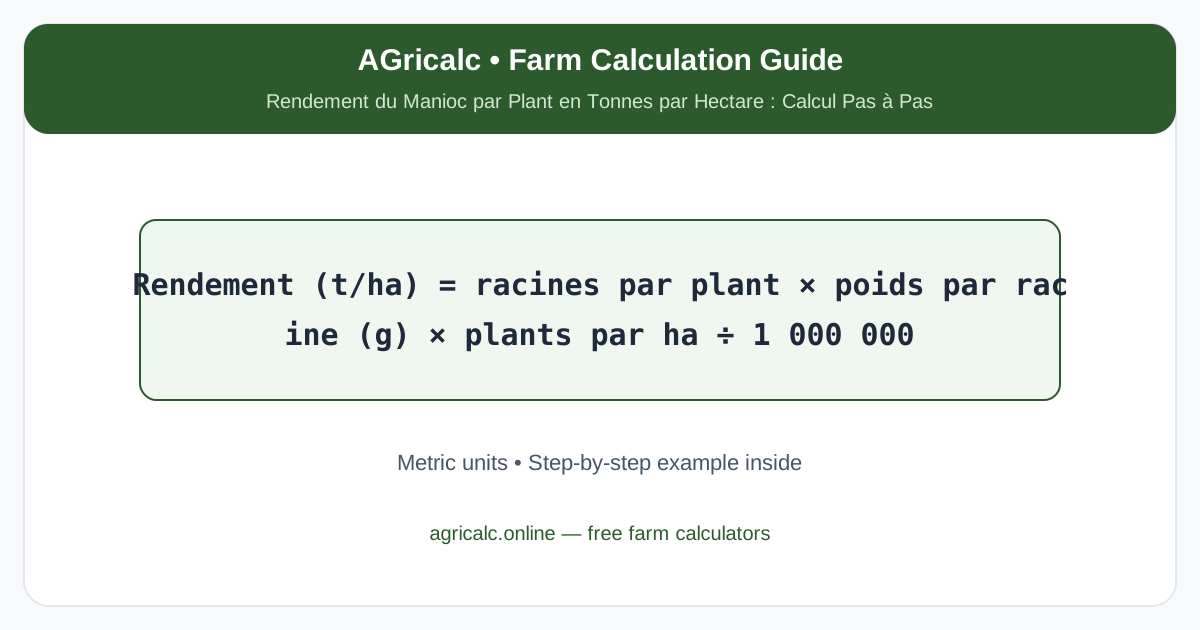
Multiply average roots per plant by average root weight in grams, then divide by 1,000. A plant with 11 roots at 420 g carries 11 × 420 / 1,000 = 4.62 kg of fresh roots.
Step 3: convert to tons per hectare
Yield (t/ha) = yield per plant (kg) × population (plants/ha) ÷ 1,000. At 4.62 kg and 12,500 plants/ha: 4.62 × 12,500 ÷ 1,000 = 57.8 t/ha fresh weight. If your density is per acre, convert first: plants/ha = plants/acre × 2.47.
Worked Example: A One-Hectare Block Before Harvest
A farmer samples eight plants at 12 months from a field planted at 1 m × 0.8 m (12,500 plants/ha). Root counts are 9, 12, 10, 13, 11, 12, 8 and 14, averaging 11.1 roots per plant. Combined root weights give an average of 395 g per root.
Yield per plant = 11.1 × 395 ÷ 1,000 = 4.38 kg. Field estimate = 4.38 × 12,500 ÷ 1,000 = 54.8 t/ha fresh roots. If 8% of roots are expected to rot or break during lifting, the realistic harvest is 54.8 × 0.92 ≈ 50.4 t/ha. At a farmgate price of 60 per ton, that block is worth roughly 3,024 before harvest costs.
Adjusting for dry season harvests
Cassava gains starch and loses water as it ages, so the same root count weighs less at 18 months than at 10 months in many environments. If you estimate long before lifting, re-weigh a few plants close to harvest day rather than trusting a six-month-old number.
Practical Notes and Common Mistakes
Counting Commercial Roots Only
Include only roots thick enough to be worth peeling and marketing. Thin, branchy roots that a buyer would reject should not inflate your estimate, even though they contribute to plant biology.
Ignoring Stand Gaps
Use the actual stand count, not the planned population. If 10% of positions died in planting, your divisor is 11,250 plants/ha, not 12,500. A quick count of missing positions along two 20-meter rows gives you the correction.
Weighing Wet Soil
Mud on lifted roots adds real kilograms to your scale but not to your sale. Brush or rinse roots before weighing samples; a 5% soil error is common after rain.
Agronomy services aligned with FAO cassava guidance recommend recording density, roots per plant and root weight separately every season, because knowing which factor limited yield tells you what to fix next planting. Use the Cassava Yield Calculator on agricalc.online to run this conversion instantly for any plant count, root weight and density combination.
Frequently Asked Questions
How accurate is a per-plant cassava yield estimate?
With eight to ten well-chosen plants and correct density, estimates typically land within ten to fifteen percent of the weighed harvest. Accuracy improves if you sample across the whole field and re-check close to lifting, since root bulking continues until harvest.
Should I include small or rotten roots in the count?
Count only marketable storage roots for a commercial estimate. Small, woody or rotten roots are part of plant biology but not part of the tonnage a buyer will pay for, so including them overstates your saleable yield.
What plant density is typical for cassava?
Smallholder plantings commonly run between 10,000 and 15,000 plants per hectare, with 1 m × 1 m, 1 m × 0.8 m and 1 m × 0.5 m layouts all used. Intercropping reduces the effective cassava population, so count only cassava positions in mixed fields.
Does the estimate include leaves and stems?
No. The formula covers fresh storage roots only. Stems have value as planting material and leaves as fodder in some systems, but they are estimated separately if needed.
Turning a handful of dug plants into a dependable tons-per-hectare number comes down to honest sampling, true stand count and clean weights. Run your own figures through the Cassava Yield Calculator on agricalc.online and you will have a defensible estimate ready before the first fork hits the soil.