Estimate Corn Yield Before Harvest Using the Kernel Count Method

Grain buyers want tonnage commitments weeks before the combine rolls, and the yield monitor cannot help until the header is in the crop. The kernel count method lets you estimate corn yield from a few ears sampled across the field, using nothing more than a tape, a counter and repeatable arithmetic.
How the Kernel Count Method Works
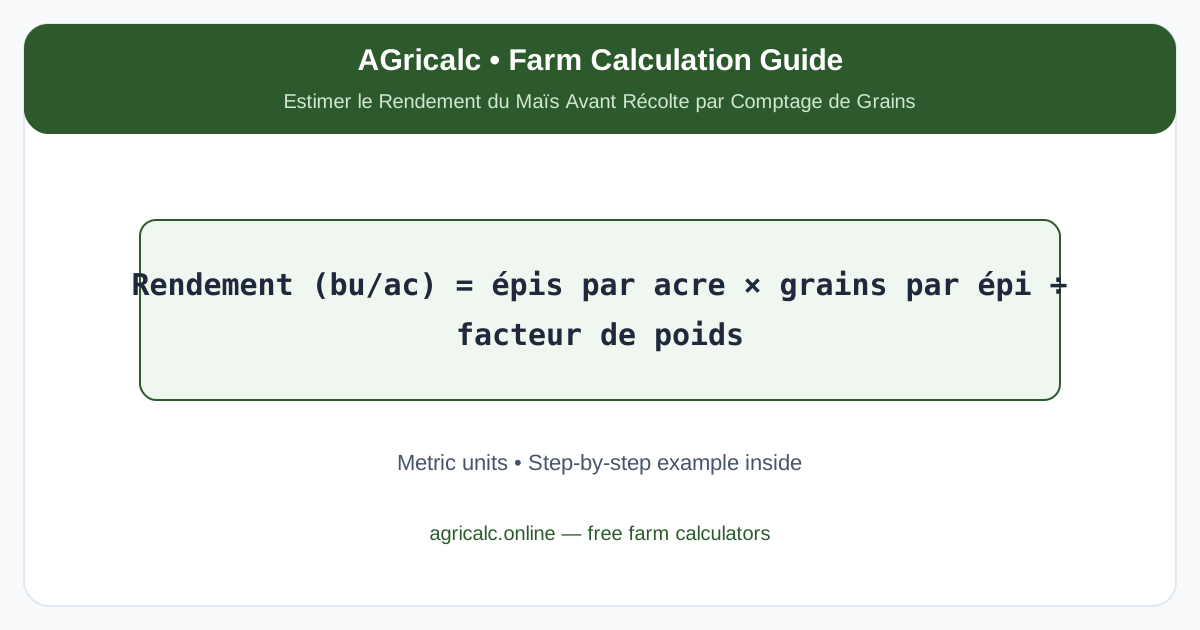
Corn yield is the product of four components you can see in the field at dent stage: ears per area, kernel rows per ear, kernels per row, and the weight of those kernels. The classic yield-estimation equation multiplies the first three and divides by a kernel weight factor, giving either bushels per acre or tons per hectare once moisture is considered.
Timing matters. Kernel count estimates are most reliable from R5 (dent) onward, when kernel depth is largely set. Earlier counts made during milk or dough stage over predict, because some kernels will still abort. University extension services, including USDA land-grant guidance, advise waiting until the dent stage for the numbers to stabilize.
Sampling pattern
Walk a diagonal or a W across the field and stop at 8 to 12 representative spots. At each stop count the ears in 1/1000 acre of row (for 30-inch rows that is 17 feet 5 inches) and pull one average-looking ear per stop.
The Formula and Calculation Method
Step 1: ears and kernels
At each stop, count harvestable ears in your row length, then on the sampled ear count kernel rows around and kernels per row. Multiply rows × kernels per row to get kernels per ear. Average across all stops.
Step 2: choose the kernel weight factor
The traditional factor is 90, meaning 90,000 kernels per bushel at 15.5% moisture. Modern hybrids often need 80 to 85; a factor of 100 suits light, low-test-weight grain. Choose 80 for great grain fill, 85–90 for average, and 95–100 for stressed crops.
Step 3: the equation
Yield (bu/ac) = ears per acre × kernels per ear ÷ factor. To work in metric: yield (t/ha) = ears per ha × kernels per ear × individual kernel weight (g) ÷ 1,000,000, where kernel weight commonly sits between 0.25 and 0.35 g.
Worked Example: 40 Hectares of Dent-Stage Maize
Across 10 stops on 30-inch rows you count an average of 32 ears per 17'5" of row, which scales to 32,000 ears per acre (about 79,000 ears per hectare). The sampled ears average 16 rows with 34 kernels per row, or 544 kernels per ear.
Using the factor 85: 32,000 × 544 ÷ 85 = 204.8 bu/ac. In metric with 0.30 g kernels: 79,000 × 544 × 0.30 ÷ 1,000,000 = 12.9 t/ha at field moisture. Discount 5% for harvest loss and any unharvested headlands and you can commit to roughly 12.3 t/ha with a straight face.
Checking your own arithmetic
Recompute one stop end to end before trusting the field average; a single rows-times-length slip multiplies through every following step. The Corn Yield Calculator on agricalc.online performs these conversions, so you only enter ears, kernel counts and the factor.
Mistakes That Ruin Kernel Count Estimates
Sampling Only the Best Ground
Estimates collapse when the walk avoids wet spots, compaction headlands or skipped rows. Include the poor patches at their real frequency or present a range instead of a single number.
Counting Gleanings as Harvestable
Ears below the header height, stalk-lodged ears and poor tips that the combine will leave should be excluded. Count what the machine will actually gather.
Ignoring Moisture and Discounts
A bushel is a unit of weight at defined moisture. If your buyer dries 20% corn to 15.5%, the shrink belongs in the offer, not in the surprise. State moisture alongside every estimate.
USDA risk-agency crop guides use the same component logic for their own pre-harvest assessments, which is why the method has survived decades of yield-monitor technology: it is transparent, quick and close enough for contracts. Run your counts through the Corn Yield Calculator on agricalc.online to turn stops into a defensible number in seconds.
Frequently Asked Questions
When is the best time to estimate corn yield?
From the dent stage (R5) onward, once kernel depth is set. Counts made during milk or dough stage typically over predict because additional kernels may still abort before maturity.
How many stops do I need per field?
Eight to twelve stops along a diagonal or W pattern is the practical standard for uniform fields. Split heavily variable fields into zones and estimate each separately.
What kernel weight factor should I use?
Use 90 as the traditional default, 80 to 85 for well-filled modern hybrids and 95 to 100 for drought-stressed or light grain. Calibrate against your weigh wagon history when available.
Does the estimate account for harvest losses?
No. Kernel counts describe biological yield at the plant. Apply your own harvest loss percentage, typically three to seven percent with well-set combines, before quoting deliverable tonnage.
The kernel count method turns a twenty-minute walk into a number you can defend to a buyer. Sample honestly, pick the right factor and let the Corn Yield Calculator on agricalc.online do the arithmetic before you sign anything.