Dockage Percentage Net Weight Calculation for Grain Sales

For grain producers, the moment of delivery at the elevator is the culmination of a season's hard work, yet the final paycheck often reflects a weight lower than what was hauled. This discrepancy is usually due to the dockage percentage net weight calculation, a standard industry process that removes the weight of non-grain material from the total. Understanding how these deductions are applied is crucial for farmers to accurately forecast their revenue and verify the settlements provided by grain buyers.
The Core Principles of Grain Dockage and Why It Matters
Defining Dockage in the Global Grain Trade
Dockage refers to the specific portion of a grain delivery that is not the primary crop itself, consisting of elements like chaff, stems, stones, weed seeds, and other foreign materials that can be easily removed using standard cleaning equipment. According to USDA guidance, dockage is determined during the official grading process to ensure that buyers are only paying for the usable grain. Unlike damaged kernels which affect the grade but not necessarily the weight, dockage is a direct weight deduction. It represents the 'non-value' part of the load that must be cleaned out before processing or export. For a farmer, high dockage levels don't just mean a lower net weight; they can also indicate issues with combine settings, weed management, or harvest timing, making it a vital metric for operational assessment.
The economic impact of dockage is twofold. First, it reduces the total number of units (bushels or tonnes) for which the farmer receives payment. Second, if dockage levels exceed certain thresholds, elevators may apply additional cleaning fees or handling charges on top of the weight deduction. By mastering the dockage percentage net weight calculation, producers can better negotiate contracts and decide whether on-farm cleaning is a financially viable alternative to accepting elevator deductions. In a tight-margin industry, every kilogram of foreign material subtracted from the gross weight represents a direct hit to the bottom line, making transparency in the weighing and sampling process a top priority for agricultural professionals.
The Step-by-Step Method for Calculating Net Weight
From Gross Weight to Final Settlement
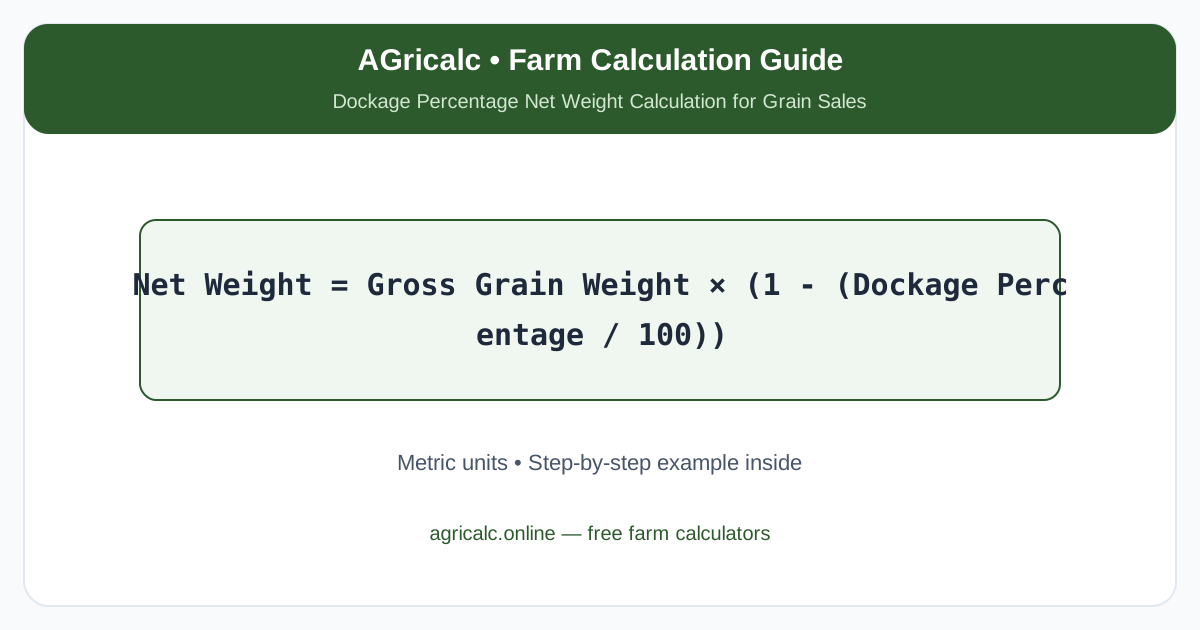
The process of arriving at the net weight involves a series of standardized steps to ensure accuracy and fairness. It begins at the scale, where the gross weight of the truck and grain is recorded. After the grain is sampled, a laboratory-grade dockage tester or a series of hand sieves is used to separate the foreign material from the clean grain. The weight of this separated material is expressed as a percentage of the total sample weight. Once this percentage is established, it is applied to the entire load. The calculation involves subtracting the weight equivalent of that percentage from the total gross weight of the grain. This ensures that the buyer is only purchasing the actual commodity, free from the debris that naturally accompanies the harvest process.
To perform the dockage percentage net weight calculation manually, you first determine the total weight of the grain by subtracting the truck's tare weight from the initial gross weight. Next, you convert the dockage percentage into a decimal by dividing it by 100. Multiply the total grain weight by this decimal to find the total dockage weight in kilograms or pounds. Finally, subtract this dockage weight from the total grain weight to find your net delivered weight. It is important to note that this calculation should be performed before any other adjustments, such as moisture shrinkage, are applied, as dockage represents physical material that is present in the load regardless of its water content.
A Worked Example Using Realistic Metric Units
Calculating a Wheat Delivery Deduction
Let us consider a realistic scenario involving a large-scale wheat delivery to a local terminal. A farmer delivers a tandem trailer of Hard Red Winter Wheat. The weighbridge records a gross weight of 42,500 kg. After the truck is emptied, the tare weight of the vehicle is recorded at 14,200 kg. This leaves a total wet grain weight of 28,300 kg. During the grading process, the elevator technician takes a representative sample and determines that the dockage level is 3.4%. To find the weight of the dockage, we multiply the grain weight by the percentage: 28,300 kg multiplied by 0.034 equals 962.2 kg. This nearly one-tonne deduction represents the weed seeds and chaff mixed within the grain that the elevator will remove before storage.
Following the dockage weight determination, the final step in the dockage percentage net weight calculation is to subtract that weight from the initial grain weight. In our example, 28,300 kg minus 962.2 kg results in a net delivered weight of 27,337.8 kg. If the contract price for the wheat is $310 per tonne, the farmer would be paid based on 27.338 tonnes rather than the initial 28.3 tonnes. This calculation demonstrates how a seemingly small percentage can lead to a significant reduction in the final payout. By performing these calculations independently, the farmer can verify the accuracy of the elevator's settlement sheet and ensure that the dockage recorded matches the physical reality of the delivered crop.
Practical Notes and Avoiding Common Calculation Mistakes
Distinguishing Between Dockage and Moisture Shrink
One of the most frequent errors in post-harvest accounting is the confusion between dockage and moisture shrinkage. While both result in a reduction of the net weight, they are calculated differently and represent different things. Dockage is the physical, non-grain material removed by mechanical cleaning. Moisture shrink, on the other hand, is a mathematical adjustment used to account for the water weight that will be lost when the grain is dried to a standard storage level (typically 13.5% or 14% for wheat). Farmers must ensure they are not 'double-counting' these deductions or applying them in the wrong order. Generally, dockage is removed from the gross weight first, and then the moisture shrink is applied to the remaining clean grain weight to arrive at the final dry, clean net weight.
Another common mistake is failing to account for representative sampling errors. If the sample taken from the truck is not truly representative of the entire load—perhaps because it was taken only from the top layer where chaff tends to settle—the dockage percentage may be artificially high. Producers should observe the sampling process whenever possible to ensure probes are used correctly. Additionally, always check the math on the settlement check. Even with automated systems, errors in data entry can occur. By keeping a log of gross weights and estimated dockage from on-farm testing, you can quickly spot discrepancies. Precision in these numbers is the difference between a profitable year and a break-even one, especially when dealing with high-volume deliveries where small percentage errors compound.
Frequently Asked Questions
What is the difference between dockage and foreign material?
While the terms are often used interchangeably, dockage specifically refers to material that can be removed by standard cleaning sieves and aspirators. Foreign material (FM) usually refers to debris that remains in the grain after dockage is removed, such as stones or pieces of glass that are the same size as the grain, which can affect the final grade and price.
Can I get my dockage back from the elevator?
Generally, no. Once the grain is delivered and the dockage percentage net weight calculation is applied, the elevator takes possession of the screenings. In some cases, large-scale producers may negotiate to keep screenings for use as livestock feed, but this usually requires specialized logistics and is not standard practice for most commercial grain deliveries.
How does high dockage affect my grain grade?
Dockage itself is usually recorded separately from the grade (e.g., Grade No. 1 Wheat, 2% dockage). However, if the material mixed with the grain is 'inseparable' or significantly affects the quality (like ergot or high levels of heat-damaged kernels), it can lower the numerical grade, leading to price discounts in addition to the weight deduction.
Is there a limit to how much dockage is acceptable?
Most grain contracts specify a maximum allowable dockage level. If a load exceeds this limit, the elevator may reject the load entirely or charge a significant 'cleaning fee' per tonne. It is often more cost-effective to clean extremely dirty grain on the farm before delivery to avoid these heavy penalties and high transportation costs for waste material.
Managing your harvest logistics requires a sharp eye on the numbers to ensure every load is accounted for fairly. By understanding the dockage percentage net weight calculation, you can better prepare for elevator deductions and protect your farm's profitability. To make this process even easier and avoid manual errors, use the dockage calculator tool on agricalc.online for fast and accurate results.