Maximizing Fodder Production per Hectare for Dairy Farms
Dairy farming thrives on consistent, high-quality feed, yet many producers struggle with accurately planning their fodder supply. Understanding your farm's precise fodder production per hectare is critical for ensuring your herd receives adequate nutrition daily, directly impacting milk yield and overall farm profitability. This guide will walk you through the essential calculations for managing your daily fodder cuttings effectively.
Optimizing Fodder Production per Hectare for Dairy Success
The Crucial Role of Consistent Feed
For dairy farms, a stable and nutritious feed supply is the cornerstone of productivity. Fluctuations in fodder availability or quality directly translate to reduced milk production, compromised herd health, and increased supplementary feed costs. By accurately assessing fodder production per hectare, farmers can ensure a predictable feed budget, supporting optimal cow performance and preventing costly nutritional deficiencies. This proactive approach minimizes stress on animals and maximizes the economic return from your pastures.
Planning daily cuttings is not just about having enough feed; it’s about having the right amount at the right time, at the right stage of growth for peak nutritional value. This requires a precise understanding of your pasture's growth rate and yield potential. Farmers need to balance cutting frequency with regrowth periods to sustain high-quality fodder throughout the grazing season. Over-grazing or under-utilization both lead to inefficiencies, making precise daily planning indispensable for sustainable dairy operations.
Calculating Daily Fodder Needs and Production Potential
Understanding the Core Formula
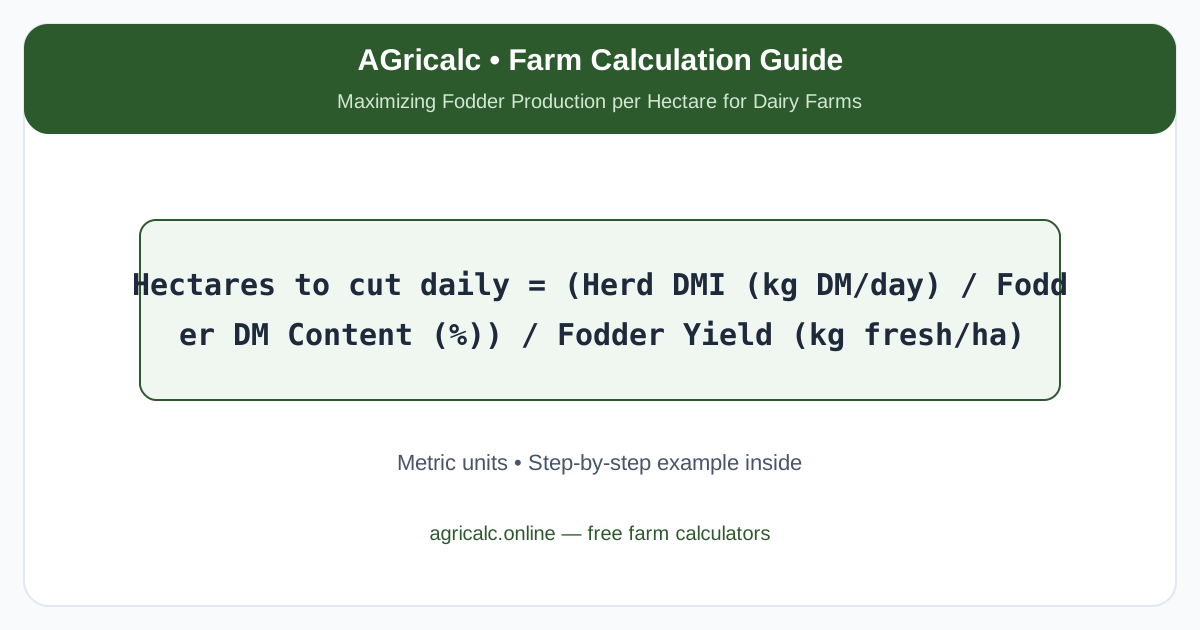
To begin, determine the total dry matter intake (DMI) required by your herd daily. This involves knowing the average DMI per cow (which varies by lactation stage, weight, and milk yield) and multiplying it by the number of cows. Since fodder is typically measured fresh, you'll need to convert this DMI requirement to fresh weight by dividing by the fodder's dry matter content percentage (e.g., if DM content is 20%, divide by 0.20). This gives you the total fresh fodder mass needed daily.
Once the total fresh fodder required daily is established, the next step is to determine how much land needs to be cut. This is achieved by dividing the total daily fresh fodder requirement by your estimated fresh fodder yield per hectare. Accurate yield estimation is crucial and can be done through test cuts or historical data. This calculation provides the exact area (in hectares) that needs to be harvested each day to meet the herd's nutritional demands, allowing for precise rotational grazing or cutting schedules.
Practical Example: Daily Fodder Cuttings for a Dairy Herd
Step-by-Step Calculation for a 100-Cow Herd
Let's calculate the daily fodder cutting area for a dairy farm with 100 lactating cows. Average Dry Matter Intake (DMI) per cow: 18 kg DM/day (according to FAO guidance for a mid-lactation cow). Total Herd DMI: 100 cows * 18 kg DM/cow/day = 1800 kg DM/day. Fodder Dry Matter (DM) content: 22% (or 0.22). Total Fresh Fodder Needed: 1800 kg DM / 0.22 = 8181.82 kg fresh fodder/day. Expected Fresh Fodder Yield per Hectare: 25,000 kg fresh fodder/hectare (or 25 tonnes/ha).
Now we determine the daily cutting area. Hectares to be cut daily = Total Fresh Fodder Needed / Fresh Fodder Yield per Hectare. Hectares to be cut daily = 8181.82 kg / 25,000 kg/ha = 0.327 hectares/day. This means the farmer needs to cut approximately 0.33 hectares of fodder each day to feed their 100-cow herd, assuming these specific parameters. This precise figure allows for effective planning of grazing rotations or mechanical harvesting.
Maximizing Fodder Production Efficiency and Avoiding Pitfalls
Factors Influencing Fodder Yield and Quality
Several factors significantly impact fodder yield and quality. Soil health, including nutrient levels and pH, is foundational; regular soil testing and targeted fertilization are essential. Adequate irrigation, especially in dry periods, can prevent yield drops. Choosing appropriate fodder species and varieties suited to your local climate and soil type is also critical. Implementing effective rotational grazing strategies allows pastures to recover, promotes vigorous regrowth, and ensures consistent fodder quality throughout the season, maximizing your fodder production per hectare.
Common mistakes include underestimating fodder waste from trampling or incomplete consumption, which can be as high as 20-30%. Failing to account for seasonal variations in growth rates and fodder quality can lead to feed deficits or surpluses. Another pitfall is not regularly monitoring actual pasture growth and yield, relying solely on historical averages. Ignoring the varying nutritional needs of different animal groups (e.g., dry cows vs. high-lactation cows) also leads to inefficient feeding. Regular assessment and adjustment are vital for accurate planning.
Frequently Asked Questions
How often should I measure my fodder yield?
It's advisable to measure fodder yield regularly, ideally every 1-2 weeks during peak growing seasons. This allows you to track growth rates accurately and adjust your daily cutting plans in response to changing conditions, ensuring optimal pasture utilization and consistent feed availability.
What's the best way to estimate dry matter content?
The most accurate way is to take a fresh sample, weigh it, then dry it completely (e.g., in a microwave or oven) and weigh it again. The difference in weight reveals the moisture content, from which dry matter percentage can be calculated. Field estimates are less precise.
How does fodder species affect my calculations?
Different fodder species have varying growth rates, dry matter contents, and nutritional values. High-yielding species might require less land per day, but their quality might differ. Always use yield and DM content specific to the species you are growing for accurate calculations.
Can I use this calculation for silage or hay?
While the principle of matching feed supply to demand remains, this specific calculation focuses on fresh fodder for daily cutting or grazing. For silage or hay, you'd calculate total annual requirements and then determine the area needed for a single harvest, considering yield per cut.
Accurate planning of fodder production per hectare is fundamental for the profitability and sustainability of any dairy farm. By understanding your herd's precise daily needs and your pasture's potential, you can optimize feed management, reduce costs, and enhance animal welfare. To simplify these complex calculations and ensure your farm operates at peak efficiency, utilize the fodder production calculator available on agricalc.online.