Stocking Rate: How Many Cows per Acre?
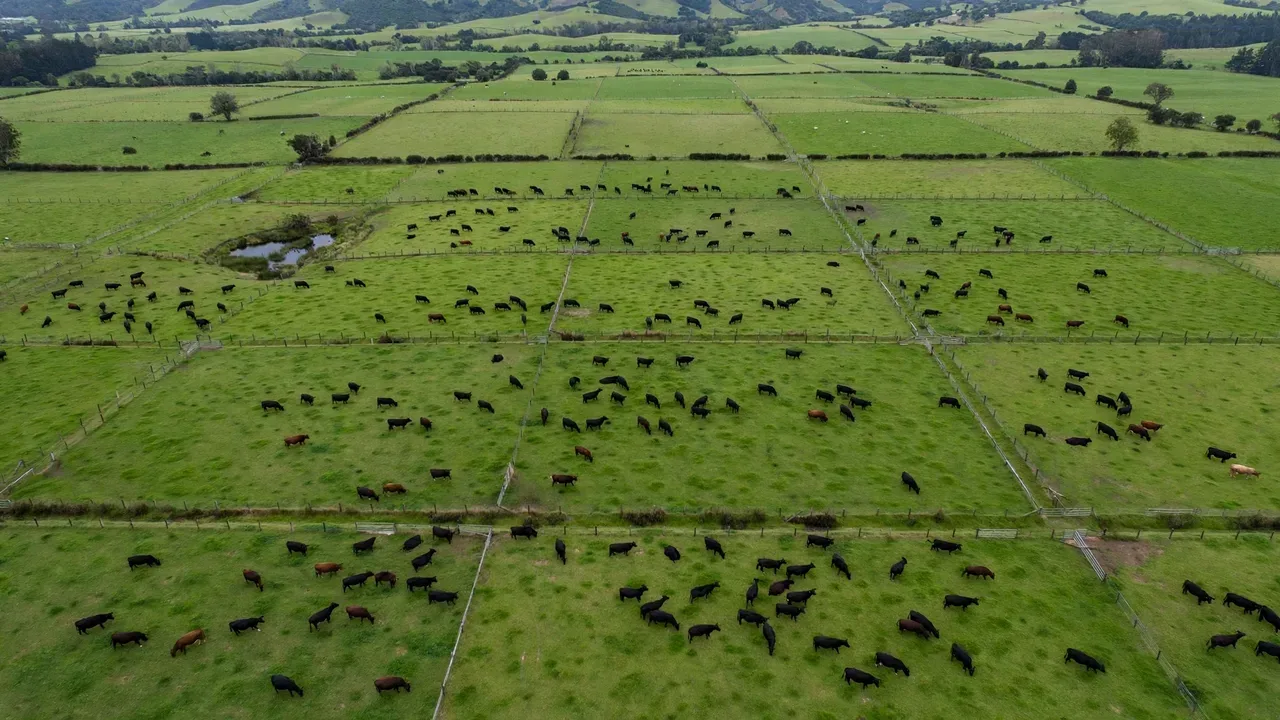
The right stocking rate depends on your pasture's forage production and your cows' intake. A 500 kg cow eats about 2.5% of body weight daily (12.5 kg dry matter). If your pasture produces 5,000 kg DM/ha/year, that supports about 1 cow per hectare (0.4 cows/acre). Use this as a starting point, then adjust for your specific conditions.
The Basic Formula
Stocking rate = Forage production (kg DM/ha) ÷ (Animal intake (kg DM/day) × grazing days) × utilization rate (50-60%).
The utilization rate is critical — you should never graze more than 50-60% of available forage. The rest maintains plant health, root reserves, soil cover, and future production. Overgrazing (utilization >70%) reduces pasture productivity by 30-50% within 2-3 years and leads to weed invasion and soil erosion.
Factors That Determine Carrying Capacity
Rainfall and Climate
Forage production is primarily driven by rainfall. General guidelines: Arid (<500 mm/year): 0.1-0.3 cows/ha. Semi-arid (500-800 mm): 0.3-0.8 cows/ha. Sub-humid (800-1200 mm): 0.8-1.5 cows/ha. Humid (>1200 mm): 1.5-3 cows/ha (with improved pasture). Irrigated pasture can support 2-5 cows/ha year-round. These are rough estimates — actual production varies with soil type, pasture species, and management.
Pasture Quality and Species
Not all forage is equal. Native rangeland produces 1,000-3,000 kg DM/ha with 6-8% crude protein. Improved pasture (ryegrass, clover, alfalfa) produces 8,000-15,000 kg DM/ha with 15-22% protein. Legume-based pastures (alfalfa, clover) fix nitrogen and have higher protein, supporting higher stocking rates and better animal performance. Toxic plants (tansy ragwort, locoweed) reduce effective forage availability.
Grazing System
Continuous grazing: utilization 30-40%, lower carrying capacity, uneven utilization (some areas overgrazed, others underutilized). Rotational grazing (4-8 paddocks): utilization 50-60%, higher carrying capacity, more uniform utilization. Intensive rotational/MOB grazing (12+ paddocks, 1-3 day moves): utilization 60-70%, highest carrying capacity, best pasture health, but requires more fencing and water infrastructure. Managed grazing can increase carrying capacity by 30-50% compared to continuous grazing on the same land.
Animal Type and Size
Stocking rates are often expressed in Animal Units (AU). 1 AU = 455 kg (1000 lb) cowith calf, consuming 12 kg DM/day. A 500 kg cow = 1.1 AU. A 600 kg cow = 1.3 AU. Yearlings = 0.7-0.8 AU. Sheep = 0.1-0.15 AU. Always calculate based on actual animal weight, not breed averages. Lactating cows eat 20-30% more than dry cows. Growing animals eat more per kg body weight than mature animals.
Practical Calculation Example
Farm: 20 hectares, 800 mm rainfall, improved ryegrass/clover pasture, rotational grazing (6 paddocks), 500 kg cows.
Step 1: Estimate forage production = 8,000 kg DM/ha/year (improved pasture, good rainfall).
Step 2: Available forage = 8,000 × 55% utilization = 4,400 kg DM/ha/year.
Step 3: Cow intake = 500 kg × 2.5% = 12.5 kg DM/day × 365 = 4,563 kg DM/year.
Step 4: Stocking rate = 4,400 ÷ 4,563 = 0.96 cows/ha (about 1 cow/ha or 0.4 cows/acre).
Step 5: Total herd = 20 ha × 0.96 = about 19 cows (with calves at foot).
Conservative approach: start at 80% of calculated rate (15 cows), monitor pasture condition, and increase gradually if pasturemains healthy.
Monitoring and Adjustment
Check pasture height weekly duringrowing season. Optimal grazing height: 15-25 cm pre-graze, 5-8 cm post-graze for ryegrass. If pastures are consistently below 5 cm post-graze, you are overstocked — reduce numbers or increase rest period. If pastures are consistently above 25 cm pre-graze and getting stemmy, you are understocked — increase numbers or cut hay/silage.
Keep records: monthly pasture growth rates, actual grazing days, animal weight gains, and hay/silage made. Use these to refine your stocking rate each year. The best managers treat stocking rate as a moving target, not a fixed number.
Related tools:Feed Ration Calculator for daily feed needs, Livestock Stocking Density for barn housing, Feed Conversion Ratio for efficiency tracking.
Frequently Asked Questions
Combien de vaches puis-je faire pâturer par acre de pâturage?
Les vaches par acre dépendent de la production fourragère, de la taille des vaches et du système de pâturage. Directives générales (pâturage continu, 50% d'utilisation): Pâturage amélioré (4 000–6 000 lb MS/acre/an): 0,15–0,25 vaches/acre = 4–6,5 acres/vache; Bon pâturage avec rotation (6 000–8 000 lb MS): 0,25–0,40 vaches/acre = 2,5–4 acres/vache; Excellent pâturage irrigué (8 000–12 000 lb MS): 0,40–0,60 vaches/acre = 1,7–2,5 acres/vache; Pâturage natif/non amélioré (1 500–3 000 lb MS): 0,05–0,15 vaches/acre = 7–20 acres/vache. Formule: Vaches/acre = (Rendement fourrager × 0,50 utilisation) ÷ (Consommation quotidienne de la vache × jours de pâturage). Une vache de 1 200 lb mange ~26 lb MS/jour. Un calculateur de charge donne des chiffres précis.
Qu'est-ce qu'un Équivalent d'Unité Animale (EUA) et comment l'utiliser?
Un Équivalent d'Unité Animale (EUA ou AUE) standardise la demande de pâturage selon différents types et tailles d'animaux. Une Unité Animale (UA) = vache de 1 000 lb avec veau, mangeant ~26 lb MS/jour. Multiplicateurs EUA: Vache de 1 200 lb = 1,2 EUA; Vache de 1 000 lb = 1,0 EUA; Vache de 800 lb = 0,8 EUA; Taureau = 1,3–1,5 EUA; Mouton (150 lb) = 0,15 EUA; Chèvre (120 lb) = 0,12 EUA; Cheval (1 000 lb) = 1,25 EUA (les chevaux paissent plus sélectivement). Pour calculer l'EUA total: Nombre d'animaux × EUA par animal. Exemple: 50 vaches en moyenne 1 200 lb = 50 × 1,2 = 60 EUA. Puis utilisez la production fourragère ÷ (EUA × consommation quotidienne × jours de pâturage) pour trouver les acres nécessaires. Un calculateur de densité gère les conversions EUA.
Comment le pâturage rotatif augmente-t-il la charge animale?
Le pâturage rotatif augmente la charge de 20–50% par rapport au pâturage continu car: (1) Le fourrage est utilisé plus uniformément — les animaux ne peuvent pas paître sélectivement les plantes préférées et laisser les moins désirables; (2) Les périodes de repos permettent aux plantes de repousser avant d'être repâturées, maintenant les réserves racinaires et la productivité; (3) Le fumier est distribué plus uniformément, améliorant la fertilité; (4) La qualité du fourrage est supérieure car les animaux paissent les plantes au stade de croissance optimal (pas trop mûres). Exemple: Pâturage continu à 50% d'utilisation à partir de 6 000 lb/acre = 3 000 lb disponibles; Pâturage rotatif à 65% = 3 900 lb disponibles — 30% de fourrage en plus pour le même pâturage. Cela signifie que vous pouvez élever 30% de bétail en plus sur la même terre. Un calculateur de rotation aide à concevoir le système.
Comment calculer le rendement fourrager pour les décisions de charge?
Méthodes pour estimer le rendement: (1) Coupe et pesée — coupez le fourrage d'un cadre de 1–2 pieds², séchez, pesez, multipliez par 43 560 pour obtenir lb/acre. Le plus précis mais laborieux; (2) Placomètre — mesurez la hauteur comprimée, utilisez une équation de calibration (ex., ray-grass: kg MS/ha = 140 × hauteur cm + 500); (3) Bâton de pâturage — estimation visuelle basée sur la hauteur et la densité; (4) Règle à pâturer — similaire au placomètre; (5) Télédétection — NDVI depuis des drones ou satellites pour les grandes surfaces. Pour la planification, utilisez des estimations historiques basées sur les précipitations: Rendement (lb MS/acre) = Précipitations annuelles (pouces) × 100–200 lb/pouce (pâturage amélioré) ou 50–100 lb/pouce (pâturage natif). Un calculateur de rendement aide à convertir les mesures. Échantillonnez plusieurs fois par saison — le rendement varie selon le mois.
Quelle intensité de pâturage (taux d'utilisation) dois-je utiliser?
Le taux d'utilisation est le pourcentage de fourrage disponible consommé par le bétail. Taux recommandés: Pâturage continu: 40–50% d'utilisation (laissez 50–60% pour la récupération); Pâturage rotatif: 55–65% d'utilisation (laissez 35–45%); Pâturage rotatif intensif/MIG: 60–70% d'utilisation (laissez 30–40%); Pâturage différé (période de repos): 0% pendant le repos, puis 50–60% au pâturage. Ne pâturez jamais en dessous de 2–3 pouces de chaume pour les graminées de saison fraîche — cela enlève trop de surface foliaire, affaiblit les racines et réduit la production future. Le surpâturage (utilisation >70%) réduit le rendement fourrager de 20–40% les années suivantes, permet l'invasion d'adventices et cause de l'érosion. Un calculateur de charge permet d'ajuster l'utilisation.
Comment planifier les lacunes fourragères saisonnières et la sécheresse?
La production fourragère n'est pas uniforme — les graminées de saison fraîche produisent 60–70% au printemps, avec une baisse estivale (juillet–août) et une repousse automnale. Stratégies de planification: (1) Fourrage stocké — différez le pâturage à la fin de l'été pour le pâturage automnal/hivernal (la fétuque stockée peut fournir 2 000–4 000 lb MS/acre); (2) Semez des annuelles de saison chaude (sorgho-soudan, millet perlé) pour le pâturage estival; (3) Semez des annuelles de saison fraîche (seigle, avoine, navets) pour le pâturage automnal/hivernal; (4) Maintenez des réserves de foin — gardez 1–2 tonnes de foin par vache comme aliment d'urgence; (5) Réduisez la charge proactivement en sécheresse — vendez ou réformez le bétail tôt plutôt que de surpâturer; (6) Utilisez un budget fourrager: calculez l'offre vs. la demande mensuelle, identifiez les lacunes 2–3 mois à l'avance. Un calculateur de rendement aide à projeter la production.