Stocking Rate: How Many Cows per Acre?
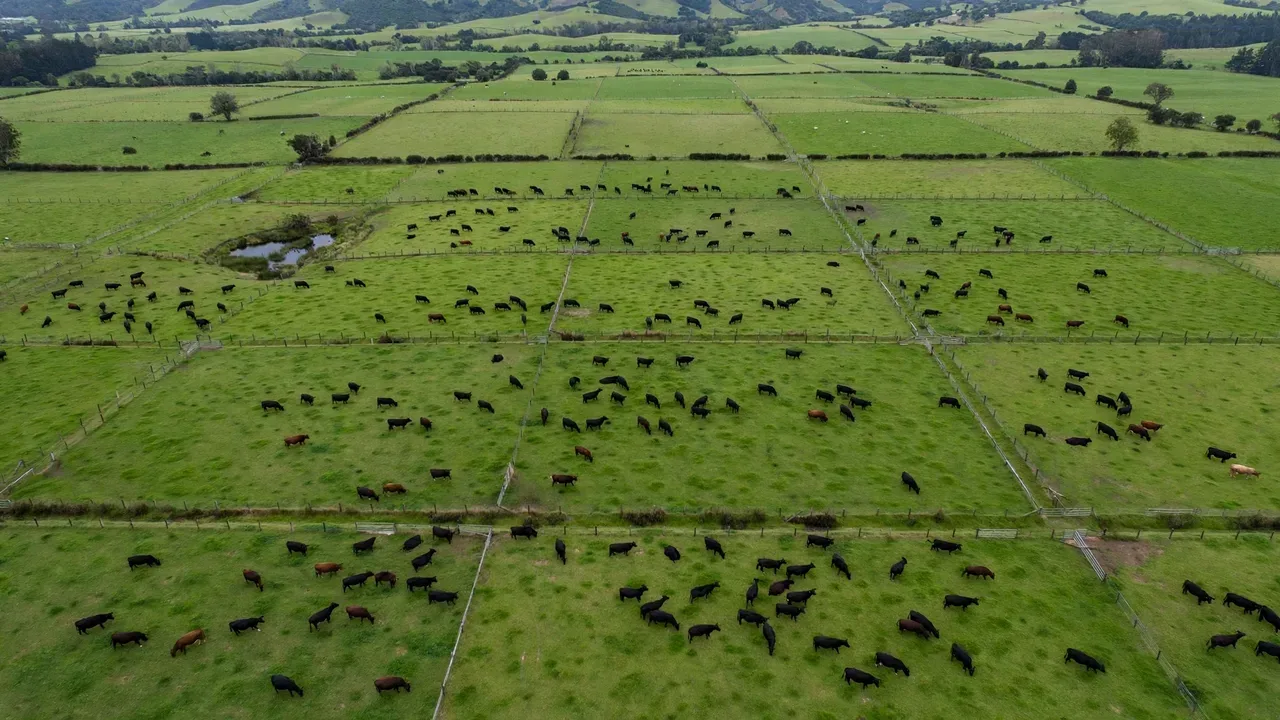
The right stocking rate depends on your pasture's forage production and your cows' intake. A 500 kg cow eats about 2.5% of body weight daily (12.5 kg dry matter). If your pasture produces 5,000 kg DM/ha/year, that supports about 1 cow per hectare (0.4 cows/acre). Use this as a starting point, then adjust for your specific conditions.
The Basic Formula
Stocking rate = Forage production (kg DM/ha) ÷ (Animal intake (kg DM/day) × grazing days) × utilization rate (50-60%).
The utilization rate is critical — you should never graze more than 50-60% of available forage. The rest maintains plant health, root reserves, soil cover, and future production. Overgrazing (utilization >70%) reduces pasture productivity by 30-50% within 2-3 years and leads to weed invasion and soil erosion.
Factors That Determine Carrying Capacity
Rainfall and Climate
Forage production is primarily driven by rainfall. General guidelines: Arid (<500 mm/year): 0.1-0.3 cows/ha. Semi-arid (500-800 mm): 0.3-0.8 cows/ha. Sub-humid (800-1200 mm): 0.8-1.5 cows/ha. Humid (>1200 mm): 1.5-3 cows/ha (with improved pasture). Irrigated pasture can support 2-5 cows/ha year-round. These are rough estimates — actual production varies with soil type, pasture species, and management.
Pasture Quality and Species
Not all forage is equal. Native rangeland produces 1,000-3,000 kg DM/ha with 6-8% crude protein. Improved pasture (ryegrass, clover, alfalfa) produces 8,000-15,000 kg DM/ha with 15-22% protein. Legume-based pastures (alfalfa, clover) fix nitrogen and have higher protein, supporting higher stocking rates and better animal performance. Toxic plants (tansy ragwort, locoweed) reduce effective forage availability.
Grazing System
Continuous grazing: utilization 30-40%, lower carrying capacity, uneven utilization (some areas overgrazed, others underutilized). Rotational grazing (4-8 paddocks): utilization 50-60%, higher carrying capacity, more uniform utilization. Intensive rotational/MOB grazing (12+ paddocks, 1-3 day moves): utilization 60-70%, highest carrying capacity, best pasture health, but requires more fencing and water infrastructure. Managed grazing can increase carrying capacity by 30-50% compared to continuous grazing on the same land.
Animal Type and Size
Stocking rates are often expressed in Animal Units (AU). 1 AU = 455 kg (1000 lb) cow with calf, consuming 12 kg DM/day. A 500 kg cow = 1.1 AU. A 600 kg cow = 1.3 AU. Yearlings = 0.7-0.8 AU. Sheep = 0.1-0.15 AU. Always calculate based on actual animal weight, not breed averages. Lactating cows eat 20-30% more than dry cows. Growing animals eat more per kg body weight than mature animals.
Practical Calculation Example
Farm: 20 hectares, 800 mm rainfall, improved ryegrass/clover pasture, rotational grazing (6 paddocks), 500 kg cows.
Step 1: Estimate forage production = 8,000 kg DM/ha/year (improved pasture, good rainfall).
Step 2: Available forage = 8,000 × 55% utilization = 4,400 kg DM/ha/year.
Step 3: Cow intake = 500 kg × 2.5% = 12.5 kg DM/day × 365 = 4,563 kg DM/year.
Step 4: Stocking rate = 4,400 ÷ 4,563 = 0.96 cows/ha (about 1 cow/ha or 0.4 cows/acre).
Step 5: Total herd = 20 ha × 0.96 = about 19 cows (with calves at foot).
Conservative approach: start at 80% of calculated rate (15 cows), monitor pasture condition, and increase gradually if pasturemains healthy.
Monitoring and Adjustment
Check pasture height weekly during growing season. Optimal grazing height: 15-25 cm pre-graze, 5-8 cm post-graze for ryegrass. If pastures are consistently below 5 cm post-graze, you are overstocked — reduce numbers or increase rest period. If pastures are consistently above 25 cm pre-graze and getting stemmy, you are understocked — increase numbers or cut hay/silage.
Keep records: monthly pasture growth rates, actual grazing days, animal weight gains, and hay/silage made. Use these to refine your stocking rate each year. The best managers treat stocking rate as a moving target, not a fixed number.
Related tools:Feed Ration Calculator for daily feed needs, Livestock Stocking Density for barn housing, Feed Conversion Ratio for efficiency tracking.
Frequently Asked Questions
How many cows can I graze per acre of pasture?
Cows per acre depends on forage production, cow size, and grazing system. General guidelines (continuous grazing, 50% utilization): Improved pasture (4,000–6,000 lb DM/acre/year): 0.15–0.25 cows/acre = 4–6.5 acres/cow; Good pasture with rotation (6,000–8,000 lb DM): 0.25–0.40 cows/acre = 2.5–4 acres/cow; Excellent irrigated pasture (8,000–12,000 lb DM): 0.40–0.60 cows/acre = 1.7–2.5 acres/cow; Native/unimproved pasture (1,500–3,000 lb DM): 0.05–0.15 cows/acre = 7–20 acres/cow. Formula: Cows/acre = (Forage yield × 0.50 utilization) ÷ (Cow daily DMI × grazing days). A 1,200 lb cow eats ~26 lb DM/day. A stocking rate calculator gives precise numbers for your conditions.
What is an Animal Unit Equivalent (AUE) and how do I use it?
An Animal Unit Equivalent (AUE) standardizes grazing demand across different animal types and sizes. One Animal Unit (AU) = 1,000 lb cow with calf, eating ~26 lb DM/day. AUE multipliers: 1,200 lb cow = 1.2 AUE; 1,000 lb cow = 1.0 AUE; 800 lb cow = 0.8 AUE; Bull = 1.3–1.5 AUE; Sheep (150 lb) = 0.15 AUE; Goat (120 lb) = 0.12 AUE; Horse (1,000 lb) = 1.25 AUE (horses graze more selectively). To calculate total AUE: Number of animals × AUE per animal. Example: 50 cows averaging 1,200 lb = 50 × 1.2 = 60 AUE. Then use forage production ÷ (AUE × daily DMI × grazing days) to find acres needed. A livestock density calculator handles AUE conversions.
How does rotational grazing increase stocking rate?
Rotational grazing increases stocking rate by 20–50% compared to continuous grazing because: (1) Forage is utilized more evenly — animals can't selectively graze preferred plants and leave less desirable ones; (2) Rest periods allow plants to regrow before being regrazed, maintaining root reserves and productivity; (3) Manure is distributed more evenly, improving fertility; (4) Forage quality is higher because animals graze plants at the optimal growth stage (not overmature). Example: Continuous grazing at 50% utilization from 6,000 lb/acre forage = 3,000 lb available; Rotational grazing at 65% utilization = 3,900 lb available — 30% more forage for the same pasture. This means you can run 30% more cattle on the same land. A pasture rotation calculator helps design the system.
How do I calculate forage yield for stocking rate decisions?
Methods to estimate forage yield: (1) Clip and weigh — cut forage from a 1–2 sq ft frame, dry, weigh, multiply by 43,560 to get lb/acre. Most accurate but labor-intensive; (2) Rising plate meter — measure compressed height, use a calibration equation (e.g., ryegrass: kg DM/ha = 140 × compressed height cm + 500); (3) Grazing stick — visual estimate based on sward height and density; (4) Pasture ruler — similar to plate meter; (5) Remote sensing — NDVI from drones or satellites for large areas. For planning, use historical estimates based on rainfall: Forage yield (lb DM/acre) = Annual rainfall (inches) × 100–200 lb/inch (improved pasture) or 50–100 lb/inch (native pasture). A forage yield calculator helps convert measurements to lb/acre. Sample multiple times per season — yield varies by month.
What grazing intensity (utilization rate) should I use?
Utilization rate is the percentage of available forage consumed by livestock. Recommended rates: Continuous grazing: 40–50% utilization (leave 50–60% for plant recovery); Rotational grazing: 55–65% utilization (leave 35–45%); Intensive rotational/MIG: 60–70% utilization (leave 30–40%); Deferred grazing (rest period): 0% during rest, then 50–60% when grazed. Never graze below 2–3 inches stubble height for cool-season grasses — this removes too much leaf area, weakens roots, and reduces future production. Overgrazing (utilization >70%) reduces forage yield by 20–40% in subsequent years, allows weed invasion, and causes soil erosion. A stocking rate calculator lets you adjust utilization to match your grazing system and recovery goals.
How do I plan for seasonal forage gaps and drought?
Forage production is not uniform — cool-season grasses produce 60–70% in spring, with a summer slump (July–August) and fall regrowth. Planning strategies: (1) Stockpile forage — defer grazing in late summer for fall/winter grazing (stockpiled fescue can provide 2,000–4,000 lb DM/acre); (2) Plant warm-season annuals (sorghum-sudangrass, pearl millet) for summer grazing; (3) Plant cool-season annuals (rye, oats, turnips) for fall/winter grazing; (4) Maintain hay reserves — keep 1–2 tons of hay per cow as emergency feed; (5) Reduce stocking rate proactively in drought — sell or cull cattle early rather than overgrazing; (6) Use a forage budget: calculate monthly forage supply vs. demand, identify gaps 2–3 months in advance. A forage yield calculator helps project production and plan for gaps.