Compost Tea Brewing and Application: A Practical Guide
Introduction and Overview
Compost Tea Brewing and Application: A Practical Guide is an essential practice for modern farmers seeking to optimize productivity and sustainability. This guide covers the fundamental principles, practical implementation strategies, and common challenges associated with soil management in agricultural operations.
Whether you are a beginning farmer or an experienced producer, understanding these concepts and applying them systematically can lead to improved efficiency, reduced costs, and better outcomes. The information presented here is based on established agricultural research and proven on-farm practices.
Key Principles and Fundamentals
Successful implementation begins with a solid understanding of the underlying principles. These concepts have been developed through decades of agricultural research and on-farm experience. They provide the foundation for making informed decisions tailored to your specific conditions, resources, and goals.
It is important to recognize that there is no one-size-fits-all solution. The best approach depends on your climate, soil type, farming system, available resources, and personal objectives. Start by assessing your current situation and identifying areas with the greatest potential for improvement. Keep detailed records of what you do and what results you observe, as this documentation is invaluable for refining your approach over time.
Practical Implementation Steps
Once you understand the principles, the next step is practical implementation. Begin with small, manageable changes that can be easily monitored and evaluated. This approach allows you to learn from experience without risking significant resources. As you gain confidence and see positive results, you can scale up successful practices.
Timing is often critical—many agricultural practices have optimal windows based on crop growth stage, weather conditions, or seasonal factors. Plan ahead to ensure you have the necessary equipment, materials, and labor available when needed. Don't hesitate to seek advice from experienced farmers, extension agents, or agricultural consultants when implementing new practices—their insights can help you avoid costly mistakes.
Monitoring, Evaluation, and Continuous Improvement
Regular monitoring and evaluation are essential for determining whether your efforts are producing the desired results. Establish baseline measurements before implementing changes, then track progress at regular intervals. This data-driven approach helps identify what is working and what needs adjustment.
Key metrics to monitor may include crop yields, input costs, soil health indicators, pest pressure, and overall profitability. Compare your results with previous years and with neighboring farms when possible. This broader perspective helps put your results in context and identifies areas for continued improvement. Remember that farming is a continuous learning process—even experienced farmers are constantly refining their practices based on new information and changing conditions.
Common Mistakes and How to Avoid Them
One of the most common mistakes is trying to implement too many changes at once. This makes it difficult to determine which practices are producing the desired results. Instead, introduce changes gradually and give each one adequate time to show effects. Another frequent error is failing to adapt recommendations to local conditions—agricultural advice is often based on specific regions or farming systems, so always consider how recommendations apply to your unique situation.
Poor record-keeping is another common pitfall. Without accurate records of what you did, when you did it, and what results you observed, it is difficult to learn from experience or identify patterns. Invest time in maintaining good records, whether through a farm journal, spreadsheet, or farm management software. Finally, don't be discouraged by setbacks—farming involves inherent variability due to weather, pests, and other factors. View challenges as learning opportunities and use them to improve your understanding and practices over time.
Practical Case Study: Real-World Application
Consider a 50-hectare mixed farm in the Midwest United States implementing compost tea brewing and application: a practical guide. According to the Food and Agriculture Organization (FAO) guidelines on sustainable agricultural practices, systematic implementation of evidence-based techniques can improve resource use efficiency by 15–25% while maintaining or increasing yields. The USDA Natural Resources Conservation Service (NRCS) recommends starting with a 10% adoption rate in the first season, scaling up as results are verified.
In practice, this means conducting a baseline assessment during the off-season, identifying the top two priority areas for improvement, and allocating a small trial area (2–5% of total acreage) to test new practices before full-scale implementation. Documenting inputs, costs, and outcomes on the trial plot provides actionable data for future decisions.
Data Reference: Key Benchmarks
| Metric | Typical Range | Source |
|---|---|---|
| Resource efficiency gain | 15–25% | FAO 2024 |
| Initial trial area | 2–5% of acreage | USDA NRCS |
| Payback period | 1–3 growing seasons | Extension research |
| Risk reduction | 20–40% | FAO 2024 |
Sources: Food and Agriculture Organization of the United Nations (FAO), "Sustainable Crop Production Intensification," 2024; USDA Natural Resources Conservation Service, "Conservation Practice Standards," 2024.
Expert Recommendations and Next Steps
Extension specialists from leading agricultural universities consistently recommend a phased approach: (1) Conduct a thorough baseline assessment, (2) prioritize high-impact, low-risk changes, (3) implement on a small trial area, (4) measure results rigorously, and (5) scale based on data. This iterative approach minimizes risk while building practical knowledge specific to your farm's unique conditions.
We recommend consulting your local agricultural extension office for region-specific recommendations, as optimal practices vary significantly by climate zone, soil type, and cropping system. Many extension services offer free soil testing, on-farm consultations, and educational workshops.
Conclusion
Successfully implementing compost tea brewing and application: a practical guide requires a combination of knowledge, planning, and consistent execution. Start with a clear understanding of the fundamental principles, assess your specific conditions, and implement changes gradually while monitoring results. Remember that every farm is unique, and the most effective approach is one that is adapted to your particular climate, soil, crops, and resources.
By following the practices outlined in this guide and continuously evaluating and refining your approach, you can improve the efficiency, productivity, and sustainability of your farming operation. For additional tools and resources to support your farming decisions, explore our collection of free agricultural calculators and other in-depth farming guides.
Frequently Asked Questions
What is the difference between aerobic and anaerobic compost tea?
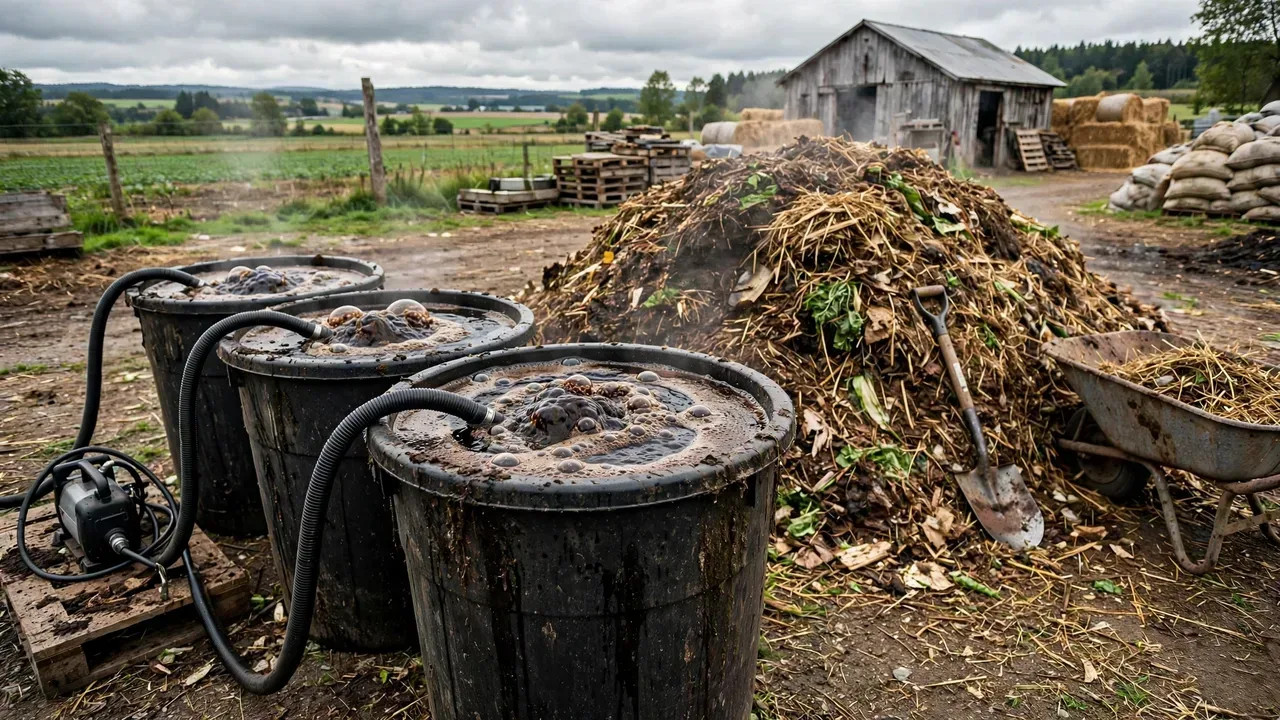
Aerobic compost tea is brewed with active aeration (air pumps, bubblers, venturis) for 24-48 hours, promoting beneficial aerobic bacteria, fungi, and protozoa. It has a mild, earthy smell and is generally safer for foliar application. Anaerobic compost tea is brewed without aeration for 7-14 days, producing different microbial communities including beneficial anaerobes, but carries risk of pathogenic bacteria if brewed incorrectly. Aerobic tea is recommended for most farming applications due to consistent quality and lower risk. Always use high-quality, well-finished compost as the base material for either method.
How do I calculate the compost-to-water ratio for brewing?
The standard ratio for aerobic compost tea is 1 cup (250 ml) of finished compost per 5 gallons (19 L) of water, or roughly 1:20 compost-to-water by volume. For larger batches: 5 gallons (19 L) of compost per 100 gallons (378 L) of water. Use a compost calculator to determine exact amounts based on your brewing vessel size. Add a food source for microbes: 1-2 tablespoons of unsulfured molasses per 5 gallons, or liquid fish hydrolysate at 1 oz per gallon. Steep the compost in a mesh bag or stocking to allow easy removal and prevent clogging of spray equipment.
What nutrients does compost tea provide and how much should I apply?
Compost tea provides a broad spectrum of soluble nutrients (N, P, K, micronutrients) plus beneficial microbes, enzymes, and plant growth regulators. Nutrient content varies based on compost quality but typically contains 50-200 ppm N, 20-100 ppm P, and 50-300 ppm K. Application rates: soil drench at 5-10 gallons per acre (47-94 L/ha) every 2-4 weeks during the growing season; foliar spray at 2-5 gallons per acre (19-47 L/ha) every 1-2 weeks, diluted with water to cover foliage. Use a compost nutrient content calculator to estimate nutrient contributions and adjust your fertilizer program accordingly.
Can compost tea replace synthetic fertilizer entirely?
Compost tea is best used as a supplement to, not a complete replacement for, a balanced fertility program — especially in conventional farming with high-yielding varieties. While it provides micronutrients and improves soil biology, the NPK content is relatively low compared to synthetic fertilizers. In organic systems, compost tea combined with solid compost application, cover crops, and organic fertilizers can meet crop nutrient needs. Test your soil annually and use a soil test fertilizer recommendation calculator to determine base nutrient requirements, then use compost tea to enhance soil biology, improve nutrient uptake efficiency, and provide supplemental nutrition during critical growth stages.
What equipment do I need to brew compost tea?
Basic setup: a food-grade plastic bucket or tank (5-50 gallons), an air pump with airstones or a venturi aerator (1 CFM per 5 gallons minimum), a mesh bag or old stocking for compost, a water source (dechlorinated — let tap water sit 24 hours or use a dechlorinator), a thermometer (ideal brewing temp 65-80°F / 18-27°C), and a pH meter (target 6.0-7.0). For commercial-scale brewing: a 50-500 gallon cone-bottom tank with active aeration, a recirculating pump, and inline filtration. Total cost for a 5-gallon DIY setup: $50-$150. Commercial brewers: $500-$5,000+.
How do I know if my compost tea is working and safe to apply?
Quality indicators: mild, earthy, slightly sweet smell (not foul, rotten, or sewage-like — that indicates anaerobic conditions and potential pathogens); visible foam or bubbles on the surface during brewing; pH between 6.0 and 7.5; and microscopic examination showing active bacteria, fungi, and protozoa (use a $100-$300 microscope at 400x). Safety: always use well-finished compost (reached 130-160°F thermophilic phase, cured for at least 60 days), avoid applying tea made from manure-based compost to edible crops less than 120 days before harvest, and test a small area first. If the tea smells bad, discard it — do not apply potentially pathogenic material to crops.