No-Till Farming: Benefits, Transition, and Equipment
No-till farming means planting crops without disturbing the soil through tillage. Instead, seeds are placedirectly through crop residue or cover crop mulch using a no-till drill. Benefits include 80-90% less erosion, 1-2% higher organic matter over 5 years, 50% less fuel use, better water infiltration, and lower labor requirements. The transition takes 3-5 years and requires careful management of residue, weeds, and fertility.
What Is No-Till Farming?
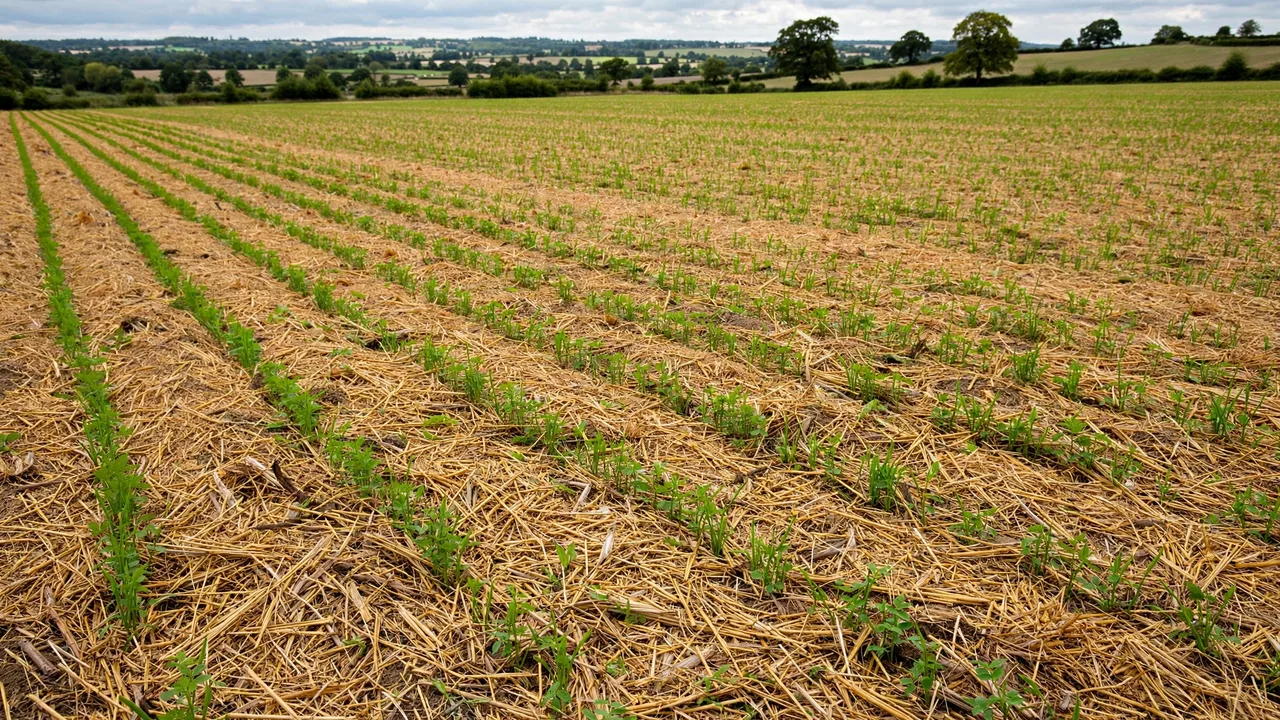
No-till (also called zero-till or direct drilling) is a farming system where the soil is never inverted or disturbed. Instead of plowing, disking, or chiseling, seeds are placedirectly into undisturbed soil through a thin slit or slot opened by a no-till drill. The soil surface remains covered by crop residue from the previous crop or a cover crop mulch.
No-till is not just "not plowing" — it is a complete system that includes: permanent soil cover (residue or cover crops), diverse crop rotations, minimal soil disturbance, and integrated nutrient and pest management. No-till without residue cover is just "direct seeding into bare soil" and loses most of the benefits.
Benefits of No-Till
Soil Erosion Control
This is the biggest and most immediate benefit. Crop residue on the soil surface absorbs the impact of raindrops, slows runoff, and holdsoil particles in place. USDA data shows no-till reduces water erosion by 80-90% and wind erosion by 70-80% compared to conventional tillage. On sloping fields, the difference can be tons of topsoil saved per acre per year.
Soil Organic Matter
Tillage oxidizes soil organic matter — every time you plow, you release carbon as CO2. No-till stops this loss and, with residue additions, gradually builds organic matter. Research shows 0.5-1% organic matter increase over 5-10 years in no-till systems. Each 1% increase in organic matter adds about 20,000 gallons per acre of water-holding capacity and 20 lb/acre of plant-available N through mineralization.
Water Management
No-till soils have better structure, more earthworms channels, and more macropores — all of which improve water infiltration. Studies show no-till fields can absorb 1-3 inches more rain per hour than tilled fields. This means less runoff, more water stored in the soil profile, and better drought resistance. In dry years, no-till crops often yield 5-15% better than tilled crops because of better water availability.
Fuel and Labor Savings
| Operation | Conventional Tillage | No-Till | Savings |
|---|---|---|---|
| Primary tillage (plow/chisel) | 1-2 passes | 0 passes | $15-30/acre |
| Secondary tillage (disk/field cult.) | 1-2 passes | 0 passes | $10-20/acre |
| Planting | 1 pass | 1 pass (no-till drill) | — |
| Total fuel (gal/acre) | 5-8 | 2-3 | 3-5 gal/acre |
| Total labor (hrs/acre) | 1.5-2.5 | 0.5-1.0 | 1-1.5 hrs/acre |
At $3.50/gallon diesel and $20/hour labor, the savings add up to $40-80/acre per year. This often pays for the no-till drill (which costs $30,000-80,000) in 3-5 years. Custom no-till planting services charge $15-25/acre, which is still cheaper than doing all the tillage passes yourself.
The Transition Period (Years 1-3)
The transition to no-till is the hardest part. In the first 1-3 years, you may see:
- Cooler, wetter soils in spring: Residue insulates the soil, keeping it 2-5°F cooler in spring. This can delay planting and early growth, especially in northern climates. Solutions: plant later, use row cleaners on the planter to move residue away from the seed row, or use strip-till as a transition system.
- Weed shifts: Tillage kills weeds and buries weed seeds. No-till allows weeds to germinate on the soil surface. You may see more annual grasses and small-seeded broadleaves initially. Solutions: use cover crops for weed suppression, diversify herbicide modes of action, and consider occasional strategic tillage (once every 3-5 years) for hard-to-control weeds.
- Nitrogen tie-up: Residue decomposition by microbes temporarily immobilizes nitrogen. This most noticeable with high C:N residue like corn stalks or cereal rye. Solutions: apply 20-40 lb/acre extra N at planting, place N below the residue layer, or use legume cover crops to add N.
- Uneven stands: No-till requires precise planting depth and good seed-to-soil contact. Residue can interfere with seed placement. Solutions: invest in a good no-till drill with down-pressure, row cleaners, and depth gauges; check seed depth frequently; plant when soil moisture is optimal (not too wet or too dry).
Most farmers see a 5-15% yield dip in year 1, recovery to conventional yields by year 2-3, and yield advantages by year 3-5. The key is to stick with it — the soil improves every year, and the system gets easier and more productive over time.
No-Till Equipment
No-Till Drill / Planter
This is the most critical piece of equipment. A good no-till drill needs:
- Heavy down-pressure: 200-500 lbs per row unito cut through residue and penetrate undisturbed soil
- Row cleaners: To move residue away from the seed row (especially for corn in corn residue)
- Depth gauges: Precise depth control (1.5-2 inches for corn, 1-1.5 inches for soybeans)
- Seed firming wheels: To ensure good seed-to-soil contact in the slot
- Fertilizer opener: For placing starter fertilizer below and beside the seed
New no-till drills cost $30,000-80,000 (15-30 ft width). Used drills in good condition cost $15,000-40,000. Custom planting services charge $15-25/acre. If you have less than 200 acres, custom hiring or sharing equipment with neighbors may be more economical than buying.
Sprayer
In no-till, herbicides replace tillage for weed control. A good sprayer is essential. Features to look for:
- 60-90 ft boom width for field efficiency
- GPS guidance for accurate application and reduced overlap
- Section control (auto on/off) to save chemical and prevent overlaps
- 10-20 gallon/acre spray volume for good coverage
- Air induction or drift reduction nozzles
Roller-Crimper (Organic No-Till)
For organic no-till systems, a roller-crimper kills cover crops mechanically without herbicides. It works best with cereal rye at flowering stage (anthesis). The roller crimps the stems, killing the plant and creating a thick mulch mat. Cost: $3,000-8,000 for a 10-15 ft roller. Best for 30-inch row crops (corn, soybeans, vegetables) where the mulch suppresses weeds between rows.
Crop Rotation for No-Till
Diverse crop rotations are even more important in no-till than in tilled systems. Rotations:
- Break pest cycles: Corn rootworm, soybean cyst nematode, and other pests build up in monocultures
- Diversify residue: Different C:N ratios (corn = high C:N, soybean = low C:N) balance N immobilization/mineralization
- Spread workload: Different planting/harvest timings reduce peak labor needs
- Improve weed management: Different crops allow different herbicide modes of action and planting dates
Recommended rotations:
- Corn-Soybean (2-year): Most common, but becoming less diverse. Add wheat or cover crops for better results.
- Corn-Soybean-Wheat (3-year): Excellent rotation. Wheat allows double-crop soybeans or cover crops. Breaks pest cycles better than 2-year.
- Corn-Soybean-Wheat-Alfalfa (4-year): Best for soil health. Alfalfa (perennial legume) adds 2-3 years of no-till-friendly cover and deep roots. Highest organic matter gains.
- Diverse vegetable rotation: Include warm-season (tomato, pepper), cool-season (lettuce, broccoli), root crops (carrot, potato), and cover crops.
No-Till + Cover Crops = Synergy
No-till and cover crops are a powerful combination. No-till keeps the soil undisturbed, and cover crops keep it covered. Together they:
- Maximize erosion control (90%+ reduction)
- Build organic matter faster (residue + roots + no oxidation)
- Suppress weeds without herbicides (mulch effect)
- Improve water infiltration and storage
- Provide nitrogen (legume cover crops)
- Create habitat for beneficial insects and earthworms
The combination is so effective that many no-till farmers say they would not go back to tillageeven if cover crops were not available. The soil becomes darker, softer, more porous, and more productivevery year.
References
Plan your no-till transition: Use our Fertilizer Calculator to adjust N rates for residue tie-up, Seed Rate Calculator for cover crop seeding, Date Calculator for planting schedules, and our Cover Cropping Guide for cover crop selection.
Is No-Till Right for You?
No-till works well for:
- Row crop farmers (corn, soybeans, wheat, cotton)
- Vegetable growers with appropriate equipment
- Farmers with erosion-prone soils (sloping, sandy, low organic matter)
- Farmers looking to reduce fuel and labor costs
- Farmers willing to invest in equipment and learn new management skills
No-till may be challenging for:
- Very poorly drained soils (residue keeps soils wetter)
- Northern climates with short growing seasons (cooler soils delay planting)
- Farmers with heavy weed pressure (especially perennial weeds like bindweed)
- Root crops that require loose, tilled soil (carrots, potatoes, onions)
- Farmers unwilling to invest in no-till equipment or custom services
If you are unsure, start with strip-till (tilling only a 6-8 inch strip where seeds are planted) as a transition system. Strip-till gives you the warmer, tilled seed zone of conventional tillage withe residue cover and soil conservation of no-till. Many farmers use strip-till for 2-3 years before transitioning to full no-till.
Frequently Asked Questions
What is no-till farming and how does it differ from conventional tillage?
No-till farming leaves the soil undisturbed from harvest to planting, with seeds placed directly through crop residue using a no-till drill or planter. Conventional tillage uses plows, disks, and cultivators to turn over and break up the soil, burying residue and creating a fine seedbed. No-till preserves soil structure, increases organic matter, reduces erosion by 90%+, and conserves moisture. The tradeoff is higher reliance on herbicides for weed control (especially in the transition years) and the need for specialized planting equipment that can cut through residue.
How long does it take to see benefits from no-till farming?
No-till benefits accumulate over time. Year 1–2: reduced erosion and fuel savings (50–70% less fuel), but yields may be 5–10% lower due to weed pressure, cooler soils, and nutrient tie-up in residue. Year 3–5: soil organic matter increases 0.1–0.3% per year, earthworm populations multiply, water infiltration improves, yields recover to match or exceed conventional. Year 5+: significant soil health improvements, reduced input costs, drought resilience, and carbon sequestration benefits. Patience is critical — the transition period is the biggest barrier to adoption.
How do I manage weeds in a no-till system?
Weed management in no-till relies on multiple strategies: (1) Cover crops — dense growing cover crops suppress weeds by competition and allelopathy (cereal rye is especially effective); (2) Crop rotation — rotating between warm- and cool-season crops prevents weed adaptation; (3) Residual herbicides — apply pre-emergence herbicides at planting for season-long control; (4) Burndown herbicides — kill existing vegetation before planting (glyphosate, paraquat); (5) High-residue cultivation — row cultivators that work between rows without disturbing the seed row; (6) Harvest weed seed control — chaff carts, seed destructors, or narrow windrow burning to prevent weed seed return. Avoid over-reliance on a single herbicide mode of action to prevent resistance.
What cover crops work best in a no-till system?
Top cover crops for no-till: (1) Cereal rye — most popular, excellent biomass production (3–5 tons/acre), winter-hardy, effective weed suppression via allelopathy, easy to terminate; (2) Hairy vetch — nitrogen fixer (80–150 lb N/acre), winter-hardy legume, excellent for following corn; (3) Crimson clover — nitrogen fixer (70–120 lb N/acre), good biomass, attractive to pollinators; (4) Radishes/turnips — deep taproots break up compaction, scavenge nutrients, winter-kill (no termination needed); (5) Oats — quick growth, weed suppression, winter-kill in cold climates. Use mixes (e.g., rye + vetch + radish) for multiple benefits. A cover crop calculator helps select species and seeding rates.
How do I set up and calibrate a no-till drill?
No-till drill setup is critical for successful planting through residue. Key steps: (1) Set down pressure — enough to cut through residue and place seed at consistent depth (typically 100–200 lb per opener unit); (2) Set seeding depth — 1–1.5 inches for corn, 0.5–1 inch for soybeans, 0.25–0.5 inch for small grains; (3) Set row cleaners — move residue away from the seed row without removing too much soil; (4) Calibrate seed metering — run the drill stationary, collect seed from each opener, verify rate per acre; (5) Check seed-to-soil contact — press wheels should firm soil around seed. A seed drill calibration calculator helps determine the correct settings for your seed size and target population.
What are the economic benefits of no-till farming?
No-till reduces costs significantly: (1) Fuel savings — 50–70% less diesel (no plowing, disking, cultivating), saving $10–25/acre; (2) Labor savings — fewer field operations, 30–50% less labor time; (3) Machinery savings — less wear on tillage equipment, fewer tractor hours; (4) Soil health dividends — improved water holding capacity reduces irrigation needs, increased organic matter reduces fertilizer requirements over time; (5) Erosion prevention — avoids topsoil loss that would require costly remediation. Potential costs: no-till drill purchase ($30,000–80,000), higher herbicide costs in transition years, possible yield drag in first 2–3 years. A farm budget calculator helps compare no-till vs. conventional economics.