Greenhouse Management: Temperature, Humidity, and Ventilation
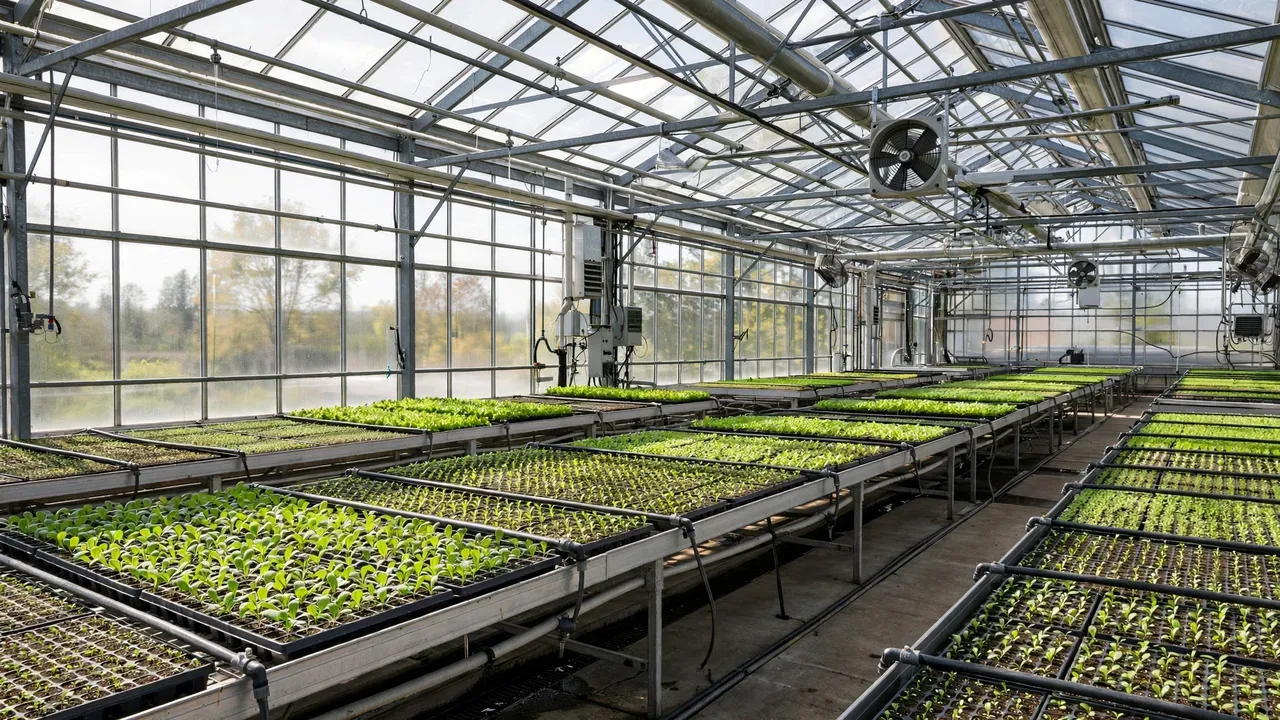
Greenhouse management requires precise control of temperature, humidity, ventilation, irrigation, and CO2 to maximize crop growth and minimize disease. Optimal conditions vary by crop: tomatoes prefer 70-85°F (21-29°C) days and 60-65°F (15-18°C) nights with 60-70% RH; lettuce prefers 60-70°F (15-21°C) with 70-80% RH. This guide covers the key management areas and practical strategies for success.
Temperature Management
Day and Night Temperature Setpoints
| Crop | Day Temp (°F/°C) | Night Temp (°F/°C) | DIF |
|---|---|---|---|
| Tomato | 70-85 / 21-29 | 60-65 / 15-18 | +10-20 |
| Pepper | 75-85 / 24-29 | 62-68 / 17-20 | +10-18 |
| Cucumber | 75-85 / 24-29 | 65-70 / 18-21 | +10-15 |
| Lettuce | 60-70 / 15-21 | 50-55 / 10-13 | +10-15 |
| Strawberry | 65-75 / 18-24 | 50-55 / 10-13 | +15-20 |
| Herbs (basil) | 70-80 / 21-27 | 60-65 / 15-18 | +10-15 |
| Seedlings (general) | 70-75 / 21-24 | 65-70 / 18-21 | +5-10 |
DIF (Difference) is the difference between day and night temperature. Positive DIF (warmer days) promotes stem elongation; negative DIF (cooler days) reducestretch. For seedlings, use a small positive DIF (+5°F) to promote moderate growth. For finished plants, use a larger DIF to control height. Use our Temperature Calculator to convert between Fahrenheit and Celsius.
Heating Systems
- Unit heaters (gas/propane): Most common for small to medium greenhouses. $500-2,000 per unit. Mount near air inlets for good distribution. Use poly tube (perforated tubing) for even heat distribution.
- Central boiler (hot water): Best for large operations. $10,000-50,000+. Heats water circulated through fin tubes or radiant floor. More efficient and uniform than unit heaters. Can use wood, coal, gas, or biomass fuel.
- Radiant (infrared) heaters: Heat objects (plants, soil) directly rather than air. More efficient for tall crops or spot heating. $300-1,000 per unit.
- Heat mats (seedlings): Electric heating mats under seedling trays. $20-100 per mat. Maintains 75-85°F root zone for faster germination. Essential for seed starting in cool climates.
Heating cost is the largest operating expense for greenhouses in cold climates. Typical heating fuel use: 1-2 gallons of propane per square foot per heating season (northern US). At $2.50/gallon, a 1,000 sq ft greenhouse costs $2,500-5,000 per winter. Reduce heating costs with: double-layer poly with inflation (30% savings), thermal blankets (20-40% savings at night), north wall insulation, and proper weatherstripping.
Cooling Systems
- Natural ventilation (roof + side vents): Cheapest and most energy-efficient. Works well in mild climates. Open roof vents (hot air escapes) and side vents (cool air enters). Need vent area = 15-20% of floor area.
- Fan and pad cooling: Most effective for hot climates. Exhaust fans pull air through wet cellulose pads, cooling air by 10-20°F through evaporation. $2,000-10,000 for system. Works best in dry climates (less effective in high humidity).
- Shade cloth: Reduces solar radiation by 30-70%. $0.50-2.00/sq ft. External shade is more effective than internal (heat stays outside). Use 30-50% shade for most crops, 50-70% for shade-loving plants (orchids, ferns).
- Fogging/misting: Fine water droplets evaporate quickly, cooling air. $1,000-5,000 system. Works in dry climates. Can increase humidity too much in humid climates.
Humidity Management
Humidity is the most overlooked and most critical factor in greenhouse disease management. High humidity (>85% RH) creates ideal conditions for fungal diseases (botrytis, powdery mildew, downy mildew). Low humidity (<40% RH) causes water stress and poor growth.
Optimal Humidity Ranges
| Crop/Stage | Day RH (%) | Night RH (%) | Critical Threshold |
|---|---|---|---|
| Seedlings (germination) | 70-80 | 70-80 | 85% = damping-off |
| Vegetative growth | 60-70 | 65-75 | 80% = disease risk |
| Flowering/fruiting | 55-65 | 60-70 | 75% = botrytis risk |
| Lettuce/leafy greens | 65-75 | 70-80 | 85% = bottom rot |
| Tomato/pepper | 55-65 | 60-70 | 75% = botrytis/leaf mold |
| Cucumber | 60-70 | 65-75 | 80% = powdery mildew |
Strategies to Reduce Humidity
- Ventilation: The most effective method. Exchange moist inside air with drier outside air. Ventilate when outside humidity is lower than inside (usually daytime). Even in winter, short ventilation bursts (10-15 minutes at midday) remove excess moisture.
- Heat before venting: Heating air increases its moisture-holding capacity. Warm the greenhouse 5-10°F before opening vents — this reduces relative humidity even before air exchange.
- Avoid evening watering: Water in the morning so foliage dries before night. Wet foliage at night = disease.
- Use drip irrigation: Drip irrigation keeps water at root zone, not on foliage. Reduces humidity by 10-20% compared to overhead sprinklers.
- Horizontal airflow (HAF) fans: Circulate air continuously to prevent humidity stratification and cold spots. $50-150 per fan. One fan per 1,000-2,000 sq ft. Run 24/7 at low speed.
- Dehumidifiers: For sealed greenhouses or very humid climates. $1,000-5,000 unit. Removes water from air directly. Most energy-efficient way to control humidity in winter (no heat loss from ventilation).
- Plant spacing: Crowded plants create humid microclimates. Follow recommended spacing, prune lower leaves, and use trellising to improve air movement through the canopy.
Dew Point — The Critical Number
Dew point is the temperature at which air becomes saturated (100% RH) and condensation begins. When leaf temperature drops below dew point, water condenses on leaves — this is when fungal spores germinate and infect. Use our Temperature & Humidity Calculator to calculate dew point from temperature and RH.
Management rule: Never let leaf temperature drop below dew point. In practice, this means: maintain night temperature 2-3°F above dew point, ventilate before sunset to remove moisture, and use HAF fans to prevent cold spots on leaves. A data logger that records temperature and RH every 15 minutes ($50-200) is the best investment for humidity management — it shows you exactly when dew point is reached and helps you fine-tune your ventilation strategy.
Ventilation Management
Ventilation serves three purposes: temperature control, humidity control, and CO2 replenishment. A well-ventilated greenhouse has air completely exchanged every 1-3 minutes during active growth.
Natural Ventilation
- Roof vents: Hot airises and escapes through roof vents. Most effective for cooling. Should be 10-15% of floor area.
- Side/roll-up walls: Cool air enters at sides, creates cross-ventilation. Should be 15-20% of floor area. Roll-up sides are common in hoop houses.
- Chimney effect: Hot air escaping roof vents creates negative pressure, pulling cool air in through side vents. Works best when both roof and side vents are open.
- Wind effect: Wind creates pressure differences that drive air exchange. Position greenhouse perpendicular to prevailing summer winds for best cross-ventilation.
Mechanical Ventilation
- Exhaust fans: Pull air out of greenhouse, creating negative pressure. Air enters through louvers on opposite end. Fan capacity = 8-10 cfm per sq ft of floor area. $200-800 per fan (36-48 inch).
- Intake louvers: Allow air entry when fans are on, close when off. Must be properly sized (same area as fan capacity). $100-500 per louver.
- HAF (horizontal airflow) fans: Circulate air inside greenhouse, preventing stratification. 1/10-1/15 hp fans, mounted 6-8 ft high, pointing along the greenhouse length. Run continuously at low speed.
Ventilation Schedule
| Time/Condition | Action | Goal |
|---|---|---|
| Early morning (sunrise) | Open vents slightly | Remove overnight moisture |
| Mid-morning (temp rising) | Open vents wider | Prevent overheating, maintain setpoint |
| Midday (hot) | Full ventilation + shade | Keep temp below 85-90°F |
| Afternoon (cooling) | Gradually close vents | Conserve heat for night |
| Evening (sunset) | Close vents, heat if needed | Maintain night temp, prevent dew |
| Cloudy/cool days | Minimal ventilation | Conserve heat, brief moisture removal |
Use our Greenhouse Ventilation Calculator to calculate required ventilation rates and durations based on your greenhouse volume, temperature difference, and humidity.
Irrigation Management
Water Quality
Greenhouse crops are sensitive to water quality. Test your water source annually for:
- pH: Optimal 5.5-6.5 for soilless media, 6.0-7.0 for soil. High pH causes micronutrient (Fe, Mn, Zn) deficiency. Low pH causes calcium/magnesium deficiency.
- EC (electrical conductivity): Measures dissolved salts. <1.0 mS/cm = good, 1.0-2.0 = acceptable for tolerant crops, >2.0 = problematic (salt buildup).
- Alkalinity: Measures bicarbonate/carbonate. High alkalinity (>150 ppm CaCO3) raises media pH over time. Neutralize with acid (sulfuric, phosphoric, nitric).
- Specific ions: Sodium (Na), chloride (Cl), boron (B), fluoride (F) can be toxic at high levels. Sodium >50 ppm or chloride >70 ppm can damage sensitive crops.
Irrigation Methods
- Drip irrigation: Most common and efficient. Emitters deliver water directly to root zone. 90-95% efficiency. Use pressure-compensating emitters for uniform distribution. Flush lines monthly.
- Ebb and flow (flood floor): Bench or floor floods with nutrient solution, then drains. Excellent for potted plants. 95%+ efficiency. Allows precise watering and nutrient recycling.
- Nutrient Film Technique (NFT): Thin film of nutrient solution flows through channels where roots grow. Used for lettuce and herbs. Very efficient but high maintenance.
- Overhead sprinklers: Simple but inefficient (70-80%). Wets foliage (disease risk). Only for seed germination or certain crops.
- Hand watering: For small operations or individual plants. Labor-intensive, inconsistent.
When and How Much to Water
The golden rule: water when plants need it, not on a fixed schedule. Signs plants need water:
- Media surface is dry 1-2 inches deep (stick finger in media)
- Pot feels light when lifted
- Plants show slight wilting at midday (recover by evening = mild stress; don't recover = severe stress)
- Media EC is rising (salt buildup from under-watering)
Water thoroughly until water drains from bottom of pot (10-20% leaching fraction). This preventsalt buildup. Water in the morning so foliage dries before night. In hot, sunny weather, plants may need water twice daily. In cool, cloudy weather, once every 2-3 days may be enough. Use a moisture meter ($20-50) or data logger to track media moisture and remove guesswork.
CO2 Enrichment
Ambient CO2 is ~420 ppm. Greenhouse crops can benefit from CO2 enrichmento 800-1,200 ppm, increasing photosynthesis and yield by 10-30%. CO2 enrichment is most beneficial when vents are closed (winter, early morning, late afternoon) and light levels are high (>5,000 foot-candles).
CO2 Sources
- Natural gas/propane burner: Most common. Burns fuel to produce CO2 and heat. $500-2,000 per burner. Produces ~1 lb CO2 per cubic foot of gas. Must have proper ventilation and combustion (no ethylene or CO).
- Liquid CO2 tank: Pure CO2 from compressed liquid. $200-500 for regulator + tank. Clean, no combustion byproducts. Refill cost $0.20-0.50/lb. Best for small greenhouses or when heat is not needed.
- Compost/organic matter: Decomposing organic matter releases CO2. Free but inconsistent. Place compost piles near air intake (outside greenhouse, not inside — can introduce pests and odors).
CO2 Management Tips
- Enrich only when light >5,000 fc and vents are closed (no benefit when vents are open — CO2 escapes)
- Maintain 800-1,200 ppm (above 1,500 ppm can cause injury; above 5,000 ppm is dangerous to humans)
- Use a CO2 controller/monitor ($200-800) to maintain setpoint automatically
- Ensure adequate air circulation (HAF fans) to distribute CO2 evenly
- Turn off CO2 30-60 minutes before opening vents to avoid waste
Integrated Pest Management (IPM) in Greenhouses
Greenhouses create ideal conditions for pests — warm, humid, sheltered, and continuous food supply. IPM combines multiple strategies to keep pests below damaging levels while minimizing pesticide use.
Monitoring
- Yellow sticky cards: Trap flying insects (whiteflies, aphids, fungus gnats, thrips). Place 1 card per 1,000 sq ft, just above crop canopy. Check weekly, count and identify pests. Replacevery 4-6 weeks.
- Blue sticky cards: More attractive to thrips. Use alongside yellow cards.
- Regular plant inspection: Check undersides of leaves, stem tips, and flowers weekly. Look for pests, damage, and disease symptoms. Focus on "hot spots" near vents, doors, and fans.
- Indicator plants: Place susceptible plants (eggplant for whiteflies, marigolds for thrips) throughout greenhouse to detect pests early.
Biological Control (Beneficial Insects)
| Pest | Beneficial Insect | Rate | Cost |
|---|---|---|---|
| Whiteflies | Encarsia formosa (wasp) | 1-3/plant/week | $15-30/1000 |
| Aphids | Aphidius colemani (wasp) | 0.5-1/plant/week | $20-40/1000 |
| Spider mites | Phytoseiulus persimilis (mite) | 10-50/plant | $15-30/1000 |
| Thrips | Amblyseius cucumeris (mite) | 50-100/plant | $15-25/1000 |
| Fungus gnats | Steinernema feltiae (nematode) | 50 million/1000 sq ft | $30-50 |
| Mealybugs | Cryptolaemus montrouzieri (beetle) | 2-5/plant | $1-2 each |
Biological control works best as prevention (release before pests establish), not rescue. Start releases at planting or when pests are first detected (low levels). Avoid broad-spectrum pesticides (they kill beneficials too). If pesticides are needed, uselective, short-residual products and wait 1-2 weeks beforeintroducing beneficials. Order beneficials from reputable suppliers (IPM Laboratories, Arbico Organics, Rincon-Vitova). Ship overnight, release immediately upon arrival.
Cultural Control
- Sanitation: Remove weeds, plant debris, and crop residues immediately. Disinfect tools, benches, and containers between crops. Use new or sterilized growing media.
- Exclusion: Use insect screening (50-60 mesh) on vents and doors to prevent pest entry. Double-door entryways reduce pest introduction.
- Resistant varieties: Choose crop varieties with resistance to common pests and diseases (e.g., tomato varieties resistant to fusarium, verticillium, nematodes).
- Proper spacing: Crowded plants create humid microclimates and make pest detection harder. Follow recommended spacing.
- Quarantinew plants: Isolate new plant material for 1-2 weeks and inspect carefully before introducing to main greenhouse.
References
- USDA - Greenhouse and Nursery Production
- University of Minnesota Extension - Greenhouse Production
- FAO - Protected Agriculture
Optimize your greenhouse: Use our Temperature & Humidity Calculator for dew point and conversions, Greenhouse Ventilation Calculator for ventilation rates, Irrigation Calculator for water scheduling, and Seed Rate Calculator for planting density.
Greenhouse Record-Keeping
Successful greenhouse management requires good records. Keep a logbook or spreadsheet with:
- Daily: High/low temperature, high/low RH, weather (sunny/cloudy/rainy), irrigation amount and timing, any pest/disease observations, actions taken (venting, heating, spraying)
- Weekly: Pest counts from sticky cards, plant growth stage, height measurement, EC/pH of mediand irrigation water, fertilizer changes
- Per crop: Planting date, variety, seed source, transplant date, harvest dates, yields, problems encountered, total inputs (seed, fertilizer, pesticides, fuel, labor), revenue, profit/loss
Review records after each crop to identify patterns and improve. After 2-3 cycles, you will have valuable data on which varieties perform best, what pest problems occur at what times, and how your management actions affect yields and profits. This data is the foundation of continuous improvement and profitability.
Common Greenhouse Mistakes
- Ignoring humidity: Focusing only on temperature and ignoring RH is the #1 cause of greenhouse disease outbreaks. Monitor and manage both.
- Overwatering: The most common cultural problem. Overwatering causes root rot, nutrient leaching, and weak growth. Let media dry slightly between waterings.
- Poor ventilation: Closed-up greenhouses on mildays quickly overheat and build up humidity. Even in winter, brief ventilation is essential.
- Not monitoring pests: By the time you see pest damage, populations are already high and hard to control. Use sticky cards and inspect weekly.
- Inconsistent environment: Wild temperature swings (hot days, cold nights) stress plants and cause physiological problems (blossom drop, fruit cracking, bolting). Maintain consistent conditions.
- Not calibrating equipment: pH meters, EC meters, thermostats, and fertilizer injectors drift over time. Calibrate monthly. A $10 calibration solution can save thousands in crop losses.
- Planting too early: Starting seedlings too early results in leggy, root-bound transplants that never fully recover. Match planting schedule to your greenhouse heating capacity and transplant date.
Frequently Asked Questions
What is the ideal temperature range for greenhouse vegetable production?
Most greenhouse vegetables thrive at 70–80°F during the day and 60–65°F at night. Tomatoes prefer 75–85°F daytime and 62–68°F nighttime, while lettuce grows best at 60–70°F daytime and 50–55°F nighttime. Use a greenhouse ventilation calculator to size fans and vents for your structure.
How do I calculate greenhouse ventilation requirements?
The general rule is one complete air exchange per minute during peak summer heat. Calculate fan capacity: CFM = Greenhouse Floor Area (sq ft) × 8 (for sidewall vents) to 10 (for ridge vents). For a 30×96 ft greenhouse: 2,880 sq ft × 8 = 23,040 CFM minimum. A greenhouse ventilation calculator accounts for glazing type, shade, and local climate.
What humidity level should I maintain in a greenhouse?
Target relative humidity of 50–70% for most greenhouse crops. Above 80% promotes fungal diseases like botrytis and powdery mildew; below 40% causes excessive transpiration and plant stress. Use ventilation, heating, and dehumidification to manage humidity. Vent moist air during the day and heat at night to prevent condensation on plant surfaces.
How much does it cost to heat a greenhouse in winter?
Heating costs depend on climate, glazing, insulation, and fuel price. A typical 30×96 ft polyethylene greenhouse in a moderate climate (USDA Zone 6) requires 50,000–80,000 BTU/hr peak heating load, costing $3,000–$6,000 per winter with natural gas. Double-layer poly with inflation reduces heat loss by 30–40%. Use a greenhouse cost payback calculator to evaluate energy upgrades.
How often should I vent a greenhouse?
Ventilate whenever internal temperature exceeds the crop's optimal range by 5°F, or when relative humidity exceeds 80%. In summer, run exhaust fans continuously during daylight hours. In winter, vent briefly (5–15 minutes) each morning to remove moist air even when cold — the brief heat loss is worth the disease prevention. Use thermostatically controlled vents for automatic operation.
What is the best greenhouse glazing for energy efficiency?
Double-layer polyethylene with inflation offers the best value, providing 0.7–0.8 R-value at low cost and reducing heat loss by 30–40% versus single layer. Polycarbonate panels (twin-wall 8mm) offer R-2.5–3.0 but cost 3–5× more. Glass provides excellent light transmission but the poorest insulation (R-1). For cold climates, consider double poly plus thermal blankets for night use.