Banana Fertilizer Per Plant Per Year: A Practical Monthly Schedule
Bananas are heavy feeders, and a missing month of potassium shows up directly in bunch weight. The question every plantation manager asks is how much fertilizer per plant per year the crop actually needs, and how to split it so the money spent on nutrients comes back in fruit.
What a Banana Crop Removes Each Year
A producing banana mat exports large quantities of potassium in the fruit, plus nitrogen and phosphorus in bunches and leaves. Field programs aligned with FAO banana production guidance commonly work with annual removal ranges of 200 to 300 g nitrogen, 50 to 80 g phosphorus and 700 to 1,000 g potassium per plant on yielding plantations, adjusted upward on high-density or high-yielding blocks.
Because potassium drives fruit fill and punching strength, under-supplying K is the most expensive saving a grower can make. Soil testing sets the starting point: on soils already rich in K, budgets move toward the lower band; on sandy or exhausted soils, toward the top.
Fertile soil or tired soil?
Read your last soil test before fixing numbers. Organic mulch from old pseudostems and leaves returns part of the nutrients, which smallholders can credit against the mineral budget.
The Budget and Split Method
Step 1: set the annual nutrient budget
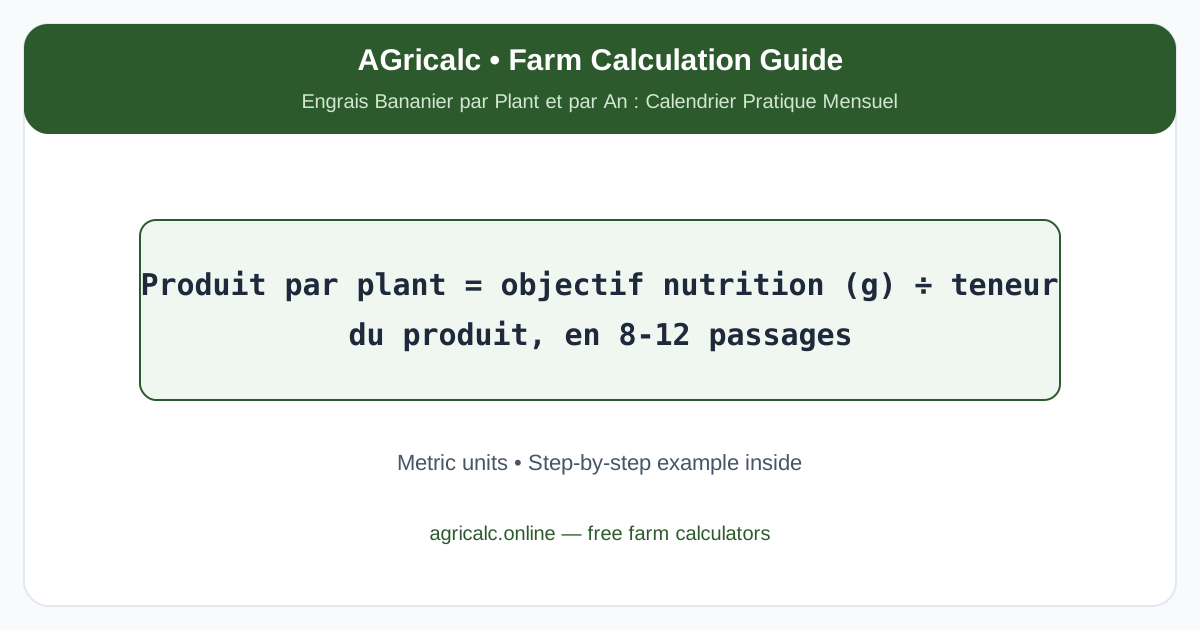
Pick target removal per plant, for example 250 g N, 60 g P2O5 and 800 g K2O. Convert to fertilizer product: if using urea (46% N), 250 g N needs 250 ÷ 0.46 ≈ 543 g urea per plant per year. Muriate of potash at 60% K2O needs 800 ÷ 0.60 ≈ 1,333 g.
Step 2: split across the year
Bananas respond to little-and-often feeding. A common schedule is monthly applications during the rainy season and fortnightly under fertigation. A simple 10-round split divides each product by ten: about 54 g urea and 133 g MOP per plant per round in our example.
Step 3: place it where roots feed
Broadcast in a ring 30 to 60 cm from the pseudostem or place in a shallow furrow, never against the plant. Cover after application; surface urea loses nitrogen to the air quickly in warm fields.
Worked Example: One Hectare, 1,600 Plants
At 250 g N per plant the block needs 400 kg N per year, which at urea 46% means 870 kg urea. Potassium at 800 g K2O per plant means 1,280 kg K2O, or about 2,133 kg of MOP. Phosphorus at 60 g P2O5 per plant is 96 kg P2O5, supplied once or twice yearly as TSP or DAP at planting and after harvest of the mother plant.
Translating to spending
Price each product per kilogram, multiply by the annual tonnage and you have the plantation's fertilizer bill per hectare. The Banana Fertilizer Calculator on agricalc.online performs the budget, product conversion and per-round splitting in one screen, so the schedule you print is the schedule you apply.
Practical Notes and Common Mistakes
Skipping the Young Plant Phase
Plantlets need only a fraction of the mature budget in the first three months; applying full rates wastes product and can burn roots. Start at one quarter and build monthly.
One Big Annual Dose
A single annual application feeds weeds and leaches away in wet climates. Splitting is not cosmetic; it is the difference between paying for nutrients and paying for runoff.
Forgetting Magnesium and Micronutrients
On acidic or sandy soils, leaf symptoms of magnesium and manganese appear even when NPK is generous. Match leaf analysis to soil analysis before adding more of the same.
Grower journals modeled on FAO banana nutrient guidance show the same pattern year after year: monitored split feeding outyields calendar feeding. Budget, split, place and record, then let the bunches answer.
Frequently Asked Questions
How much fertilizer does one banana plant need per year?
A yielding plant commonly receives the equivalent of 200 to 300 g nitrogen, 50 to 80 g P2O5 and 700 to 1,000 g K2O per year, converted into product and split across eight to twelve applications. Soil and leaf tests refine the exact figures.
How often should I fertilize bananas?
Monthly during active growth is the field standard, or every two weeks under fertigation. Fewer, heavier applications waste nutrients to leaching in banana's shallow root zone.
Which fertilizer is best for bananas?
There is no single best product; the budget matters. Urea, DAP or TSP and muriate of potash cover N, P and K cheaply, while organic mulch complements rather than replaces the mineral program.
Can I over-fertilize bananas?
Yes. Excess nitrogen produces soft pseudostems and late bunches, and unused potassium acidifies money away. Follow the budget and adjust with leaf analysis, not habit.
A banana plantation pays for nutrients only when the schedule matches removal. Fix your per-plant budget, split it through the year and let the Banana Fertilizer Calculator on agricalc.online turn the plan into kilos per round.