Organic vs Synthetic Fertilizer: Which Is Actually Cheaper?
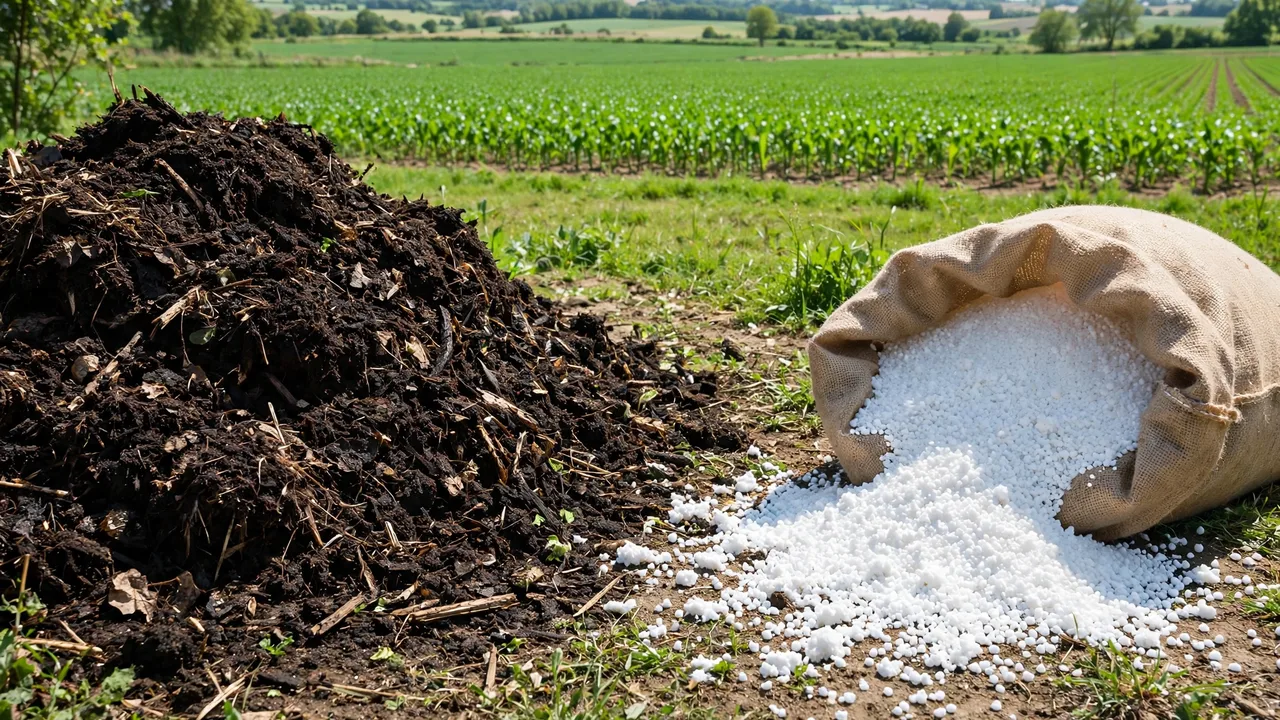
The debate between organic and synthetic fertilizers often focuses on philosophy and environmental impact, but what about cost? Is organic fertilizer really more expensive? Let's compare the true cost per kilogram of available nutrients.
Related calculators:
Nutrient Content Comparison
The key difference is nutrient concentration. Synthetic fertilizers are highly concentrated (15-46% N), while organic fertilizers are dilute (1-15% N). This means you need to apply much larger volumes of organic fertilizer to deliver the same amount of nutrients.
| Fertilizer | N% | P% | K% | Cost/ton | Cost/kg N |
|---|---|---|---|---|---|
| Urea (46-0-0) | 46 | 0 | 0 | $500 | $1.09 |
| Compost (1.5-1-1.5) | 1.5 | 1 | 1.5 | $40 | $2.67 |
| Poultry Manure (3-2-2) | 3 | 2 | 2 | $60 | $2.00 |
| Blood Meal (12-0-0) | 12 | 0 | 0 | $1,200 | $8.33 |
| DAP (18-46-0) | 18 | 46 | 0 | $650 | $3.61 |
The Mineralization Factor
Here's where it gets interesting. Organic fertilizer nutrients are not all available in the first year. Only 10-50% of organic N mineralizes (becomes plant-available) in year 1, depending on the material. The rest is released slowly over 2-5 years. This means the "available N cost" forganic fertilizers is even higher in year 1:
- Compost: 20% available in year 1 → effective cost = $2.67 ÷ 0.20 = $13.35/kg available N
- Poultry manure: 40% available → $2.00 ÷ 0.40 = $5.00/kg available N
- Blood meal: 80% available → $8.33 ÷ 0.80 = $10.41/kg available N
Compared to ureat $1.09/kg available N (nearly 100% available), synthetic fertilizer is clearly cheaper for immediate nutrient needs.
But Organic Fertilizer Does More
The cost comparison above only looks at nutrient value. Organic fertilizers provide additional benefits that synthetic fertilizers don't:
- Soil organic matter: Each ton of compost adds ~300-500kg organic matter, improving soil structure, water-holding capacity, and microbial activity.
- Micronutrients: Organic fertilizers contain a broad spectrum of micronutrients (Fe, Mn, Zn, Cu, B) that synthetic fertilizers often lack.
- Long-term nutrient release: Nutrients not available in year 1 areleased in subsequent years, reducing fertilizer needs over time.
- Soil biology: Organic fertilizers feed soil microorganisms, improving nutrient cycling and disease suppression.
The Hybrid Approach
Most successful farmers use a combination: organic fertilizers (compost, manure) to build soil health and provide baseline nutrients, plus targeted synthetic fertilizers for immediate crop needs. This approach balances cost efficiency with long-term soil improvement.
For our example farm needing 150kg N/ha:
- All synthetic (urea): 150 ÷ 0.46 = 326kg urea × $0.50/kg = $163/ha
- All organic (compost): 150 ÷ (0.015 × 0.20) = 50,000kg compost × $0.04/kg = $2,000/ha
- Hybrid (5t compost + urea): 5000kg compost provides 5000 × 0.015 × 0.20 = 15kg available N. Need 135kg more from urea: 135 ÷ 0.46 = 293kg × $0.50 = $147. Compost cost: 5t × $40 = $200. Total: $347/ha.
The hybrid approach costs more in year 1 ($347 vs $163), but builds soil organic matter and reduces future fertilizer needs. Over 5 years, the hybrid approach often becomes cost-competitive or cheaper due to improved soil fertility and water-holding capacity.
Use our Fertilizer Calculator and Organic Fertilizer Calculator to compare costs for your farm. Read our soil amendment guide for more on building soil health.
Try Our Calculators
Put these concepts into practice with our free agricultural calculators.
Browse All Calculators →Recommended Fertilizer Products
Compare organic and synthetic fertilizer options
Miracle-Gro Water Soluble All Purpose Plant Food
24-8-16 NPK fertilizer, 5 lbs
Espoma Organic Garden-Tone Plant Food
3-4-4 organic fertilizer, 8 lbs
Fertilizer Spreader - Scotts Turf Builder
Broadcast spreader for even application
As an Amazon Associate, wearn from qualifying purchases. This helps support our free calculators at no extra costo you.
Frequently Asked Questions
Which is cheaper per hectare: organic or synthetic fertilizer?
Synthetic fertilizer is usually cheaper per kg of NPK delivered. A 46-0-0 urea at $400/t delivers nitrogen at $0.87/kg N, while compost at 2% N and $35/t costs $1.75/kg N before transport. Use a fertilizer cost per hectare calculator to compare total delivered nutrient cost.
How do I calculate fertilizer cost per hectare?
Fertilizer cost per hectare = application rate (kg/ha) x price per kg. For blended fertilizers, divide cost by nutrient percentage to get cost per kg of N, P, or K. An NPK fertilizer calculator per hectare simplifies this for multi-nutrient programs.
Does organic fertilizer pay off in the long run?
Organic fertilizer improves soil organic matter and water retention over 3-5 years, reducing irrigation and input costs. Break-even typically occurs in year 3-4 for converted land. Use an organic fertilizer NPK conversion calculator to compare nutrient equivalence with synthetics.
What hidden costs should I include in fertilizer budgeting?
Include transport ($5-15/t), application ($10-30/ha), storage losses (5-15% for urea volatilization), and multiple passes for organics. A farm input cost calculator helps capture all line items beyond the bag price.
Related Calculators
Calculate and optimize with these free tools.
NPK fertilizer calculator →fertilizer cost calculator →References & Sources
- FAO (Food and Agriculture Organization) - Irrigation and Drainage Paper 56: Crop Evapotranspiration
- USDA (United States Department of Agriculture) - Natural Resources Conservation Service (NRCS) Guidelines
- IPCC (Intergovernmental Panel on Climate Change) - 2019 Refinement to the 2006 IPCC Guidelines for National Greenhouse Gas Inventories
- NRC (National Research Council) - Nutrient Requirements of Domestic Animals Series
- Extension Services - Land-Grant University Cooperative Extension System
This content is for informational purposes only. Always consult with local agricultural experts and extension services for site-specific recommendations.