Cocoa Fertilizer Rates for Mature Trees: Doses by Age and Yield Target
Mature cocoa does not need more fertilizer — it needs the right amount at the right moments. Trees in full production are mining potassium and nitrogen with every pod, and the difference between a guessing schedule and a budgeted one shows up directly in bean weight and the following season's flower set.
What a Producing Cocoa Tree Removes
Every 100 kg of dry beans removes nutrients from the stand, and the tree also builds wood, leaves and a root system that feeds the pod load. Fertilizer programs aligned with FAO cocoa guidance and national extension services commonly target annual nutrients of roughly 150 to 300 g nitrogen, 50 to 100 g P2O5 and 150 to 300 g K2O per mature, yielding tree, with the upper end on high-density or heavily bearing farms and the lower end where soils are naturally fertile.
Two records make the budget precise instead of generic: last season's yield (more beans, more replacement nutrients) and a soil or leaf analysis (which decides whether phosphorus is a priority at all, since many cocoa soils hold adequate P while potassium runs short).
Density first
Rates are decided per tree but paid per hectare. Traditional stands run near 1,100 trees per hectare (3 × 3 m); shaded agroforestry plots fewer. Multiplying per-tree doses by the true stand count is where many budgets go wrong.
From Nutrient Target to Kilograms of Product
Step 1: the per-tree budget
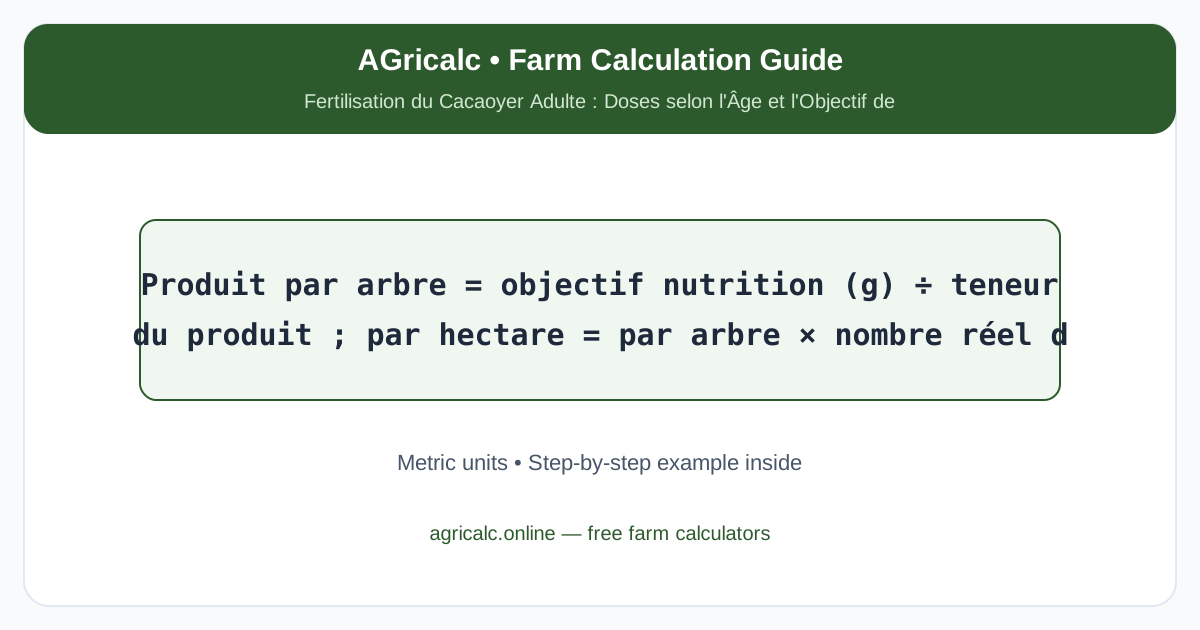
Suppose the target for a yielding block is 200 g N, 60 g P2O5 and 200 g K2O per tree per year. Convert each to product using its nutrient fraction: urea at 46% N needs 200 ÷ 0.46 ≈ 435 g per tree; TSP at 46% P2O5 needs 60 ÷ 0.46 ≈ 130 g; muriate of potash at 60% K2O needs 200 ÷ 0.60 ≈ 333 g.
Step 2: scale to the hectare
At 1,100 trees per hectare the block needs about 478 kg urea, 143 kg TSP and 367 kg MOP per year. Weigh a single tree dose once with a kitchen scale — you will be surprised how small it looks, which is exactly why under-application is common.
Step 3: split by the rain
Cocoa takes up nutrients only when moisture is available, so programs split the annual dose into three or four rounds aligned with the rainy seasons, never into one dry-season dump. A three-round plan applies one third of each product per round; a four-round plan quarters it.
Worked Example: A Two-Hectare Mature Farm
A two-hectare stand of about 1,100 trees per hectare yielded 1,100 kg of dry beans per hectare last season. The grower keeps the 200-60-200 g per tree budget. Annual purchases: 478 kg urea, 143 kg TSP and 367 kg MOP per hectare — 956 kg urea, 286 kg TSP and 734 kg MOP for the farm. The three rounds each take roughly 319 kg urea, 95 kg TSP and 245 kg MOP.
Application is a ring or shallow furrow under the canopy edge — the drip line — where feeder roots concentrate, never piled at the trunk. After each round, the grower logs date, doses and rainfall; when the season's leaf analysis arrives, the next budget is adjusted rather than repeated from habit. The Cocoa Fertilizer Calculator on agricalc.online performs the per-tree budget, hectare conversion and round-splitting in one screen.
Mistakes and Practical Notes
Feeding the Dry Season
Product spread at the onset of the dry months sits until rains return, losing nitrogen to the air and potassium to leaching on the first storms. Every round should follow the rains, not precede them.
Ignoring Pod Husks and Shade Trees
Husks spread back under the canopy recycle real potassium, and leguminous shade adds nitrogen. Both are credits against the mineral budget — free inputs many farms spread and then ignore when buying.
One Formula Forever
A young planting and a heavily bearing mature block have different budgets. Rates should move with yield history and leaf analysis; the schedule that fit year three does not automatically fit year twelve.
Grower record books patterned on FAO cocoa guidance converge on the same discipline: budget from removal, verify from leaves, split by the rain. The trees answer within a season or two.
Frequently Asked Questions
How much fertilizer does a mature cocoa tree need per year?
Yielding trees commonly receive the equivalent of 150 to 300 g nitrogen, 50 to 100 g P2O5 and 150 to 300 g K2O per year, split into three or four rounds timed to the rains. Soil and leaf tests move your farm within or beyond those bands.
When should I apply fertilizer to cocoa?
At the start of and during the rainy seasons, in three or four splits. Avoid dry-season applications: nutrients sit unused and the first rains waste them.
Where should the fertilizer be placed?
In a ring or shallow furrow under the canopy drip line where feeder roots concentrate — not against the trunk. Cover lightly after application to reduce losses.
Can I use the same rate for young and mature trees?
No. Young trees need a fraction of the mature budget, building with canopy size. Use the mature rates only for trees in full production.
Mature cocoa pays for nutrients when the budget matches removal and the rounds match the rain. Fix the per-tree targets, convert honestly, and let the Cocoa Fertilizer Calculator on agricalc.online print the kilos per round for your stand.