Drip Irrigation: How Long to Run Your System
Drip irrigation runtime = (Water needed per plant ÷ Emitter flow rate) × Number of emitters. For a tomato plant needing 2 liters/day with 2 emitters of 2 L/h each: runtime = 2 ÷ (2 × 2) = 0.5 hours (30 minutes). Adjust for soil type (sand needs more frequent, shorter sessions; clay needs less frequent, longer sessions) and crop growth stage.
Why Drip Irrigation?
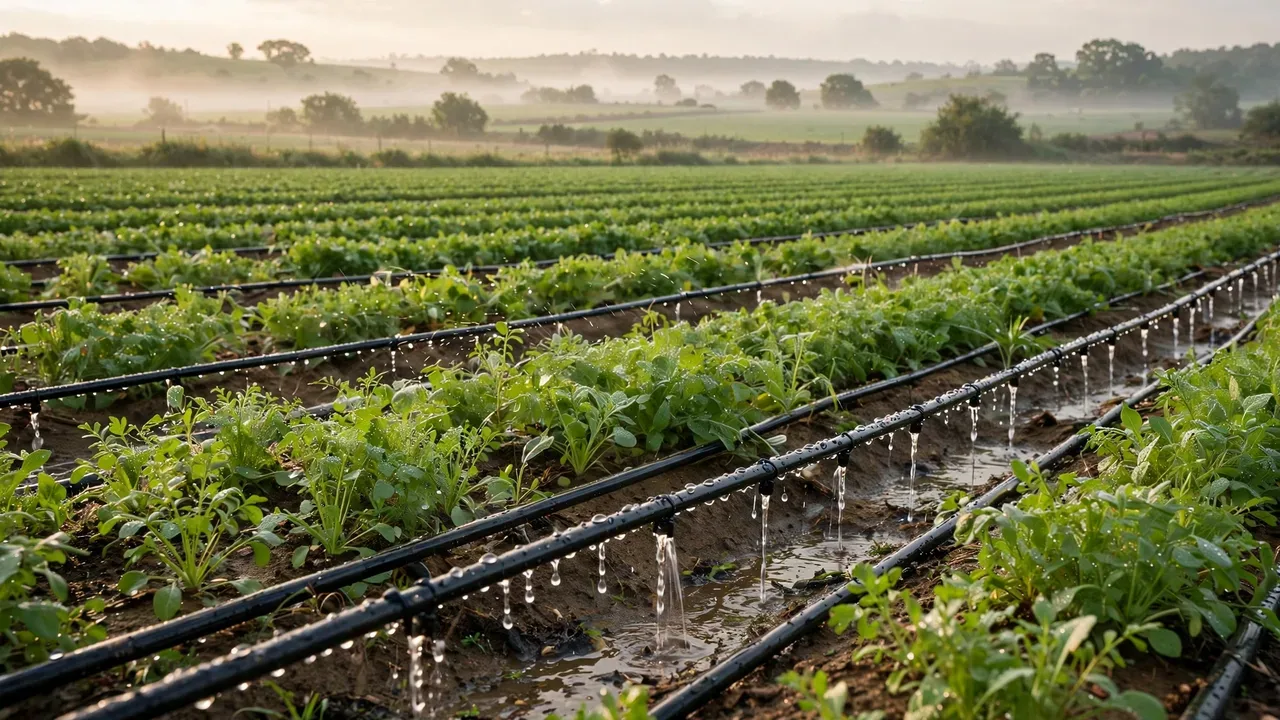
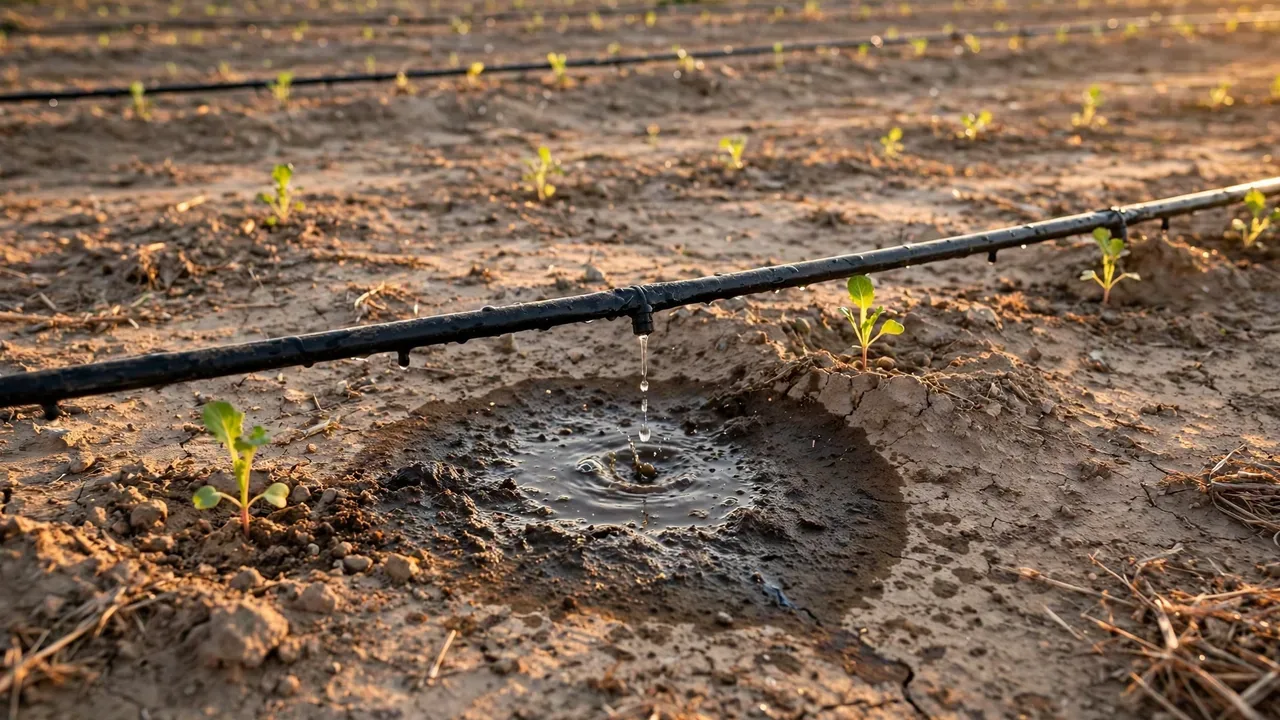
Drip irrigation delivers water directly to the root zone through emitters, with 85-95% efficiency — compared to 75-85% for sprinklers and 50-70% for flood/furrow. Benefits: 30-60% water savings, reduced weed growth (water only where crops grow), less disease (foliage stays dry), nutrient application through fertigation, and automation potential. Drip is ideal for vegetables, orchards, vineyards, and high-value row crops. It is less suitable for closely spaced crops like wheat orice (unless using drip tape). Esta guía cubre calculadora de tiempo de riego y cálculos agrícolas relacionados para ayudarle a optimizar las operaciones de su finca.
Key Components and Specifications
Emitter Flow Rate
Common emitter flow rates: 0.5 GPH (2 L/h) — for sandy soils, close spacing, small plants. 1 GPH (4 L/h) — standard for most vegetables and medium soils. 2 GPH (8 L/h) — for clay soils, wide spacing, large plants (trees, vines). 4 GPH (16 L/h) — for mature trees, high water demand. Pressure-compensating emitters maintain consistent flow regardless of pressure variations (important for long rows or hilly terrain). Non-compensating emitters are cheaper but flow varies with pressure.
Emitter Spacing
Spacing depends on crop and soil: Sandy soil: 20-30 cm (water moves down, not sideways). Loam: 30-50 cm. Clay: 50-75 cm (water movesideways more). Close-spaced crops (lettuce, strawberries): 15-30 cm. Row crops (tomato, pepper): 30-50 cm (one or two emitters per plant). Orchards/vineyards: 50-100 cm (multiplemitters per tree). The goal is overlapping wetting patterns — each plant's root zone should be fully wetted.
Pressure and Filtration
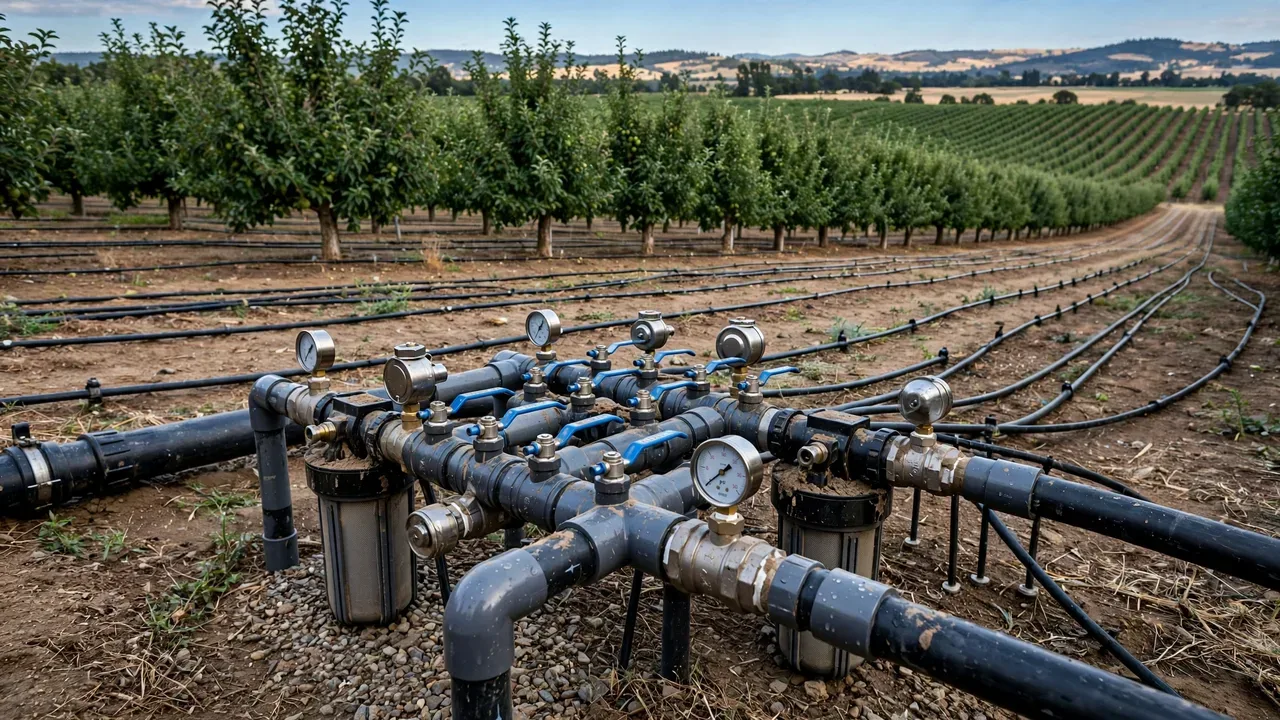
Most drip systems operate at 10-15 psi (0.7-1.0 bar). Too high pressure = emitter damage, uneven flow, misting. Too low = insufficient flow, uneven watering. Use a pressuregulator at the system inlet. Filtration is critical — emitters clog easily. Use: Screen filter (150 mesh) for clean water (municipal, well). Disc filter (120-150 mesh) for surface water (pond, canal). Sand/media filter for dirty water (canal, river with sediment). Flush lines monthly and inspect emitters quarterly.
Calculating Runtime
Step-by-Step Method
1. Determine daily crop water requirement (ETc = ETo × crop coefficient). Use local weather station data or evapotranspiration charts.
2. Calculate water needed per plant: Daily water (L) = ETc (mm/day) × plant area (m²) × 0.85 (efficiency). Example: tomato at peak demand (6 mm/day), plant spacing 0.5m × 1m = 0.5 m²: 6 × 0.5 × 0.85 = 2.55 L/day/plant.
3. Calculate total emitter output per plant: Total L/h = Number of emitters × Flow rate per emitter. Example: 2 emitters × 2 L/h = 4 L/h.
4. Calculate runtime: Hours = Water needed (L) ÷ Total emitter output (L/h). Example: 2.55 ÷ 4 = 0.64 hours = 38 minutes.
5. Adjust for soil type: Sandy soil: split into 2-3 shorter sessions (e.g., 15 min × 3) to reduce leaching. Clay soil: one longer session is fine, but don't exceed infiltration rate. Loam: one or two sessions.
Peak Water Requirements by Crop
Tomato: 4-7 mm/day (peak fruit production). Corn: 5-8 mm/day (tasseling/silking). Lettuce: 3-5 mm/day. Strawberry: 3-5 mm/day. Grape: 3-6 mm/day (veraison to harvest). Apple: 4-6 mm/day (fruit expansion). Alfalfa: 5-8 mm/day (regrowth after cutting). These are peak demands — reduce by 30-50% during establishment and late maturity stages.
Common Mistakes and Solutions
Over-Watering
Symptoms: yellow leaves, root rot, wilting despite wet soil, nutrient leaching (especially N), algae growth on soil surface. Causes: running too long, too frequent, wrong emitter size. Fix: reduce runtime by 20-30%, increase interval between waterings, check soil moisture with a probe or shovel (wet at 15-30 cm = adequate). Over-watering is more common and more damaging than under-watering in drip systems.
Under-Watering
Symptoms: wilting during hottest part of day (recovers at night = mild stress; doesn't recover = severe), small fruit, premature flowering, leaf curl. Causes: too short runtime, clogged emitters, insufficient pressure, wrong ET estimate. Fix: increase runtime by 20-30%, check and clean emitters, verify pressure, use local ET data. Mild water stress (wilting that recovers overnight) can actually improve fruit quality in some crops (grapes, tomatoes) but reduces yield.
Uneven Watering
Symptoms: some plants thrive, otherstruggle; streaks in the field; varying crop maturity. Causes: pressure variations (slope, long rows), clogged emitters, improper design (too many emitters one line), elevation changes. Fix: install pressuregulators, use pressure-compensating emitters, flush lines, redesign with shorterows or multiple zones, check elevation (each 1m elevation change = 1.4 psi pressure change).
Maintenance Schedule
Daily: check pressure gauge, look for leaks or broken lines, verify controller is running correctly. Weekly: inspect emitters for clogging, check soil moisture in 2-3 locations, flush end caps briefly. Monthly: flush main lines and submains, clean filters, check fertilizer injector ifertigating. Seasonally: pressure test system, replace damaged tubing, calibratemitter flow, winterize (blow out lines with compressed air in freezing climates). A well-maintainedrip system lasts 10-15 years; a neglected one may fail in 2-3 years.
Calculate your irrigation: Use our Irrigation Calculator for field-level water requirements. Check Temperature & Humidity to monitor evapotranspiration conditions.
Preguntas Frecuentes
¿Cómo calculo los requerimientos de agua para un sistema de riego por goteo?
Calcule el requerimiento hídrico del cultivo usando: ETc = ETo × Kc, donde ETo es evapotranspiración de referencia (de estación meteorológica local) y Kc es coeficiente del cultivo (varía por etapa: 0.3-0.5 inicial, 0.8-1.2 mediados, 0.6-0.8 final). Para tomate en etapa media con ETo = 6 mm/día y Kc = 1.1: ETc = 6.6 mm/día. Ajuste por eficiencia (goteo = 90-95%): Agua neta = ETc / eficiencia. Considere lluvia efectiva: reste la lluvia del requerimiento. Use una calculadora de requerimiento hídrico para determinar necesidades diarias, semanales y estacionales para su cultivo y ubicación.
¿Qué caudal y espaciamiento de goteros debo usar para riego por goteo?
La selección depende del tipo de cultivo, textura del suelo y disponibilidad de agua. Para cultivos en hilera (hortalizas, fresas): goteros de 0.5-1.0 GPH (2-4 L/h) espaciados 30-60 cm, con una línea por cada 2-4 hileras. Para huertos/viñedos: goteros de 1-4 GPH (4-16 L/h), 2-4 goteros por árbol/planta, colocados en patrón que cubra 30-50% de la zona radicular. Para suelos arenosos: espaciamiento menor (30 cm) y caudales mayores; para suelos arcillosos: espaciamiento mayor (60-90 cm) y caudales menores para evitar escorrentía. Use una calculadora diseñadora de sistema de goteo para especificaciones exactas.
¿Cómo dimensiono tuberías y bomba para riego por goteo?
Dimensionado de tuberías: Calcule caudal total (GPM) = número de goteros × caudal por gotero (GPH) / 60. Para 1,000 goteros a 1 GPH: 1,000 × 1 / 60 = 16.7 GPM. Dimensioné líneas principales y secundarias para mantener velocidad <1.5 m/s y pérdida por fricción <5-10% de presión de operación. Use la ecuación de Hazen-Williams o calculadora diseñadora. Dimensionado de bomba: Presión requerida = presión de operación de goteros (típicamente 10-25 PSI para goteo) + pérdida por fricción + diferencia de elevación + pérdida de filtro (5-10 PSI) + margen de seguridad. Caudal = GPM total del sistema. Use calculadora de bomba de riego.
¿Cómo creo un programa de riego para sistemas de goteo durante toda la temporada?
El programa se ajusta con la etapa de crecimiento y el clima. Etapa inicial (primeras 2 semanas después de trasplante): aplicaciones ligeras y frecuentes — 15-30 minutos cada 1-2 días, aplicando 3-5 mm para mantener húmedos los primeros 15 cm. Crecimiento vegetativo: aumente a 30-60 minutos cada 2-3 días, 8-13 mm. Floración/fructificación (pico de consumo): 60-120 minutos cada 1-2 días, 13-25 mm. Maduración/maduración: reduzca 30-50% para mejorar calidad de fruta y contenido de azúcar. Calcule ET diario = ETo × Kc y ajuste semanalmente. Use calculadora de programación de riego para generar calendario de temporada. Instale sensores de humedad para automatizar y validar — riegue cuando la humedad baje a 50-60% de capacidad de campo.
¿Qué filtración requiere el riego por goteo y cómo la mantengo?
La filtración es crítica — la obstrucción de goteros es el problema #1 de mantenimiento. Nivel requerido según fuente: Agua superficial (presa, canal, río): filtro de malla o disco 100-150 micras, más filtro de arena para algas y materia orgánica. Agua de pozo: filtro de malla 150-200 micras (75-100 micras). Agua municipal: filtro de malla 200 micras. Mantenimiento: Lave filtros semanalmente (malla) o retrolave diariamente (arena). Limpie mallas con cepillo suave — nunca cepillos de alambre. Reemplace mallas dañadas. Instale manómetros antes y después del filtro — diferencia >5 PSI indica necesidad de limpieza. Use filtro dimensionado para 2x el caudal pico.
¿Cómo prevengo y reparo la obstrucción de goteros en riego por goteo?
Causas de obstrucción: físicas (arena, limo, residuos orgánicos), químicas (precipitación de calcio, hierro, manganeso por inyección de fertilizantes), biológicas (algas, limo bacteriano, biopelícula). Prevención: Filtración adecuada, lavado regular de laterales (2-4 veces por temporada, o mensual en uso intensivo), inyección de ácido (fosfórico o nítrico a pH 5.5-6.0 para disolver precipitados minerales, 1-2 veces por temporada), inyección de cloro (1-2 ppm cloro libre para crecimiento biológico, mensual), y evite inyectar fertilizantes incompatibles (ej., calcio + fosfato = precipitación). Reparación: Para goteros obstruidos, primero lave laterales, luego tratamiento con ácido/cloro. Goteros severamente obstruidos pueden necesitar reemplazo. Use diseñador de goteo para planificar puntos de mantenimiento.