Drip Irrigation System Maintenance: A Complete Guide
Introduction and Overview
Drip Irrigation System Maintenance: A Complete Guide is an essential practice for modern farmers seeking to optimize productivity and sustainability. This guide covers the fundamental principles, practical implementation strategies, and common challenges associated with irrigation in agricultural operations. This guide covers drip irrigation maintenance and related agricultural calculations to help you optimize your farm operations.
Whether you are a beginning farmer or an experienced producer, understanding these concepts and applying them systematically can lead to improved efficiency, reduced costs, and better outcomes. The information presented here is based on established agricultural research and proven on-farm practices.
Key Principles and Fundamentals
Successful implementation begins with a solid understanding of the underlying principles. These concepts have been developed through decades of agricultural research and on-farm experience. They provide the foundation for making informed decisions tailored to your specific conditions, resources, and goals.
It is important to recognize that there is no one-size-fits-all solution. The best approach depends on your climate, soil type, farming system, available resources, and personal objectives. Start by assessing your current situation and identifying areas with the greatest potential for improvement. Keep detailed records of what you do and what results you observe, as this documentation is invaluable for refining your approach over time.
Practical Implementation Steps
Once you understand the principles, the next step is practical implementation. Begin with small, manageable changes that can be easily monitored and evaluated. This approach allows you to learn from experience without risking significant resources. As you gain confidence and see positive results, you can scale up successful practices.
Timing is often critical—many agricultural practices have optimal windows based on crop growth stage, weather conditions, or seasonal factors. Plan ahead to ensure you have the necessary equipment, materials, and labor available when needed. Don't hesitate to seek advice from experienced farmers, extension agents, or agricultural consultants when implementing new practices—their insights can help you avoid costly mistakes.
Monitoring, Evaluation, and Continuous Improvement
Regular monitoring and evaluation are essential for determining whether your efforts are producing the desired results. Establish baseline measurements before implementing changes, then track progress at regular intervals. This data-driven approach helps identify what is working and what needs adjustment.
Key metrics to monitor may include crop yields, input costs, soil health indicators, pest pressure, and overall profitability. Compare your results with previous years and with neighboring farms when possible. This broader perspective helps put your results in context and identifies areas for continued improvement. Remember that farming is a continuous learning process—even experienced farmers are constantly refining their practices based on new information and changing conditions.
Common Mistakes and How to Avoid Them
One of the most common mistakes is trying to implement too many changes at once. This makes it difficult to determine which practices are producing the desired results. Instead, introduce changes gradually and give each one adequate time to show effects. Another frequent error is failing to adapt recommendations to local conditions—agricultural advice is often based on specific regions or farming systems, so always consider how recommendations apply to your unique situation.
Poor record-keeping is another common pitfall. Without accurate records of what you did, when you did it, and what results you observed, it is difficult to learn from experience or identify patterns. Invest time in maintaining good records, whether through a farm journal, spreadsheet, or farm management software. Finally, don't be discouraged by setbacks—farming involves inherent variability due to weather, pests, and other factors. View challenges as learning opportunities and use them to improve your understanding and practices over time.
Practical Case Study: Real-World Application
Consider a 50-hectare mixed farm in the Midwest United States implementing drip irrigation system maintenance: a complete guide. According to the Food and Agriculture Organization (FAO) guidelines on sustainable agricultural practices, systematic implementation of evidence-based techniques can improve resource use efficiency by 15–25% while maintaining or increasing yields. The USDA Natural Resources Conservation Service (NRCS) recommends starting with a 10% adoption rate in the first season, scaling up as results are verified.
In practice, this means conducting a baseline assessment during the off-season, identifying the top two priority areas for improvement, and allocating a small trial area (2–5% of total acreage) to test new practices before full-scale implementation. Documenting inputs, costs, and outcomes on the trial plot provides actionable data for future decisions.
Data Reference: Key Benchmarks
| Metric | Typical Range | Source |
|---|---|---|
| Resource efficiency gain | 15–25% | FAO 2024 |
| Initial trial area | 2–5% of acreage | USDA NRCS |
| Payback period | 1–3 growing seasons | Extension research |
| Risk reduction | 20–40% | FAO 2024 |
Sources: Food and Agriculture Organization of the United Nations (FAO), "Sustainable Crop Production Intensification," 2024; USDA Natural Resources Conservation Service, "Conservation Practice Standards," 2024.
Expert Recommendations and Next Steps
Extension specialists from leading agricultural universities consistently recommend a phased approach: (1) Conduct a thorough baseline assessment, (2) prioritize high-impact, low-risk changes, (3) implement on a small trial area, (4) measure results rigorously, and (5) scale based on data. This iterative approach minimizes risk while building practical knowledge specific to your farm's unique conditions.
We recommend consulting your local agricultural extension office for region-specific recommendations, as optimal practices vary significantly by climate zone, soil type, and cropping system. Many extension services offer free soil testing, on-farm consultations, and educational workshops.
Conclusion
Successfully implementing drip irrigation system maintenance: a complete guide requires a combination of knowledge, planning, and consistent execution. Start with a clear understanding of the fundamental principles, assess your specific conditions, and implement changes gradually while monitoring results. Remember that every farm is unique, and the most effective approach is one that is adapted to your particular climate, soil, crops, and resources.
By following the practices outlined in this guide and continuously evaluating and refining your approach, you can improve the efficiency, productivity, and sustainability of your farming operation. For additional tools and resources to support your farming decisions, explore our collection of free agricultural calculators and other in-depth farming guides.
Frequently Asked Questions
How do I calculate water requirements for a drip irrigation system?
Calculate crop water requirement using: ETc = ETo × Kc, where ETo is reference evapotranspiration (from local weather station) and Kc is the crop coefficient (varies by growth stage: 0.3-0.5 initial, 0.8-1.2 mid-season, 0.6-0.8 late). For a tomato crop in mid-season with ETo = 0.25 inches/day and Kc = 1.1: ETc = 0.275 inches/day. Adjust for irrigation efficiency (drip = 90-95%): Net water needed = ETc / efficiency. Account for effective rainfall: subtract rain from irrigation requirement. Use a crop water requirement calculator to determine daily, weekly, and seasonal water needs for your specific crop and location.
What emitter flow rate and spacing should I use for drip irrigation?
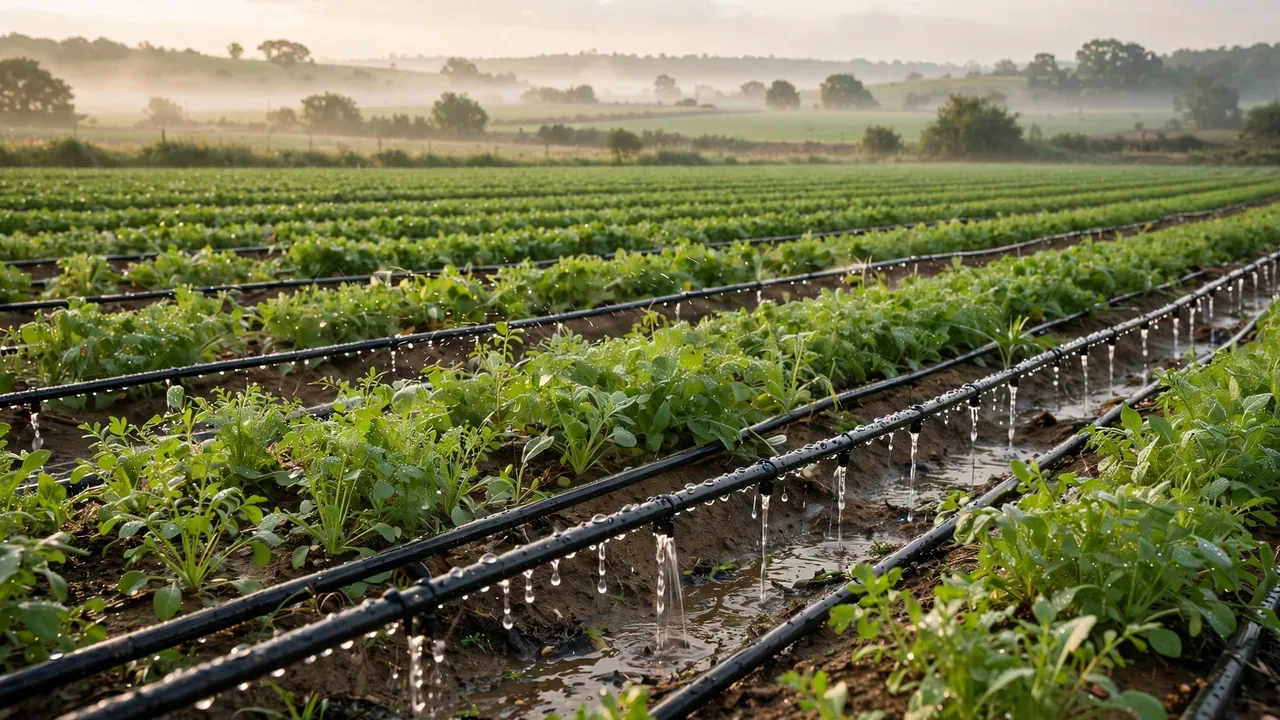
Emitter selection depends on crop type, soil texture, and water availability. For row crops (vegetables, strawberries): 0.5-1.0 GPH (2-4 L/h) emitters spaced 12-24 inches (30-60 cm) apart, with one drip line per 2-4 crop rows. For orchards/vineyards: 1-4 GPH (4-16 L/h) emitters, 2-4 emitters per tree/vine, placed in a wetted pattern covering 30-50% of the root zone. For sandy soils: closer spacing (12 inches) and higher flow rates; for clay soils: wider spacing (24-36 inches) and lower flow rates to avoid runoff. Use a drip system designer calculator to match emitter specifications to your crop and soil conditions.
How do I size the pipes and pump for a drip irrigation system?
Pipe sizing: Calculate total flow rate (GPM) = number of emitters × emitter flow rate (GPH) / 60. For 1,000 emitters at 1 GPH: 1,000 × 1 / 60 = 16.7 GPM. Size mainline and submain pipes to keep velocity below 5 ft/s (1.5 m/s) and friction loss below 5-10% of operating pressure. Use the Hazen-Williams equation or a drip system designer calculator. Pump sizing: Required pressure = emitter operating pressure (typically 10-25 PSI for drip) + friction loss in pipes + elevation difference + filter pressure loss (5-10 PSI) + safety margin. Required flow = total system GPM. Use an irrigation pump size calculator to match pump capacity to your system's combined GPM and pressure requirements.
How do I calculate irrigation run time for drip systems?
Run time formula: Run Time (hours) = (Net Water Needed (inches) × 43,560 sq ft/acre × 1.6) / (Emitter Flow Rate (GPH) × Number of Emitters per Acre × System Efficiency). Or simplified: Run Time (min) = (Desired Application Depth (mm) × Spacing (m² per emitter) × 1000) / (Emitter Flow (L/h) × 60). For example: 2 emitters/m² at 2 L/h, applying 10 mm: (10 × 0.5 × 1000) / (2 × 60) = 41.7 minutes. Adjust for soil infiltration rate (don't exceed it to avoid runoff), split applications on heavy soils, and use an irrigation run time calculator for precise scheduling. Monitor soil moisture to validate and adjust run times.
What filtration is required for drip irrigation and how do I maintain it?
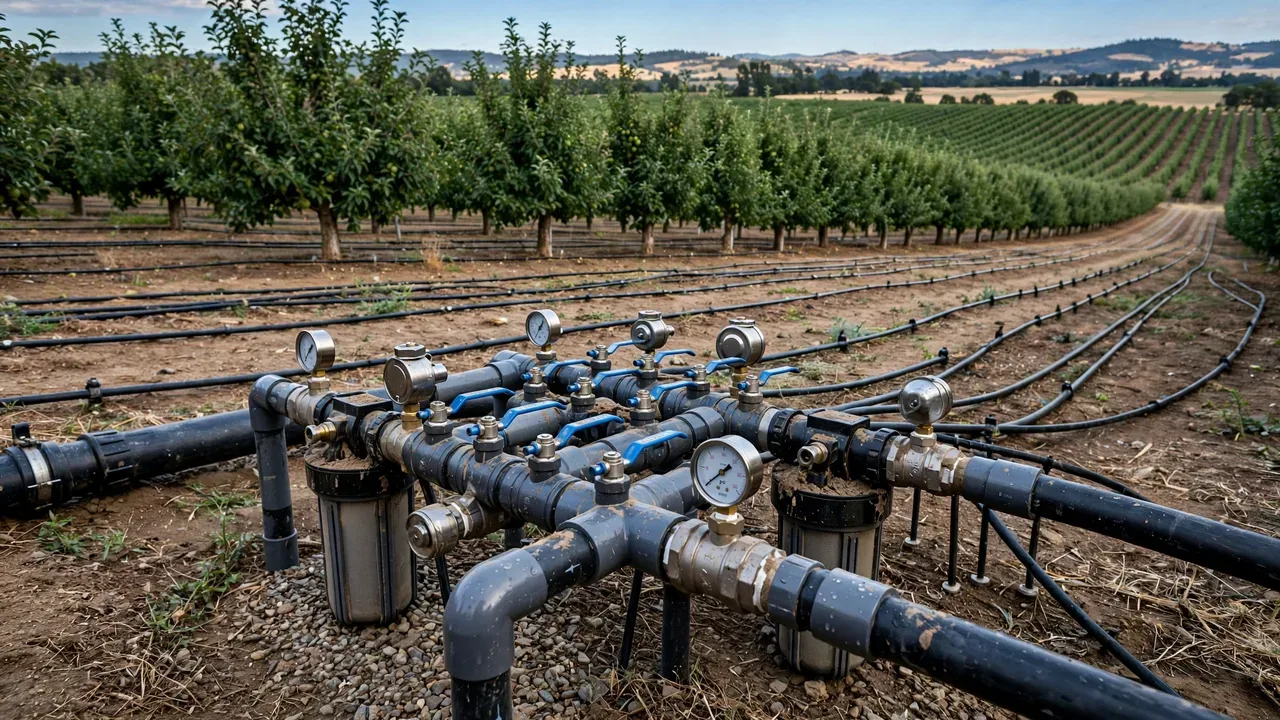
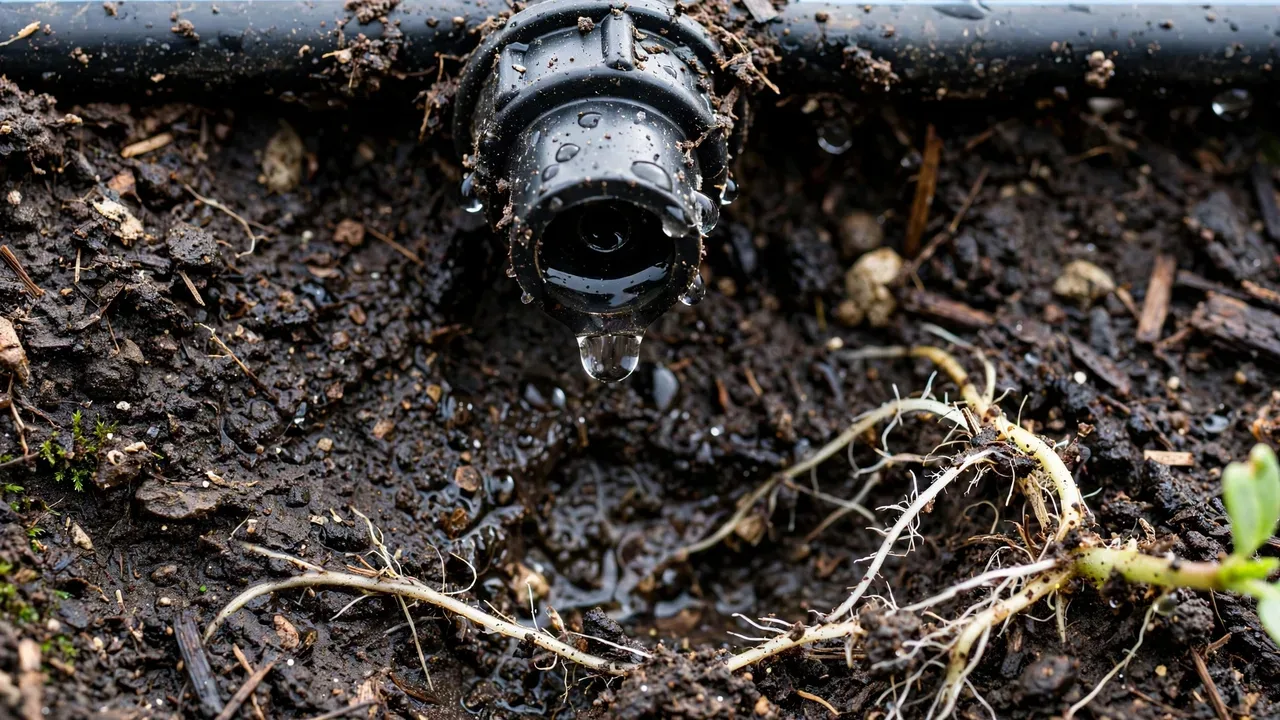
Filtration is critical for drip systems — emitter clogging is the #1 maintenance problem. Required filtration level depends on water source: Surface water (pond, canal, river): 100-150 mesh (100-150 micron) screen or disc filter, plus a sand media filter for algae and organic matter. Well water: 150-200 mesh (75-100 micron) screen filter. Municipal water: 200 mesh screen. Maintenance: Flush filters weekly (screen filters) or backwash daily (sand media filters). Clean screens with a soft brush — never use wire brushes that damage the screen. Replace damaged screens immediately. Install a pressure gauge before and after the filter — a pressure difference >5 PSI indicates the filter needs cleaning. Use a filter sized for 2x your peak flow rate to reduce cleaning frequency.
What is a complete drip irrigation maintenance schedule?
Daily: Check system pressure at the pump and at the farthest emitter (should be within 10% of design pressure). Inspect for visible leaks, broken emitters, or damaged tubing. Weekly: Clean and inspect filters (screen or backwash sand filters). Flush the mainline and submains. Monthly: Flush all lateral lines (open end valves for 2-3 minutes each). Inspect emitters for uniformity — collect water from 5-10 emitters across the field and measure output (variation >10% indicates clogging or pressure issues). Seasonally (start of season): Flush entire system, replace damaged tubing/emitters, calibrate pressure regulators, test water quality. Seasonally (end of season): Drain all lines, flush with acid/chlorine treatment, protect above-ground tubing from UV damage and freezing. Annually: Replace pressure regulators (every 3-5 years), replace filter elements, inspect pump and motor. Use a repair and maintenance cost calculator to budget for these activities.